

4 Impedance and Collective Effects
113
and with velocity v = βc
ρ (r, ϑ, s; t) =
Q
a
δ (r − a) δ p (ϑ) δ (s − vt)
=
∞
m=0
Q m cos (mϑ)
πa m+1 (1 + δ m0 )
δ (r − a) δ (s − vt) =
∞
m=0
ρ m ,
(4.13)
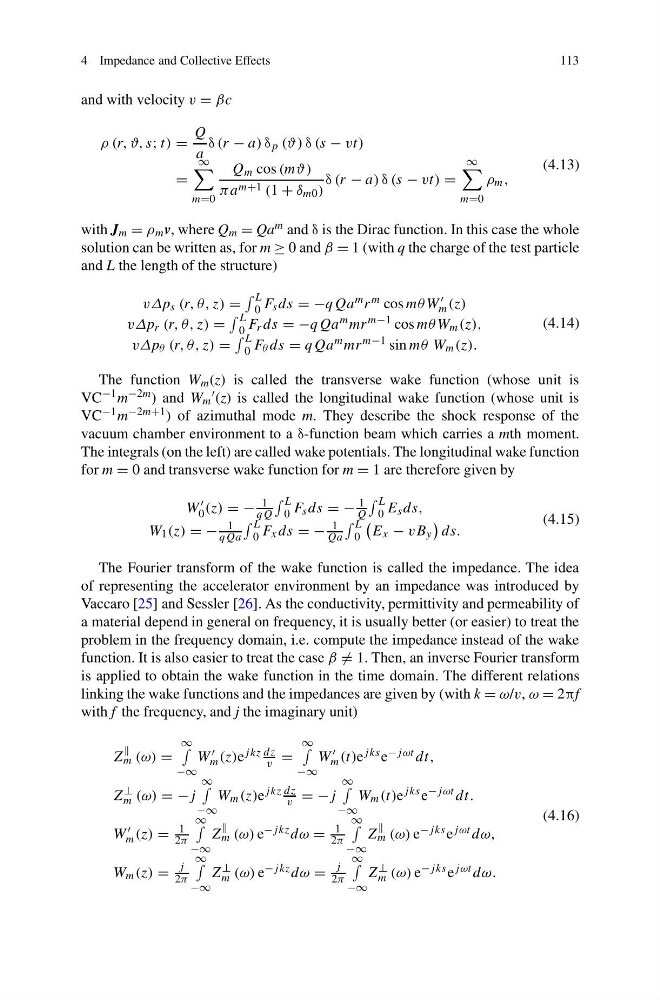
with J m = ρ m v, where Q m = Qa m and δ is the Dirac function. In this case the whole
solution can be written as, for m ≥ 0 and β = 1 (with q the charge of the test particle
and L the length of the structure)
vΔp s (r, θ, z) =
L
0 F s ds = −qQa m r m cos mθ W
m (z)
vΔp r (r, θ, z) =
L
0 F r ds = −qQa m mr m−1 cos mθ W m (z),
vΔp θ (r, θ, z) =
L
0 F θ ds = qQa m mr m−1 sin mθ W m (z).
(4.14)
The function W m (z) is called the transverse wake function (whose unit is
VC −1 m −2m ) and W m
(z) is called the longitudinal wake function (whose unit is
VC −1 m −2m+1 ) of azimuthal mode m. They describe the shock response of the
vacuum chamber environment to a δ-function beam which carries a mth moment.
The integrals (on the left) are called wake potentials. The longitudinal wake function
for m = 0 and transverse wake function for m = 1 are therefore given by
W
0 (z) = −
1
qQ
L
0 F s ds = −
1
Q
L
0 E s ds,
W 1 (z) = −
1
qQa
L
0 F x ds = −
1
Qa
L
0
E x − vB y
ds.
(4.15)
The Fourier transform of the wake function is called the impedance. The idea
of representing the accelerator environment by an impedance was introduced by
Vaccaro [25] and Sessler [26]. As the conductivity, permittivity and permeability of
a material depend in general on frequency, it is usually better (or easier) to treat the
problem in the frequency domain, i.e. compute the impedance instead of the wake
function. It is also easier to treat the case β = 1. Then, an inverse Fourier transform
is applied to obtain the wake function in the time domain. The different relations
linking the wake functions and the impedances are given by (with k = ω/v, ω = 2πf
with f the frequency, and j the imaginary unit)
Z
m (ω) =
∞
−∞
W
m (z)e jkz dz
v =
∞
−∞
W
m (t)e jks e −jωt dt,
Z ⊥
m (ω) = −j
∞
−∞
W m (z)e jkz dz
v = −j
∞
−∞
W m (t)e jks e −jωt dt.
W
m (z) =
1
2π
∞
−∞
Z
m (ω) e −jkz dω =
1
2π
∞
−∞
Z
m (ω) e −jks e jωt dω,
W m (z) =
j
2π
∞
−∞
Z ⊥
m (ω) e −jkz dω =
j
2π
∞
−∞
Z ⊥
m (ω) e −jks e jωt dω.
(4.16)
113
and with velocity v = βc
ρ (r, ϑ, s; t) =
Q
a
δ (r − a) δ p (ϑ) δ (s − vt)
=
∞
m=0
Q m cos (mϑ)
πa m+1 (1 + δ m0 )
δ (r − a) δ (s − vt) =
∞
m=0
ρ m ,
(4.13)
with J m = ρ m v, where Q m = Qa m and δ is the Dirac function. In this case the whole
solution can be written as, for m ≥ 0 and β = 1 (with q the charge of the test particle
and L the length of the structure)
vΔp s (r, θ, z) =
L
0 F s ds = −qQa m r m cos mθ W
m (z)
vΔp r (r, θ, z) =
L
0 F r ds = −qQa m mr m−1 cos mθ W m (z),
vΔp θ (r, θ, z) =
L
0 F θ ds = qQa m mr m−1 sin mθ W m (z).
(4.14)
The function W m (z) is called the transverse wake function (whose unit is
VC −1 m −2m ) and W m
(z) is called the longitudinal wake function (whose unit is
VC −1 m −2m+1 ) of azimuthal mode m. They describe the shock response of the
vacuum chamber environment to a δ-function beam which carries a mth moment.
The integrals (on the left) are called wake potentials. The longitudinal wake function
for m = 0 and transverse wake function for m = 1 are therefore given by
W
0 (z) = −
1
L
0 F s ds = −
1
Q
L
0 E s ds,
W 1 (z) = −
1
qQa
L
0 F x ds = −
1
Qa
L
0
E x − vB y
ds.
(4.15)
The Fourier transform of the wake function is called the impedance. The idea
of representing the accelerator environment by an impedance was introduced by
Vaccaro [25] and Sessler [26]. As the conductivity, permittivity and permeability of
a material depend in general on frequency, it is usually better (or easier) to treat the
problem in the frequency domain, i.e. compute the impedance instead of the wake
function. It is also easier to treat the case β = 1. Then, an inverse Fourier transform
is applied to obtain the wake function in the time domain. The different relations
linking the wake functions and the impedances are given by (with k = ω/v, ω = 2πf
with f the frequency, and j the imaginary unit)
Z
m (ω) =
∞
−∞
W
m (z)e jkz dz
v =
∞
−∞
W
m (t)e jks e −jωt dt,
Z ⊥
m (ω) = −j
∞
−∞
W m (z)e jkz dz
v = −j
∞
−∞
W m (t)e jks e −jωt dt.
W
m (z) =
1
2π
∞
−∞
Z
m (ω) e −jkz dω =
1
2π
∞
−∞
Z
m (ω) e −jks e jωt dω,
W m (z) =
j
2π
∞
−∞
Z ⊥
m (ω) e −jkz dω =
j
2π
∞
−∞
Z ⊥
m (ω) e −jks e jωt dω.
(4.16)