

108
E. Metral et al.
tune will be Q s = Q s0 + s , where s is the incoherent synchrotron tune shift.
The betatron and synchrotron linearized incoherent space charge tune shifts are
given by
ΔQ Lin
x = −
N b r p
4πβγ 2 ε norm
x,rms B
, ΔQ Lin
s = +
ηN b e 2 R 2
8π
√
2πε 0 E total β 2 γ 2 σ 3
z Q s0
1 + 2 ln
b
√
2σ
,
(4.5)
where N b is the number of protons in the bunch, r p the classical proton radius,
ε norm
x,rms = βγ ε x,rms the normalized rms horizontal emittance, with ε x, rms = σ 2 /β x at a
place of zero dispersion with β x the horizontal betatron function, B =
√
2πσ z /2πR
is the bunching factor (assuming a Gaussian longitudinal distribution with rms σ z )
with R the average machine radius, η = γ
−2
tr − γ −2 the slip factor (where γ tr stands
for γ at transition energy) and E total is the total particles’ energy. It is shown from
Eq. (4.5) that the transverse betatron tune shift is always negative, revealing that the
space charge force is always defocusing. Note that for the case of an ion with mass
number A and charge state Z, the transverse tune shift has to be multiplied by Z 2 /A.
Contrary to the transverse case, the longitudinal space charge is defocusing below
transition (as η < 0) and focusing above (as η > 0). One can therefore already
anticipate some longitudinal mismatch issues when crossing transition with highintensity bunches, i.e. the bunch length will not be in equilibrium anymore and
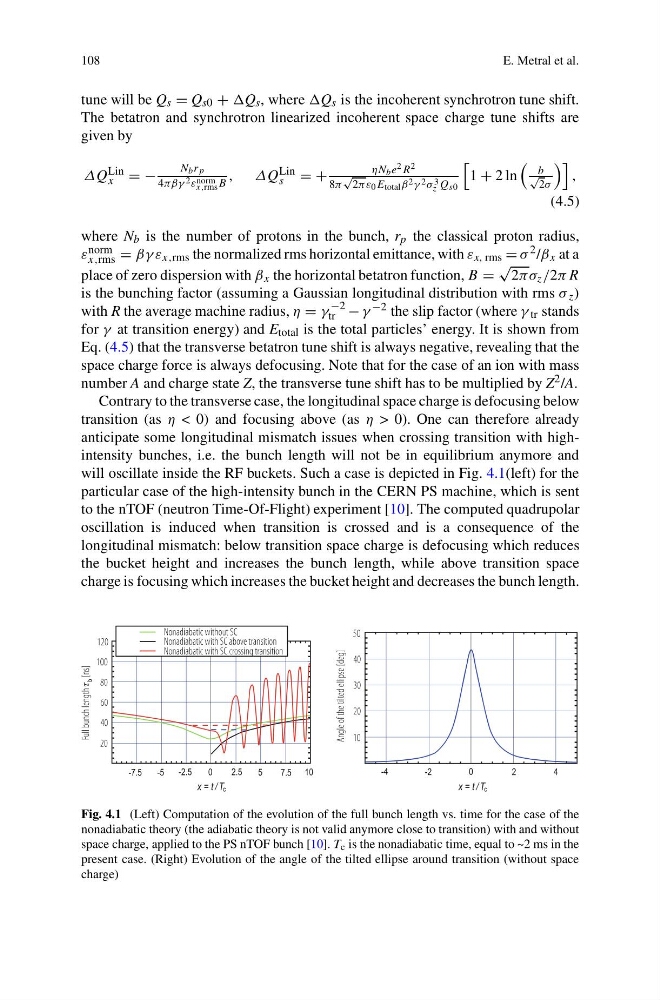
will oscillate inside the RF buckets. Such a case is depicted in Fig. 4.1(left) for the
particular case of the high-intensity bunch in the CERN PS machine, which is sent
to the nTOF (neutron Time-Of-Flight) experiment [10]. The computed quadrupolar
oscillation is induced when transition is crossed and is a consequence of the
longitudinal mismatch: below transition space charge is defocusing which reduces
the bucket height and increases the bunch length, while above transition space
charge is focusing which increases the bucket height and decreases the bunch length.
Fig. 4.1 (Left) Computation of the evolution of the full bunch length vs. time for the case of the
nonadiabatic theory (the adiabatic theory is not valid anymore close to transition) with and without
space charge, applied to the PS nTOF bunch [10]. T c is the nonadiabatic time, equal to ~2 ms in the
present case. (Right) Evolution of the angle of the tilted ellipse around transition (without space
charge)
E. Metral et al.
tune will be Q s = Q s0 + s , where s is the incoherent synchrotron tune shift.
The betatron and synchrotron linearized incoherent space charge tune shifts are
given by
ΔQ Lin
x = −
N b r p
4πβγ 2 ε norm
x,rms B
, ΔQ Lin
s = +
ηN b e 2 R 2
8π
√
2πε 0 E total β 2 γ 2 σ 3
z Q s0
1 + 2 ln
b
√
2σ
,
(4.5)
where N b is the number of protons in the bunch, r p the classical proton radius,
ε norm
x,rms = βγ ε x,rms the normalized rms horizontal emittance, with ε x, rms = σ 2 /β x at a
place of zero dispersion with β x the horizontal betatron function, B =
√
2πσ z /2πR
is the bunching factor (assuming a Gaussian longitudinal distribution with rms σ z )
with R the average machine radius, η = γ
−2
tr − γ −2 the slip factor (where γ tr stands
for γ at transition energy) and E total is the total particles’ energy. It is shown from
Eq. (4.5) that the transverse betatron tune shift is always negative, revealing that the
space charge force is always defocusing. Note that for the case of an ion with mass
number A and charge state Z, the transverse tune shift has to be multiplied by Z 2 /A.
Contrary to the transverse case, the longitudinal space charge is defocusing below
transition (as η < 0) and focusing above (as η > 0). One can therefore already
anticipate some longitudinal mismatch issues when crossing transition with highintensity bunches, i.e. the bunch length will not be in equilibrium anymore and
will oscillate inside the RF buckets. Such a case is depicted in Fig. 4.1(left) for the
particular case of the high-intensity bunch in the CERN PS machine, which is sent
to the nTOF (neutron Time-Of-Flight) experiment [10]. The computed quadrupolar
oscillation is induced when transition is crossed and is a consequence of the
longitudinal mismatch: below transition space charge is defocusing which reduces
the bucket height and increases the bunch length, while above transition space
charge is focusing which increases the bucket height and decreases the bunch length.
Fig. 4.1 (Left) Computation of the evolution of the full bunch length vs. time for the case of the
nonadiabatic theory (the adiabatic theory is not valid anymore close to transition) with and without
space charge, applied to the PS nTOF bunch [10]. T c is the nonadiabatic time, equal to ~2 ms in the
present case. (Right) Evolution of the angle of the tilted ellipse around transition (without space
charge)