

62
3 Combination Tables
3.7 Oxygen Compounds
3.7.1 Alcohols and Phenols
Assignment
Range
Comments
al C–OH
50–80 ppm
Shift with respect to C–H ≈50 ppm
al C–(C–OH)
10–60 ppm
Hardly any shift with respect to C–(C–CH 3 )
al C–(C–C–OH) 10–60 ppm
Shift with respect to C–(C–C–CH 3 ) ≈-5 ppm
ar C–OH
140–155 ppm
Shift with respect to C–H ≈+25 ppm
ar C–(C–OH) 100–130 ppm
Shift with respect to C–(C–H): ortho ≈-13
ppm, meta ≈+1 ppm, para ≈-8 ppm
HO–C al
HO–C ar
0.5–6 ppm
4–12 ppm
Often broad; position and shape strongly
depend on experimental conditions
CH 2 –(OH)
CH–(OH)
3.5–4.0 ppm
3.8–4.2 ppm
ar CH–(C–OH) 6.5–7.0 ppm
Shift with respect to CH–(C–H): ortho ≈-0.6
ppm, meta ≈-0.1 ppm, para ≈-0.5 ppm
O–H st
3650–3200 cm -1 Position and shape depend on the degree of
association. Often different bands for Hbonded and free OH
C–O(H) st
1260–970 cm -1 Strong
Molecular ion
Aliphatic: weak, often missing in the case of
primary and highly branched alcohols; in
this case, peaks at highest mass are often
due to [M-18] +· or [M-15] +
Aromatic: strong
Fragments
Aliphatic:
m/z 31, 45, 59, …
[M-33] +
Primary: m/z 31 > m/z 45 ≈ m/z 59
Secondary, tertiary: local maxima due to
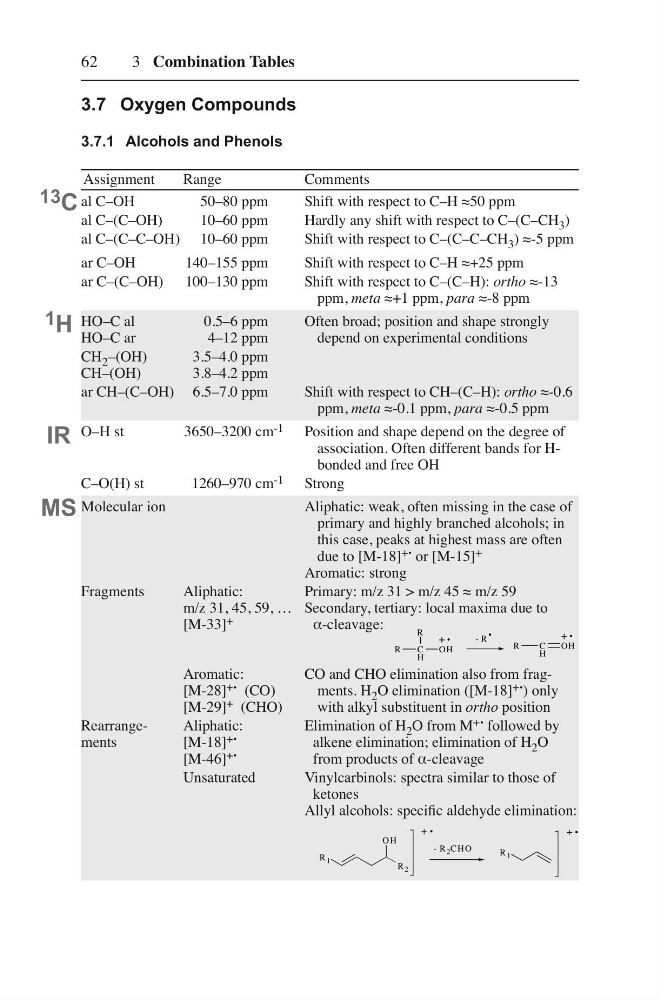
α-cleavage:
R
C
H
OH
R
- R
.
R
C
H
OH
+ .
+ .
Aromatic:
[M-28] +· (CO)
[M-29] + (CHO)
CO and CHO elimination also from fragments. H 2 O elimination ([M-18] +· ) only
with alkyl substituent in ortho position
Rearrangements
Aliphatic:
[M-18] +·
[M-46] +·
Elimination of H 2 O from M +· followed by
alkene elimination; elimination of H 2 O
from products of α-cleavage
Unsaturated
Vinylcarbinols: spectra similar to those of
ketones
Allyl alcohols: specific aldehyde elimination:
R 1
R 2
O H
- R 2 C H O
R 1
+ .
+ .
13 C
1 H
IR
MS
3 Combination Tables
3.7 Oxygen Compounds
3.7.1 Alcohols and Phenols
Assignment
Range
Comments
al C–OH
50–80 ppm
Shift with respect to C–H ≈50 ppm
al C–(C–OH)
10–60 ppm
Hardly any shift with respect to C–(C–CH 3 )
al C–(C–C–OH) 10–60 ppm
Shift with respect to C–(C–C–CH 3 ) ≈-5 ppm
ar C–OH
140–155 ppm
Shift with respect to C–H ≈+25 ppm
ar C–(C–OH) 100–130 ppm
Shift with respect to C–(C–H): ortho ≈-13
ppm, meta ≈+1 ppm, para ≈-8 ppm
HO–C al
HO–C ar
0.5–6 ppm
4–12 ppm
Often broad; position and shape strongly
depend on experimental conditions
CH 2 –(OH)
CH–(OH)
3.5–4.0 ppm
3.8–4.2 ppm
ar CH–(C–OH) 6.5–7.0 ppm
Shift with respect to CH–(C–H): ortho ≈-0.6
ppm, meta ≈-0.1 ppm, para ≈-0.5 ppm
O–H st
3650–3200 cm -1 Position and shape depend on the degree of
association. Often different bands for Hbonded and free OH
C–O(H) st
1260–970 cm -1 Strong
Molecular ion
Aliphatic: weak, often missing in the case of
primary and highly branched alcohols; in
this case, peaks at highest mass are often
due to [M-18] +· or [M-15] +
Aromatic: strong
Fragments
Aliphatic:
m/z 31, 45, 59, …
[M-33] +
Primary: m/z 31 > m/z 45 ≈ m/z 59
Secondary, tertiary: local maxima due to
α-cleavage:
R
C
H
OH
R
- R
.
R
C
H
OH
+ .
+ .
Aromatic:
[M-28] +· (CO)
[M-29] + (CHO)
CO and CHO elimination also from fragments. H 2 O elimination ([M-18] +· ) only
with alkyl substituent in ortho position
Rearrangements
Aliphatic:
[M-18] +·
[M-46] +·
Elimination of H 2 O from M +· followed by
alkene elimination; elimination of H 2 O
from products of α-cleavage
Unsaturated
Vinylcarbinols: spectra similar to those of
ketones
Allyl alcohols: specific aldehyde elimination:
R 1
R 2
O H
- R 2 C H O
R 1
+ .
+ .
13 C
1 H
IR
MS