

3.6 Halogen Compounds
61
Assignment
Range
Comments
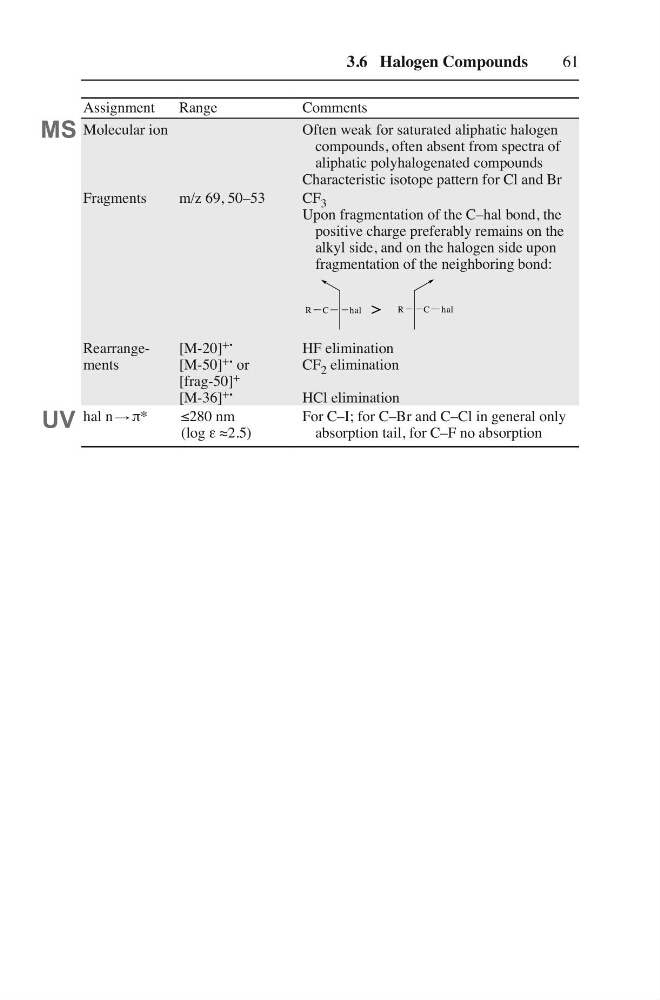
Molecular ion
Often weak for saturated aliphatic halogen
compounds, often absent from spectra of
aliphatic polyhalogenated compounds
Characteristic isotope pattern for Cl and Br
Fragments
m/z 69, 50–53
CF 3
Upon fragmentation of the C–hal bond, the
positive charge preferably remains on the
alkyl side, and on the halogen side upon
fragmentation of the neighboring bond:
R C
hal
R
C hal
>
Rearrangements
[M-20] +·
[M-50] +· or
[frag-50] +
[M-36] +·
HF elimination
CF 2 elimination
HCl elimination
hal n π*
≤280 nm
(log ε ≈2.5)
For C–I; for C–Br and C–Cl in general only
absorption tail, for C–F no absorption
MS
UV
61
Assignment
Range
Comments
Molecular ion
Often weak for saturated aliphatic halogen
compounds, often absent from spectra of
aliphatic polyhalogenated compounds
Characteristic isotope pattern for Cl and Br
Fragments
m/z 69, 50–53
CF 3
Upon fragmentation of the C–hal bond, the
positive charge preferably remains on the
alkyl side, and on the halogen side upon
fragmentation of the neighboring bond:
R C
hal
R
C hal
>
Rearrangements
[M-20] +·
[M-50] +· or
[frag-50] +
[M-36] +·
HF elimination
CF 2 elimination
HCl elimination
hal n π*
≤280 nm
(log ε ≈2.5)
For C–I; for C–Br and C–Cl in general only
absorption tail, for C–F no absorption
MS
UV