

N
X
C
Hal
O
N
S
P Si
Natural
Products
Solvents
C
C
C
C C
C
8.11 Carbonyl Compounds
423
8.11.3 Carboxylic Acids
Aliphatic Carboxylic Acids
Fragmentation: Cleavage of the C–CO bond leading to m/z 45 and to [M-45] + . Loss
of OH · leading to [M-17] + ; may be followed by decarbonylation. Cleavage of the
γ-bond (relative to CO) leads to + CH 2 CH 2 COOH (m/z 73) if there is no branching
on the α- and β-C atoms. Loss of H · (not the carboxylic one) gives [M-1] + . Water
elimination to give [M-18] +· if the alkyl group consists of at least 4 C atoms; may
be followed by decarbonylation. McLafferty rearrangement to m/z 60 (acetic acid)
if there is no α-substituent.
ESI-MS/MS: Formation of acyl ion by water elimination from [M+H] + . Elimination
of CO + H 2 O (or formic acid) to [M-45] + .
Ion series: Saturated and unsaturated alkyl ions mainly in the lower mass range
(C n H 2n+1 and C n H 2n-1 , m/z 29, 43, 57, … and 27, 41, 55, …). With long-chain
aliphatic acids, C n H 2n-1 O 2 series (m/z 59, 73, 87, …), exhibiting maxima for n = 3,
7, 11, 15, … (m/z 73, 129, 185, 241, …). Even-mass maxima, C n H 2n O 2 (m/z 60, 74,
88, …), due to McLafferty rearrangements.
Intensities: Intensive peaks due to the above mentioned ions.
Molecular ion: Generally detectable. Easily protonated to [M+H] + .
Aromatic Carboxylic Acids
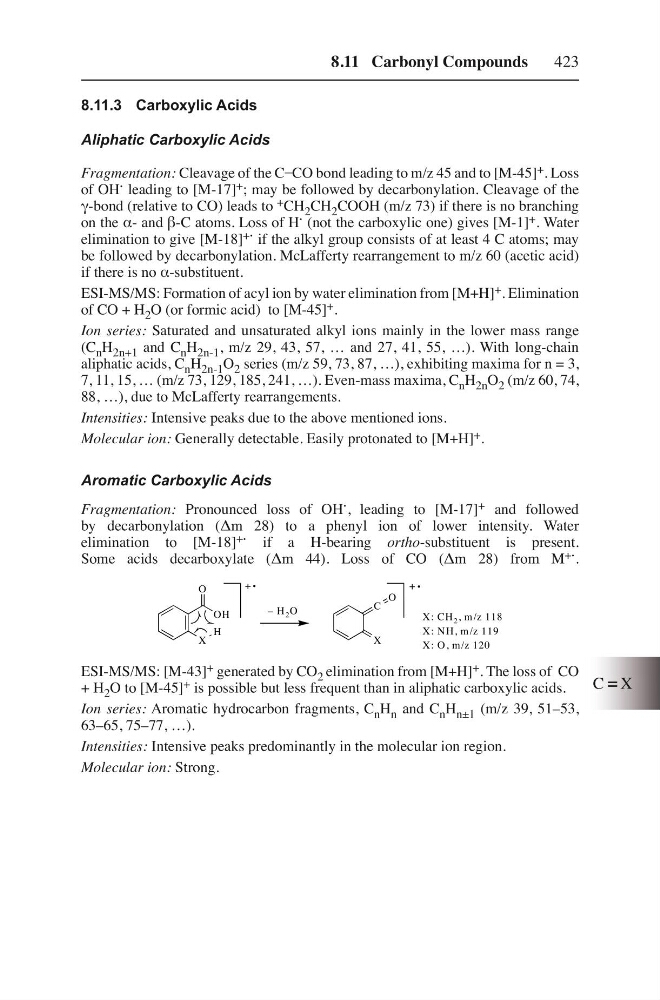
Fragmentation: Pronounced loss of OH · , leading to [M-17] + and followed
by decarbonylation (Δm 28) to a phenyl ion of lower intensity. Water
elimination to [M-18] +· if a H-bearing ortho-substituent is present.
Some acids decarboxylate (Δm 44). Loss of CO (Δm 28) from M +· .
OH
O
X
H
C
X
O
– H 2 O
X: CH 2 , m /z 118
X: N H, m /z 119
X: O , m/z 120
+ .
+ .
ESI-MS/MS: [M-43] + generated by CO 2 elimination from [M+H] + . The loss of CO
+ H 2 O to [M-45] + is possible but less frequent than in aliphatic carboxylic acids.
Ion series: Aromatic hydrocarbon fragments, C n H n and C n H n±1 (m/z 39, 51–53,
63–65, 75–77, …).
Intensities: Intensive peaks predominantly in the molecular ion region.
Molecular ion: Strong.
X
C
Hal
O
N
S
P Si
Natural
Products
Solvents
C
C
C
C C
C
8.11 Carbonyl Compounds
423
8.11.3 Carboxylic Acids
Aliphatic Carboxylic Acids
Fragmentation: Cleavage of the C–CO bond leading to m/z 45 and to [M-45] + . Loss
of OH · leading to [M-17] + ; may be followed by decarbonylation. Cleavage of the
γ-bond (relative to CO) leads to + CH 2 CH 2 COOH (m/z 73) if there is no branching
on the α- and β-C atoms. Loss of H · (not the carboxylic one) gives [M-1] + . Water
elimination to give [M-18] +· if the alkyl group consists of at least 4 C atoms; may
be followed by decarbonylation. McLafferty rearrangement to m/z 60 (acetic acid)
if there is no α-substituent.
ESI-MS/MS: Formation of acyl ion by water elimination from [M+H] + . Elimination
of CO + H 2 O (or formic acid) to [M-45] + .
Ion series: Saturated and unsaturated alkyl ions mainly in the lower mass range
(C n H 2n+1 and C n H 2n-1 , m/z 29, 43, 57, … and 27, 41, 55, …). With long-chain
aliphatic acids, C n H 2n-1 O 2 series (m/z 59, 73, 87, …), exhibiting maxima for n = 3,
7, 11, 15, … (m/z 73, 129, 185, 241, …). Even-mass maxima, C n H 2n O 2 (m/z 60, 74,
88, …), due to McLafferty rearrangements.
Intensities: Intensive peaks due to the above mentioned ions.
Molecular ion: Generally detectable. Easily protonated to [M+H] + .
Aromatic Carboxylic Acids
Fragmentation: Pronounced loss of OH · , leading to [M-17] + and followed
by decarbonylation (Δm 28) to a phenyl ion of lower intensity. Water
elimination to [M-18] +· if a H-bearing ortho-substituent is present.
Some acids decarboxylate (Δm 44). Loss of CO (Δm 28) from M +· .
OH
O
X
H
C
X
O
– H 2 O
X: CH 2 , m /z 118
X: N H, m /z 119
X: O , m/z 120
+ .
+ .
ESI-MS/MS: [M-43] + generated by CO 2 elimination from [M+H] + . The loss of CO
+ H 2 O to [M-45] + is possible but less frequent than in aliphatic carboxylic acids.
Ion series: Aromatic hydrocarbon fragments, C n H n and C n H n±1 (m/z 39, 51–53,
63–65, 75–77, …).
Intensities: Intensive peaks predominantly in the molecular ion region.
Molecular ion: Strong.