

N
X
C
O
N
S
Hal
Solvents
Natural
Products
P Si
C
C
C C
C
C
422
8 Mass Spectrometry
Cyclic Ketones
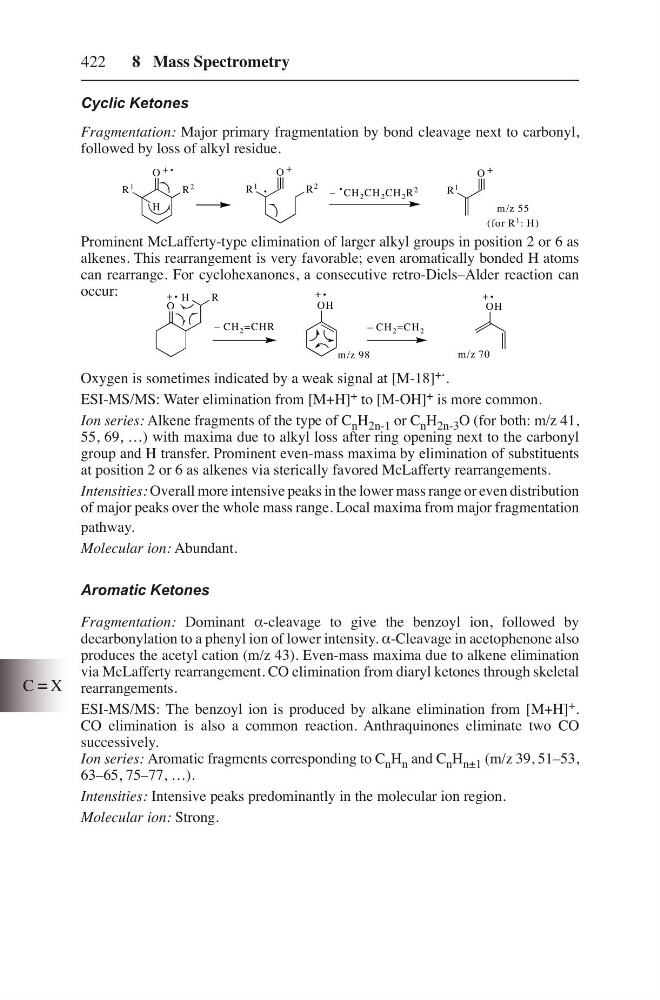
Fragmentation: Major primary fragmentation by bond cleavage next to carbonyl,
followed by loss of alkyl residue.
O
R
1
R
2
H
O
R
1
R
2
+
O
R
1
+
–
. CH 2 CH 2 CH 2 R
2
m /z 55
(for R
1
: H)
+ .
.
Prominent McLafferty-type elimination of larger alkyl groups in position 2 or 6 as
alkenes. This rearrangement is very favorable; even aromatically bonded H atoms
can rearrange. For cyclohexanones, a consecutive retro-Diels–Alder reaction can
occur:
O
OH
– CH 2 =CH 2
m/z 70
R
H
– CH 2 =CHR
OH
m /z 98
+ .
+ .
+ .
Oxygen is sometimes indicated by a weak signal at [M-18] +· .
ESI-MS/MS: Water elimination from [M+H] + to [M-OH] + is more common.
Ion series: Alkene fragments of the type of C n H 2n-1 or C n H 2n-3 O (for both: m/z 41,
55, 69, …) with maxima due to alkyl loss after ring opening next to the carbonyl
group and H transfer. Prominent even-mass maxima by elimination of substituents
at position 2 or 6 as alkenes via sterically favored McLafferty rearrangements.
Intensities: Overall more intensive peaks in the lower mass range or even distribution
of major peaks over the whole mass range. Local maxima from major fragmentation
pathway.
Molecular ion: Abundant.
Aromatic Ketones
Fragmentation: Dominant α-cleavage to give the benzoyl ion, followed by
decarbonylation to a phenyl ion of lower intensity. α-Cleavage in acetophenone also
produces the acetyl cation (m/z 43). Even-mass maxima due to alkene elimination
via McLafferty rearrangement. CO elimination from diaryl ketones through skeletal
rearrangements.
ESI-MS/MS: The benzoyl ion is produced by alkane elimination from [M+H] + .
CO elimination is also a common reaction. Anthraquinones eliminate two CO
successively.
Ion series: Aromatic fragments corresponding to C n H n and C n H n±1 (m/z 39, 51–53,
63–65, 75–77, …).
Intensities: Intensive peaks predominantly in the molecular ion region.
Molecular ion: Strong.
X
C
O
N
S
Hal
Solvents
Natural
Products
P Si
C
C
C C
C
C
422
8 Mass Spectrometry
Cyclic Ketones
Fragmentation: Major primary fragmentation by bond cleavage next to carbonyl,
followed by loss of alkyl residue.
O
R
1
R
2
H
O
R
1
R
2
+
O
R
1
+
–
. CH 2 CH 2 CH 2 R
2
m /z 55
(for R
1
: H)
+ .
.
Prominent McLafferty-type elimination of larger alkyl groups in position 2 or 6 as
alkenes. This rearrangement is very favorable; even aromatically bonded H atoms
can rearrange. For cyclohexanones, a consecutive retro-Diels–Alder reaction can
occur:
O
OH
– CH 2 =CH 2
m/z 70
R
H
– CH 2 =CHR
OH
m /z 98
+ .
+ .
+ .
Oxygen is sometimes indicated by a weak signal at [M-18] +· .
ESI-MS/MS: Water elimination from [M+H] + to [M-OH] + is more common.
Ion series: Alkene fragments of the type of C n H 2n-1 or C n H 2n-3 O (for both: m/z 41,
55, 69, …) with maxima due to alkyl loss after ring opening next to the carbonyl
group and H transfer. Prominent even-mass maxima by elimination of substituents
at position 2 or 6 as alkenes via sterically favored McLafferty rearrangements.
Intensities: Overall more intensive peaks in the lower mass range or even distribution
of major peaks over the whole mass range. Local maxima from major fragmentation
pathway.
Molecular ion: Abundant.
Aromatic Ketones
Fragmentation: Dominant α-cleavage to give the benzoyl ion, followed by
decarbonylation to a phenyl ion of lower intensity. α-Cleavage in acetophenone also
produces the acetyl cation (m/z 43). Even-mass maxima due to alkene elimination
via McLafferty rearrangement. CO elimination from diaryl ketones through skeletal
rearrangements.
ESI-MS/MS: The benzoyl ion is produced by alkane elimination from [M+H] + .
CO elimination is also a common reaction. Anthraquinones eliminate two CO
successively.
Ion series: Aromatic fragments corresponding to C n H n and C n H n±1 (m/z 39, 51–53,
63–65, 75–77, …).
Intensities: Intensive peaks predominantly in the molecular ion region.
Molecular ion: Strong.