

N
X
C
Hal
O
N
S
P Si
Natural
Products
Solvents
C
C
C
C C
C
8.8 Alcohols, Ethers, and Related Compounds
397
Cyclic Ethers
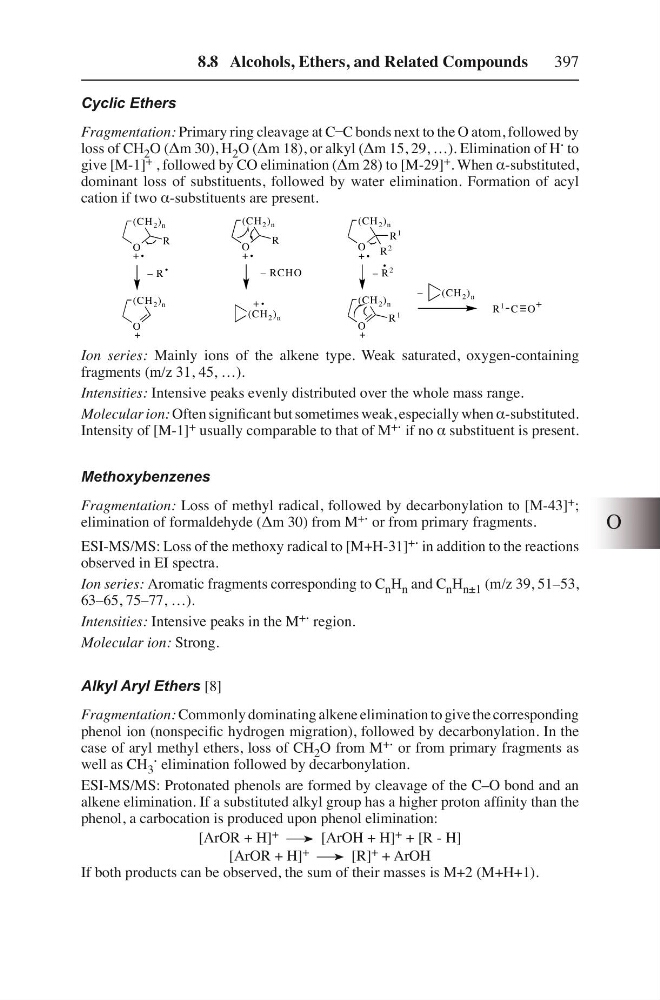
Fragmentation: Primary ring cleavage at C–C bonds next to the O atom, followed by
loss of CH 2 O (Δm 30), H 2 O (Δm 18), or alkyl (Δm 15, 29, …). Elimination of H · to
give [M-1] + , followed by CO elimination (Δm 28) to [M-29] + . When α-substituted,
dominant loss of substituents, followed by water elimination. Formation of acyl
cation if two α-substituents are present.
O
(CH 2 ) n
R
– R
.
O
(CH 2 ) n
+
O
(CH 2 ) n
R
O
(CH 2 ) n
– R
2
O
(CH 2 ) n
+
(CH 2 ) n
– RCH O
R
1
R
2
R
1
(CH 2 ) n
–
R
1
C O +
+ .
+ .
+ .
+ .
.
Ion series: Mainly ions of the alkene type. Weak saturated, oxygen-containing
fragments (m/z 31, 45, …).
Intensities: Intensive peaks evenly distributed over the whole mass range.
Molecular ion: Often significant but sometimes weak, especially when α-substituted.
Intensity of [M-1] + usually comparable to that of M +· if no α substituent is present.
Methoxybenzenes
Fragmentation: Loss of methyl radical, followed by decarbonylation to [M-43] + ;
elimination of formaldehyde (Δm 30) from M +· or from primary fragments.
ESI-MS/MS: Loss of the methoxy radical to [M+H-31] +· in addition to the reactions
observed in EI spectra.
Ion series: Aromatic fragments corresponding to C n H n and C n H n±1 (m/z 39, 51–53,
63–65, 75–77, …).
Intensities: Intensive peaks in the M +· region.
Molecular ion: Strong.
Alkyl Aryl Ethers [8]
Fragmentation: Commonly dominating alkene elimination to give the corresponding
phenol ion (nonspecific hydrogen migration), followed by decarbonylation. In the
case of aryl methyl ethers, loss of CH 2 O from M +· or from primary fragments as
well as CH 3
· elimination followed by decarbonylation.
ESI-MS/MS: Protonated phenols are formed by cleavage of the C–O bond and an
alkene elimination. If a substituted alkyl group has a higher proton affinity than the
phenol, a carbocation is produced upon phenol elimination:
[ArOR + H] +
[ArOH + H] + + [R - H]
[ArOR + H] +
[R] + + ArOH
If both products can be observed, the sum of their masses is M+2 (M+H+1).
X
C
Hal
O
N
S
P Si
Natural
Products
Solvents
C
C
C
C C
C
8.8 Alcohols, Ethers, and Related Compounds
397
Cyclic Ethers
Fragmentation: Primary ring cleavage at C–C bonds next to the O atom, followed by
loss of CH 2 O (Δm 30), H 2 O (Δm 18), or alkyl (Δm 15, 29, …). Elimination of H · to
give [M-1] + , followed by CO elimination (Δm 28) to [M-29] + . When α-substituted,
dominant loss of substituents, followed by water elimination. Formation of acyl
cation if two α-substituents are present.
O
(CH 2 ) n
R
– R
.
O
(CH 2 ) n
+
O
(CH 2 ) n
R
O
(CH 2 ) n
– R
2
O
(CH 2 ) n
+
(CH 2 ) n
– RCH O
R
1
R
2
R
1
(CH 2 ) n
–
R
1
C O +
+ .
+ .
+ .
+ .
.
Ion series: Mainly ions of the alkene type. Weak saturated, oxygen-containing
fragments (m/z 31, 45, …).
Intensities: Intensive peaks evenly distributed over the whole mass range.
Molecular ion: Often significant but sometimes weak, especially when α-substituted.
Intensity of [M-1] + usually comparable to that of M +· if no α substituent is present.
Methoxybenzenes
Fragmentation: Loss of methyl radical, followed by decarbonylation to [M-43] + ;
elimination of formaldehyde (Δm 30) from M +· or from primary fragments.
ESI-MS/MS: Loss of the methoxy radical to [M+H-31] +· in addition to the reactions
observed in EI spectra.
Ion series: Aromatic fragments corresponding to C n H n and C n H n±1 (m/z 39, 51–53,
63–65, 75–77, …).
Intensities: Intensive peaks in the M +· region.
Molecular ion: Strong.
Alkyl Aryl Ethers [8]
Fragmentation: Commonly dominating alkene elimination to give the corresponding
phenol ion (nonspecific hydrogen migration), followed by decarbonylation. In the
case of aryl methyl ethers, loss of CH 2 O from M +· or from primary fragments as
well as CH 3
· elimination followed by decarbonylation.
ESI-MS/MS: Protonated phenols are formed by cleavage of the C–O bond and an
alkene elimination. If a substituted alkyl group has a higher proton affinity than the
phenol, a carbocation is produced upon phenol elimination:
[ArOR + H] +
[ArOH + H] + + [R - H]
[ArOR + H] +
[R] + + ArOH
If both products can be observed, the sum of their masses is M+2 (M+H+1).