

N
X
C
O
N
S
Hal
Solvents
Natural
Products
P Si
C
C
C C
C
C
396
8 Mass Spectrometry
Unsaturated Ethers [7]
Fragmentation of vinylic and acetylenic alkyl ethers: Dominant homolysis of the
alkyl C–C bond next to the O atom on the saturated side, leading to C 3 H 5 O + (m/z 57)
for vinylic and C 3 H 3 O + (m/z 55) for acetylenic ethers of primary aliphatic alcohols.
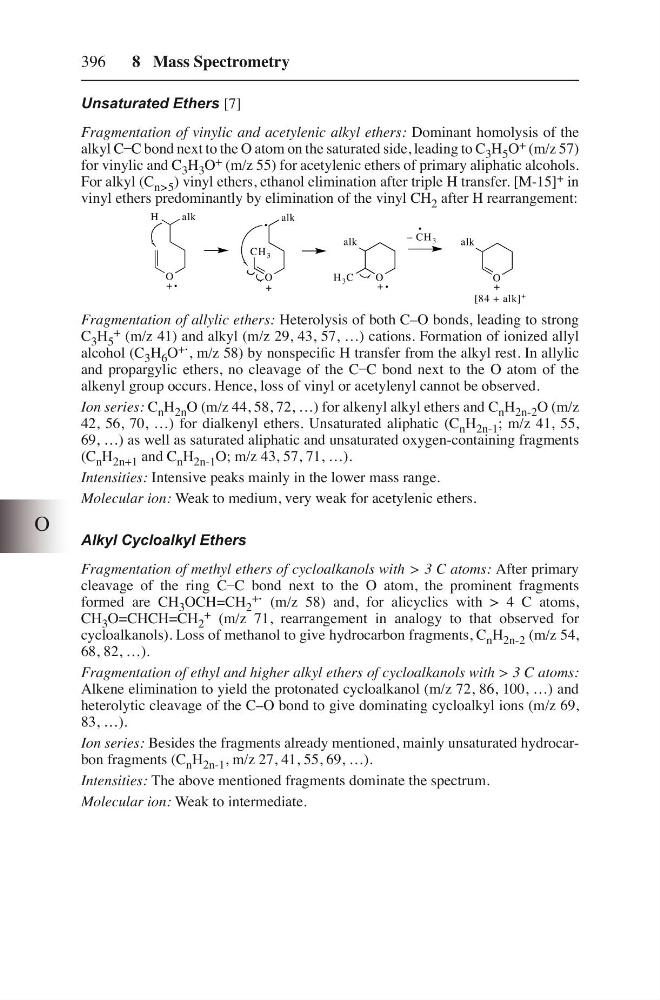
For alkyl (C n > 5 ) vinyl ethers, ethanol elimination after triple H transfer. [M-15] + in
vinyl ethers predominantly by elimination of the vinyl CH 2 after H rearrangement:
O
H
alk
CH 3
O
alk
+
O
O
+
alk
H 3 C
alk
– CH 3
[84 + alk]
+
+ .
+ .
.
.
Fragmentation of allylic ethers: Heterolysis of both C–O bonds, leading to strong
C 3 H 5
+ (m/z 41) and alkyl (m/z 29, 43, 57, …) cations. Formation of ionized allyl
alcohol (C 3 H 6 O +· , m/z 58) by nonspecific H transfer from the alkyl rest. In allylic
and propargylic ethers, no cleavage of the C–C bond next to the O atom of the
alkenyl group occurs. Hence, loss of vinyl or acetylenyl cannot be observed.
Ion series: C n H 2n O (m/z 44, 58, 72, …) for alkenyl alkyl ethers and C n H 2n-2 O (m/z
42, 56, 70, …) for dialkenyl ethers. Unsaturated aliphatic (C n H 2n-1 ; m/z 41, 55,
69, …) as well as saturated aliphatic and unsaturated oxygen-containing fragments
(C n H 2n+1 and C n H 2n-1 O; m/z 43, 57, 71, …).
Intensities: Intensive peaks mainly in the lower mass range.
Molecular ion: Weak to medium, very weak for acetylenic ethers.
Alkyl Cycloalkyl Ethers
Fragmentation of methyl ethers of cycloalkanols with > 3 C atoms: After primary
cleavage of the ring C–C bond next to the O atom, the prominent fragments
formed are CH 3 OCH=CH 2
+· (m/z 58) and, for alicyclics with > 4 C atoms,
CH 3 O=CHCH=CH 2
+ (m/z 71, rearrangement in analogy to that observed for
cycloalkanols). Loss of methanol to give hydrocarbon fragments, C n H 2n-2 (m/z 54,
68, 82, …).
Fragmentation of ethyl and higher alkyl ethers of cycloalkanols with > 3 C atoms:
Alkene elimination to yield the protonated cycloalkanol (m/z 72, 86, 100, …) and
heterolytic cleavage of the C–O bond to give dominating cycloalkyl ions (m/z 69,
83, …).
Ion series: Besides the fragments already mentioned, mainly unsaturated hydrocarbon fragments (C n H 2n-1 , m/z 27, 41, 55, 69, …).
Intensities: The above mentioned fragments dominate the spectrum.
Molecular ion: Weak to intermediate.
X
C
O
N
S
Hal
Solvents
Natural
Products
P Si
C
C
C C
C
C
396
8 Mass Spectrometry
Unsaturated Ethers [7]
Fragmentation of vinylic and acetylenic alkyl ethers: Dominant homolysis of the
alkyl C–C bond next to the O atom on the saturated side, leading to C 3 H 5 O + (m/z 57)
for vinylic and C 3 H 3 O + (m/z 55) for acetylenic ethers of primary aliphatic alcohols.
For alkyl (C n > 5 ) vinyl ethers, ethanol elimination after triple H transfer. [M-15] + in
vinyl ethers predominantly by elimination of the vinyl CH 2 after H rearrangement:
O
H
alk
CH 3
O
alk
+
O
O
+
alk
H 3 C
alk
– CH 3
[84 + alk]
+
+ .
+ .
.
.
Fragmentation of allylic ethers: Heterolysis of both C–O bonds, leading to strong
C 3 H 5
+ (m/z 41) and alkyl (m/z 29, 43, 57, …) cations. Formation of ionized allyl
alcohol (C 3 H 6 O +· , m/z 58) by nonspecific H transfer from the alkyl rest. In allylic
and propargylic ethers, no cleavage of the C–C bond next to the O atom of the
alkenyl group occurs. Hence, loss of vinyl or acetylenyl cannot be observed.
Ion series: C n H 2n O (m/z 44, 58, 72, …) for alkenyl alkyl ethers and C n H 2n-2 O (m/z
42, 56, 70, …) for dialkenyl ethers. Unsaturated aliphatic (C n H 2n-1 ; m/z 41, 55,
69, …) as well as saturated aliphatic and unsaturated oxygen-containing fragments
(C n H 2n+1 and C n H 2n-1 O; m/z 43, 57, 71, …).
Intensities: Intensive peaks mainly in the lower mass range.
Molecular ion: Weak to medium, very weak for acetylenic ethers.
Alkyl Cycloalkyl Ethers
Fragmentation of methyl ethers of cycloalkanols with > 3 C atoms: After primary
cleavage of the ring C–C bond next to the O atom, the prominent fragments
formed are CH 3 OCH=CH 2
+· (m/z 58) and, for alicyclics with > 4 C atoms,
CH 3 O=CHCH=CH 2
+ (m/z 71, rearrangement in analogy to that observed for
cycloalkanols). Loss of methanol to give hydrocarbon fragments, C n H 2n-2 (m/z 54,
68, 82, …).
Fragmentation of ethyl and higher alkyl ethers of cycloalkanols with > 3 C atoms:
Alkene elimination to yield the protonated cycloalkanol (m/z 72, 86, 100, …) and
heterolytic cleavage of the C–O bond to give dominating cycloalkyl ions (m/z 69,
83, …).
Ion series: Besides the fragments already mentioned, mainly unsaturated hydrocarbon fragments (C n H 2n-1 , m/z 27, 41, 55, 69, …).
Intensities: The above mentioned fragments dominate the spectrum.
Molecular ion: Weak to intermediate.