

N
X
C
O
N
S
Hal
Solvents
Natural
Products
P Si
C
C
C C
C
C
394
8 Mass Spectrometry
Ion series: Aromatic hydrocarbon fragments, C n H n and C n H n±1 (m/z 39, 51–53,
63–65, 75–77, …). The presence of some m/z 55 (C 3 H 3 O) is common. A peak at
m/z 69 (O=C=CHC– – – O + ) is characteristic of 1,3-dihydroxy substitution.
Intensities: Dominant peaks in the higher mass range.
Molecular ion: Dominant, no tendency to form [M+H] + ; [M-1] + is weak.
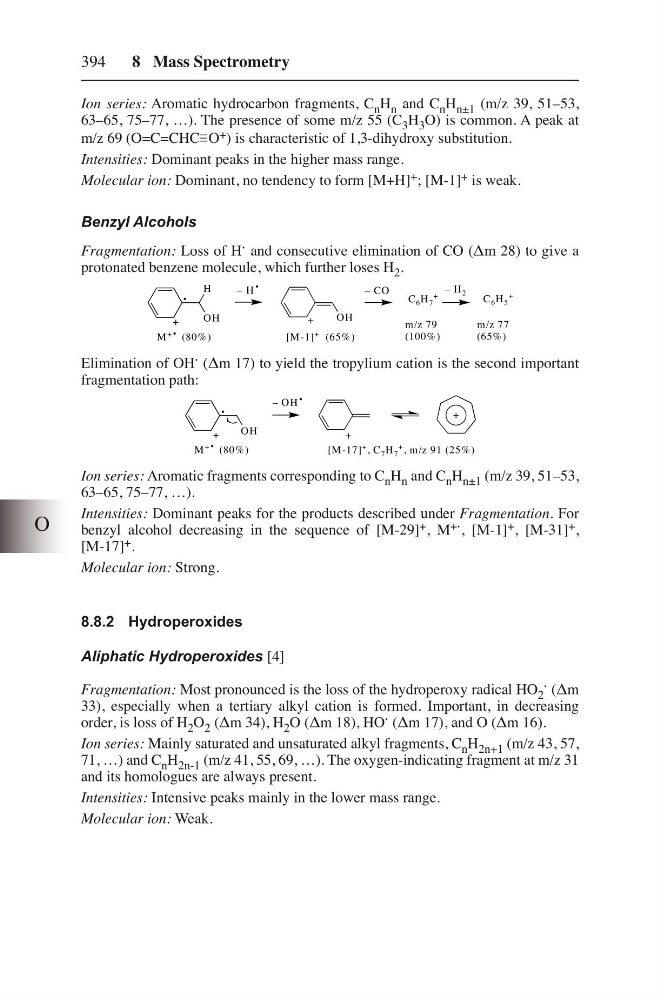
Benzyl Alcohols
Fragmentation: Loss of H · and consecutive elimination of CO (Δm 28) to give a
protonated benzene molecule, which further loses H 2 .
O H
H
+
– H
.
OH
+
– CO
– H 2
C 6 H 5
+
M
+ . (80% )
[M -1]
+
(65% )
m/z 79
(100% )
m/z 77
(65% )
C 6 H 7
+
.
Elimination of OH · (Δm 17) to yield the tropylium cation is the second important
fragmentation path:
O H
+
– O H
.
+
M
+ . (80% )
[M -17]
+
, C 7 H 7
+
, m/z 91 (25% )
+
.
Ion series: Aromatic fragments corresponding to C n H n and C n H n±1 (m/z 39, 51–53,
63–65, 75–77, …).
Intensities: Dominant peaks for the products described under Fragmentation. For
benzyl alcohol decreasing in the sequence of [M-29] + , M +· , [M-1] + , [M-31] + ,
[M-17] + .
Molecular ion: Strong.
8.8.2 Hydroperoxides
Aliphatic Hydroperoxides [4]
Fragmentation: Most pronounced is the loss of the hydroperoxy radical HO 2
· (Δm
33), especially when a tertiary alkyl cation is formed. Important, in decreasing
order, is loss of H 2 O 2 (Δm 34), H 2 O (Δm 18), HO · (Δm 17), and O (Δm 16).
Ion series: Mainly saturated and unsaturated alkyl fragments, C n H 2n+1 (m/z 43, 57,
71, …) and C n H 2n-1 (m/z 41, 55, 69, …). The oxygen-indicating fragment at m/z 31
and its homologues are always present.
Intensities: Intensive peaks mainly in the lower mass range.
Molecular ion: Weak.
X
C
O
N
S
Hal
Solvents
Natural
Products
P Si
C
C
C C
C
C
394
8 Mass Spectrometry
Ion series: Aromatic hydrocarbon fragments, C n H n and C n H n±1 (m/z 39, 51–53,
63–65, 75–77, …). The presence of some m/z 55 (C 3 H 3 O) is common. A peak at
m/z 69 (O=C=CHC– – – O + ) is characteristic of 1,3-dihydroxy substitution.
Intensities: Dominant peaks in the higher mass range.
Molecular ion: Dominant, no tendency to form [M+H] + ; [M-1] + is weak.
Benzyl Alcohols
Fragmentation: Loss of H · and consecutive elimination of CO (Δm 28) to give a
protonated benzene molecule, which further loses H 2 .
O H
H
+
– H
.
OH
+
– CO
– H 2
C 6 H 5
+
M
+ . (80% )
[M -1]
+
(65% )
m/z 79
(100% )
m/z 77
(65% )
C 6 H 7
+
.
Elimination of OH · (Δm 17) to yield the tropylium cation is the second important
fragmentation path:
O H
+
– O H
.
+
M
+ . (80% )
[M -17]
+
, C 7 H 7
+
, m/z 91 (25% )
+
.
Ion series: Aromatic fragments corresponding to C n H n and C n H n±1 (m/z 39, 51–53,
63–65, 75–77, …).
Intensities: Dominant peaks for the products described under Fragmentation. For
benzyl alcohol decreasing in the sequence of [M-29] + , M +· , [M-1] + , [M-31] + ,
[M-17] + .
Molecular ion: Strong.
8.8.2 Hydroperoxides
Aliphatic Hydroperoxides [4]
Fragmentation: Most pronounced is the loss of the hydroperoxy radical HO 2
· (Δm
33), especially when a tertiary alkyl cation is formed. Important, in decreasing
order, is loss of H 2 O 2 (Δm 34), H 2 O (Δm 18), HO · (Δm 17), and O (Δm 16).
Ion series: Mainly saturated and unsaturated alkyl fragments, C n H 2n+1 (m/z 43, 57,
71, …) and C n H 2n-1 (m/z 41, 55, 69, …). The oxygen-indicating fragment at m/z 31
and its homologues are always present.
Intensities: Intensive peaks mainly in the lower mass range.
Molecular ion: Weak.