

N
X
C
Hal
O
N
S
P Si
Natural
Products
Solvents
C
C
C
C C
C
8.8 Alcohols, Ethers, and Related Compounds
393
(CH 2 ) n
O H
H
CH 3
(CH 2 ) n
.
OH
+
m/z 57
(CH 2 ) n
O H
O H
CH 2
.
+
m /z 44
–
– C n+ 3 H 2n+ 6
+ .
+ .
Ion series: Alkene hydrocarbon fragments C n H 2n-1 (m/z 41, 55, 69, …), C n H 2n-3
(m/z 39, 53, 67, 81, …), and unsaturated O fragments, C n H 2n-1 O (m/z 43, 57,
71, …), as well as acetaldehyde and its homologues (m/z 44, 58, 72, …).
Intensities: Local maxima evenly distributed over the whole mass range.
Molecular ion: Usually weak but in contrast to aliphatic alcohols practically never
missing. [M+1] + typically contains a significant amount of [M+H] + .
Unsaturated Aliphatic Alcohols [3]
Vicinal Glycols
Fragmentation: Cleavage of bonds next to the OH-bearing C atom (α-cleavage)
dominates. Preferable fragmentation of the C–C bond between the two oxygens,
the charge remaining predominantly on the larger fragment. Water elimination from
these fragments, but scarcely from M +· .
Ion series: Saturated and unsaturated aliphatic ions (m/z 43, 57, 71, … and 41, 55,
69, …) and intensive peaks from O-containing saturated rests (m/z 45, 59, 73, …).
Intensities: Dominant peaks for the products of α-cleavages and their dehydrated
derivatives.
Molecular ion: Weak.
Phenols
Fragmentation: Decarbonylation (Δm 28) and loss of CHO · (Δm 29) followed by
elimination of acetylene. An important fragment of alkyl derivatives is [M-1] + , as
is [M-15] + if at least two alkyl carbons are present (dimethyl or ethyl). Elimination
of CO from the primary fragments. [M-18] +· mainly with ortho-alkylphenols. In
derivatives with a longer alkyl chain, benzylic cleavage and alkene elimination
(McLafferty rearrangement) are the dominant primary fragmentation processes.
The fragments then lose CO (Δm 28).
ESI-MS/MS: Elimination of CO or H 2 O from [M+H] + .
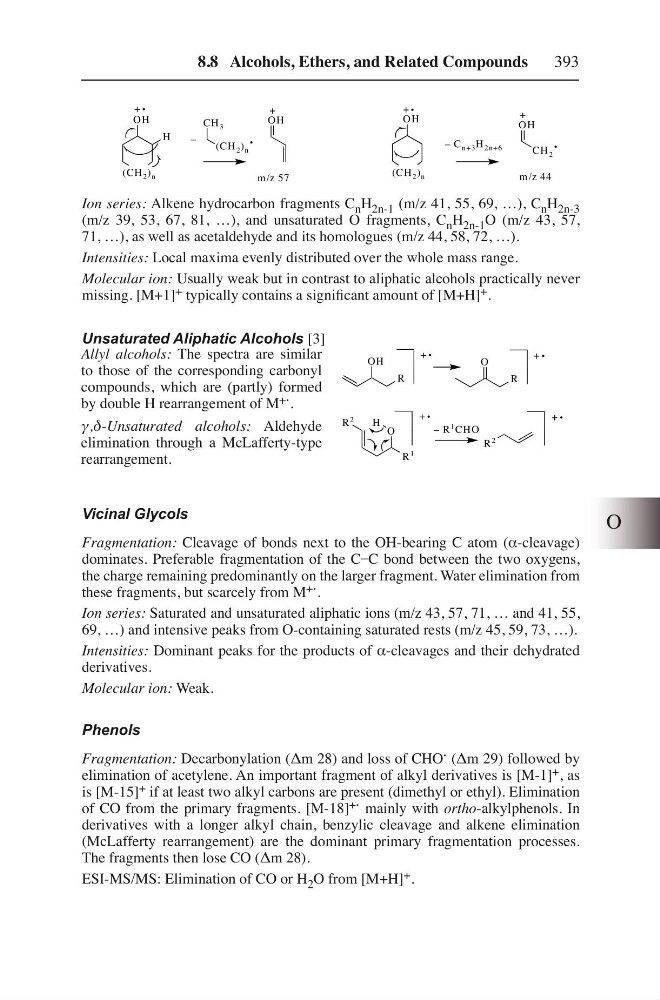
Allyl alcohols: The spectra are similar
to those of the corresponding carbonyl
compounds, which are (partly) formed
by double H rearrangement of M +· .
γ,δ-Unsaturated alcohols: Aldehyde
elimination through a McLafferty-type
rearrangement.
R
OH
R
O
+ .
+ .
O
H
R
2
R
1
R
2
– R
1
CHO
+ .
+ .
X
C
Hal
O
N
S
P Si
Natural
Products
Solvents
C
C
C
C C
C
8.8 Alcohols, Ethers, and Related Compounds
393
(CH 2 ) n
O H
H
CH 3
(CH 2 ) n
.
OH
+
m/z 57
(CH 2 ) n
O H
O H
CH 2
.
+
m /z 44
–
– C n+ 3 H 2n+ 6
+ .
+ .
Ion series: Alkene hydrocarbon fragments C n H 2n-1 (m/z 41, 55, 69, …), C n H 2n-3
(m/z 39, 53, 67, 81, …), and unsaturated O fragments, C n H 2n-1 O (m/z 43, 57,
71, …), as well as acetaldehyde and its homologues (m/z 44, 58, 72, …).
Intensities: Local maxima evenly distributed over the whole mass range.
Molecular ion: Usually weak but in contrast to aliphatic alcohols practically never
missing. [M+1] + typically contains a significant amount of [M+H] + .
Unsaturated Aliphatic Alcohols [3]
Vicinal Glycols
Fragmentation: Cleavage of bonds next to the OH-bearing C atom (α-cleavage)
dominates. Preferable fragmentation of the C–C bond between the two oxygens,
the charge remaining predominantly on the larger fragment. Water elimination from
these fragments, but scarcely from M +· .
Ion series: Saturated and unsaturated aliphatic ions (m/z 43, 57, 71, … and 41, 55,
69, …) and intensive peaks from O-containing saturated rests (m/z 45, 59, 73, …).
Intensities: Dominant peaks for the products of α-cleavages and their dehydrated
derivatives.
Molecular ion: Weak.
Phenols
Fragmentation: Decarbonylation (Δm 28) and loss of CHO · (Δm 29) followed by
elimination of acetylene. An important fragment of alkyl derivatives is [M-1] + , as
is [M-15] + if at least two alkyl carbons are present (dimethyl or ethyl). Elimination
of CO from the primary fragments. [M-18] +· mainly with ortho-alkylphenols. In
derivatives with a longer alkyl chain, benzylic cleavage and alkene elimination
(McLafferty rearrangement) are the dominant primary fragmentation processes.
The fragments then lose CO (Δm 28).
ESI-MS/MS: Elimination of CO or H 2 O from [M+H] + .
Allyl alcohols: The spectra are similar
to those of the corresponding carbonyl
compounds, which are (partly) formed
by double H rearrangement of M +· .
γ,δ-Unsaturated alcohols: Aldehyde
elimination through a McLafferty-type
rearrangement.
R
OH
R
O
+ .
+ .
O
H
R
2
R
1
R
2
– R
1
CHO
+ .
+ .