

N
X
C
O
N
S
Hal
Solvents
Natural
Products
P Si
C
C
C C
C
C
232
5 1 H NMR
The signals of the NH protons are often broad because the 14 N– 1 H coupling is only
partly eliminated by the quadrupole relaxation of 14 N (spin quantum number, I = 1;
1 J NH ≈ 60). In primary amides, the hindered rotation around the CO–N bond is
another reason for line broadening. At slow rotation, the chemical shifts of the two
primary amide protons differ by about 0.4–1 ppm. Therefore, at intermediate rotation rates, line widths of up to 1 ppm may be observed.
Due to the slow intermolecular exchange of amide protons, their coupling to
neighboring hydrogen atoms is usually detectable. The splitting of the C–H signal
is clearly observed even in those cases where the signal of the NH proton is broad
and featureless. The H–N–C–H coupling depends on the conformation in a similar
way as the H–C–C–H coupling (see Chapter 5.1.2). For N–CH 3 and N–CH 2 groups:
3 J HCNH ≈ 5–6 Hz.
Tertiary Alkylamides
The rotation around the CO–N bond is usually so slow that, for identical substituents,
two separate signals are observed for cis and trans positions. With different Nsubstituents, two separate pairs of signals are observed for the two conformers. In
general, the following relationships hold:
for NCH 3 , NCH 2 CH 3 , and NCH(CH 3 ) 2
δ cis to O ≤ δ trans to O
for NCH(CH 3 ) 2 and NC(CH 3 ) 3
δ trans to O ≤ δ cis to O
for NCH 2
δ cis to O ≈ δ trans to O
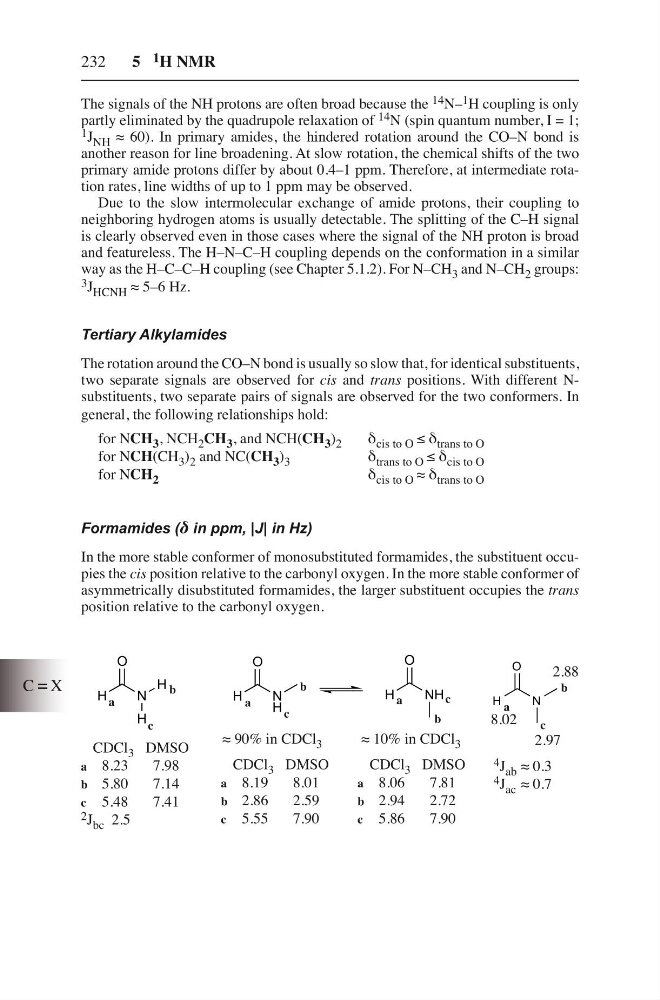
Formamides (δ in ppm, |J| in Hz)
In the more stable conformer of monosubstituted formamides, the substituent occupies the cis position relative to the carbonyl oxygen. In the more stable conformer of
asymmetrically disubstituted formamides, the larger substituent occupies the trans
position relative to the carbonyl oxygen.
H
O
N
H
H
O
N
H
H
H
O
NH
H
O
N
CDCl 3 DMSO
a 8.23
7.98
b 5.80
7.14
c 5.48
7.41
2 J bc 2.5
CDCl 3 DMSO
a 8.19
8.01
b 2.86
2.59
c 5.55
7.90
CDCl 3 DMSO
a 8.06
7.81
b 2.94
2.72
c 5.86
7.90
a
a
a
a
b
b
b
b
c
c
c
c
≈ 90% in CDCl 3
≈ 10% in CDCl 3
2.97
2.88
8.02
4 J ab ≈ 0.3
4 J ac ≈ 0.7
X
C
O
N
S
Hal
Solvents
Natural
Products
P Si
C
C
C C
C
C
232
5 1 H NMR
The signals of the NH protons are often broad because the 14 N– 1 H coupling is only
partly eliminated by the quadrupole relaxation of 14 N (spin quantum number, I = 1;
1 J NH ≈ 60). In primary amides, the hindered rotation around the CO–N bond is
another reason for line broadening. At slow rotation, the chemical shifts of the two
primary amide protons differ by about 0.4–1 ppm. Therefore, at intermediate rotation rates, line widths of up to 1 ppm may be observed.
Due to the slow intermolecular exchange of amide protons, their coupling to
neighboring hydrogen atoms is usually detectable. The splitting of the C–H signal
is clearly observed even in those cases where the signal of the NH proton is broad
and featureless. The H–N–C–H coupling depends on the conformation in a similar
way as the H–C–C–H coupling (see Chapter 5.1.2). For N–CH 3 and N–CH 2 groups:
3 J HCNH ≈ 5–6 Hz.
Tertiary Alkylamides
The rotation around the CO–N bond is usually so slow that, for identical substituents,
two separate signals are observed for cis and trans positions. With different Nsubstituents, two separate pairs of signals are observed for the two conformers. In
general, the following relationships hold:
for NCH 3 , NCH 2 CH 3 , and NCH(CH 3 ) 2
δ cis to O ≤ δ trans to O
for NCH(CH 3 ) 2 and NC(CH 3 ) 3
δ trans to O ≤ δ cis to O
for NCH 2
δ cis to O ≈ δ trans to O
Formamides (δ in ppm, |J| in Hz)
In the more stable conformer of monosubstituted formamides, the substituent occupies the cis position relative to the carbonyl oxygen. In the more stable conformer of
asymmetrically disubstituted formamides, the larger substituent occupies the trans
position relative to the carbonyl oxygen.
H
O
N
H
H
O
N
H
H
H
O
NH
H
O
N
CDCl 3 DMSO
a 8.23
7.98
b 5.80
7.14
c 5.48
7.41
2 J bc 2.5
CDCl 3 DMSO
a 8.19
8.01
b 2.86
2.59
c 5.55
7.90
CDCl 3 DMSO
a 8.06
7.81
b 2.94
2.72
c 5.86
7.90
a
a
a
a
b
b
b
b
c
c
c
c
≈ 90% in CDCl 3
≈ 10% in CDCl 3
2.97
2.88
8.02
4 J ab ≈ 0.3
4 J ac ≈ 0.7