

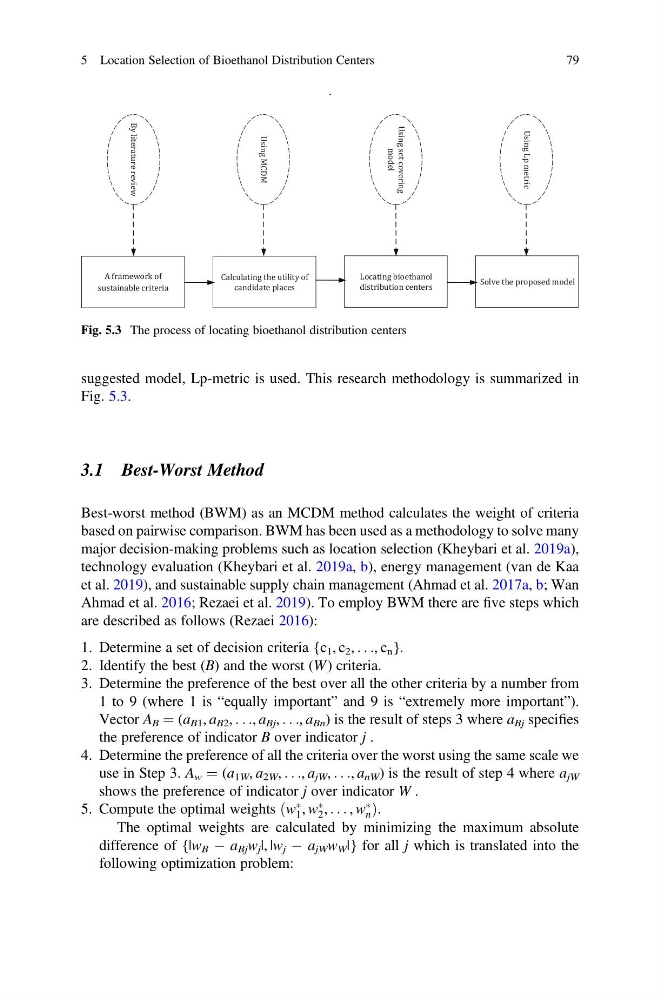
suggested model, Lp-metric is used. This research methodology is summarized in
Fig. 5.3.
3.1 Best-Worst Method
Best-worst method (BWM) as an MCDM method calculates the weight of criteria
based on pairwise comparison. BWM has been used as a methodology to solve many
major decision-making problems such as location selection (Kheybari et al. 2019a),
technology evaluation (Kheybari et al. 2019a, b), energy management (van de Kaa
et al. 2019), and sustainable supply chain management (Ahmad et al. 2017a, b; Wan
Ahmad et al. 2016; Rezaei et al. 2019). To employ BWM there are five steps which
are described as follows (Rezaei 2016):
1. Determine a set of decision criteria {c 1 , c 2 , . . ., c n }.
2. Identify the best (B) and the worst (W) criteria.
3. Determine the preference of the best over all the other criteria by a number from
1 to 9 (where 1 is “equally important” and 9 is “extremely more important”).
Vector A B ¼ (a B1 , a B2 , . . ., a Bj , . . ., a Bn ) is the result of steps 3 where a Bj specifies
the preference of indicator B over indicator j .
4. Determine the preference of all the criteria over the worst using the same scale we
use in Step 3. A w ¼ (a 1W , a 2W , . . ., a jW , . . ., a nW ) is the result of step 4 where a jW
shows the preference of indicator j over indicator W .
5. Compute the optimal weights ðw
Ã
1 , w
Ã
2 , . . . , w
Ã
n Þ.
The optimal weights are calculated by minimizing the maximum absolute
difference of {|w B À a Bj w j |, |w j À a jW w W |} for all j which is translated into the
following optimization problem:
Fig. 5.3 The process of locating bioethanol distribution centers
5 Location Selection of Bioethanol Distribution Centers
79
Fig. 5.3.
3.1 Best-Worst Method
Best-worst method (BWM) as an MCDM method calculates the weight of criteria
based on pairwise comparison. BWM has been used as a methodology to solve many
major decision-making problems such as location selection (Kheybari et al. 2019a),
technology evaluation (Kheybari et al. 2019a, b), energy management (van de Kaa
et al. 2019), and sustainable supply chain management (Ahmad et al. 2017a, b; Wan
Ahmad et al. 2016; Rezaei et al. 2019). To employ BWM there are five steps which
are described as follows (Rezaei 2016):
1. Determine a set of decision criteria {c 1 , c 2 , . . ., c n }.
2. Identify the best (B) and the worst (W) criteria.
3. Determine the preference of the best over all the other criteria by a number from
1 to 9 (where 1 is “equally important” and 9 is “extremely more important”).
Vector A B ¼ (a B1 , a B2 , . . ., a Bj , . . ., a Bn ) is the result of steps 3 where a Bj specifies
the preference of indicator B over indicator j .
4. Determine the preference of all the criteria over the worst using the same scale we
use in Step 3. A w ¼ (a 1W , a 2W , . . ., a jW , . . ., a nW ) is the result of step 4 where a jW
shows the preference of indicator j over indicator W .
5. Compute the optimal weights ðw
Ã
1 , w
Ã
2 , . . . , w
Ã
n Þ.
The optimal weights are calculated by minimizing the maximum absolute
difference of {|w B À a Bj w j |, |w j À a jW w W |} for all j which is translated into the
following optimization problem:
Fig. 5.3 The process of locating bioethanol distribution centers
5 Location Selection of Bioethanol Distribution Centers
79