

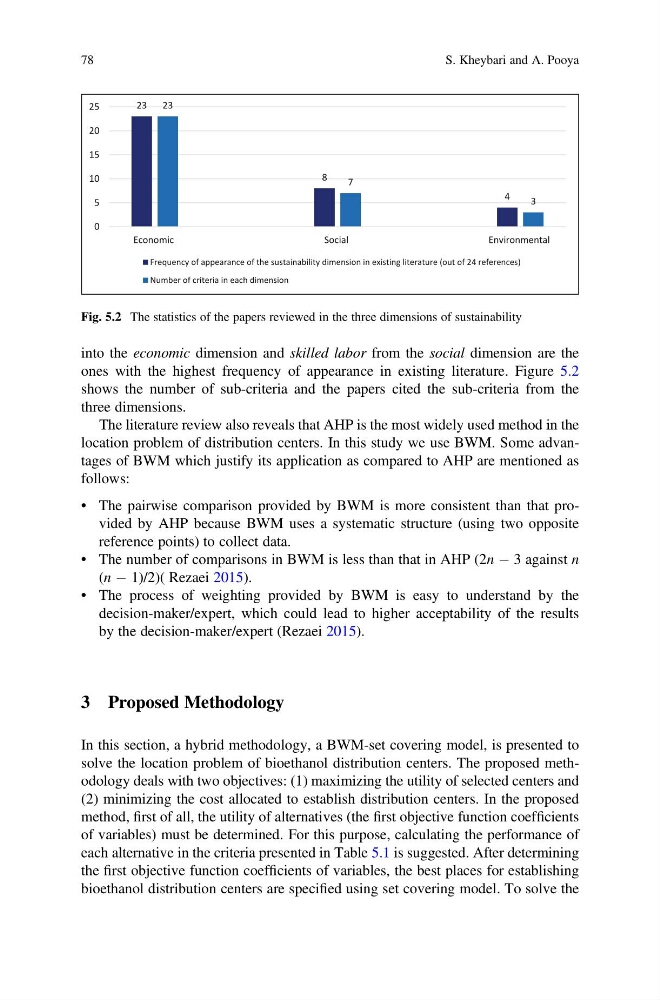
into the economic dimension and skilled labor from the social dimension are the
ones with the highest frequency of appearance in existing literature. Figure 5.2
shows the number of sub-criteria and the papers cited the sub-criteria from the
three dimensions.
The literature review also reveals that AHP is the most widely used method in the
location problem of distribution centers. In this study we use BWM. Some advantages of BWM which justify its application as compared to AHP are mentioned as
follows:
• The pairwise comparison provided by BWM is more consistent than that provided by AHP because BWM uses a systematic structure (using two opposite
reference points) to collect data.
• The number of comparisons in BWM is less than that in AHP (2n À 3 against n
(n À 1)/2)( Rezaei 2015).
• The process of weighting provided by BWM is easy to understand by the
decision-maker/expert, which could lead to higher acceptability of the results
by the decision-maker/expert (Rezaei 2015).
3 Proposed Methodology
In this section, a hybrid methodology, a BWM-set covering model, is presented to
solve the location problem of bioethanol distribution centers. The proposed methodology deals with two objectives: (1) maximizing the utility of selected centers and
(2) minimizing the cost allocated to establish distribution centers. In the proposed
method, first of all, the utility of alternatives (the first objective function coefficients
of variables) must be determined. For this purpose, calculating the performance of
each alternative in the criteria presented in Table 5.1 is suggested. After determining
the first objective function coefficients of variables, the best places for establishing
bioethanol distribution centers are specified using set covering model. To solve the
23
8
4
23
7
3
0
5
10
15
20
25
Economic
Social
Environmental
Frequency of appearance of the sustainability dimension in existing literature (out of 24 references)
Number of criteria in each dimension
Fig. 5.2 The statistics of the papers reviewed in the three dimensions of sustainability
78
S. Kheybari and A. Pooya
ones with the highest frequency of appearance in existing literature. Figure 5.2
shows the number of sub-criteria and the papers cited the sub-criteria from the
three dimensions.
The literature review also reveals that AHP is the most widely used method in the
location problem of distribution centers. In this study we use BWM. Some advantages of BWM which justify its application as compared to AHP are mentioned as
follows:
• The pairwise comparison provided by BWM is more consistent than that provided by AHP because BWM uses a systematic structure (using two opposite
reference points) to collect data.
• The number of comparisons in BWM is less than that in AHP (2n À 3 against n
(n À 1)/2)( Rezaei 2015).
• The process of weighting provided by BWM is easy to understand by the
decision-maker/expert, which could lead to higher acceptability of the results
by the decision-maker/expert (Rezaei 2015).
3 Proposed Methodology
In this section, a hybrid methodology, a BWM-set covering model, is presented to
solve the location problem of bioethanol distribution centers. The proposed methodology deals with two objectives: (1) maximizing the utility of selected centers and
(2) minimizing the cost allocated to establish distribution centers. In the proposed
method, first of all, the utility of alternatives (the first objective function coefficients
of variables) must be determined. For this purpose, calculating the performance of
each alternative in the criteria presented in Table 5.1 is suggested. After determining
the first objective function coefficients of variables, the best places for establishing
bioethanol distribution centers are specified using set covering model. To solve the
23
8
4
23
7
3
0
5
10
15
20
25
Economic
Social
Environmental
Frequency of appearance of the sustainability dimension in existing literature (out of 24 references)
Number of criteria in each dimension
Fig. 5.2 The statistics of the papers reviewed in the three dimensions of sustainability
78
S. Kheybari and A. Pooya