

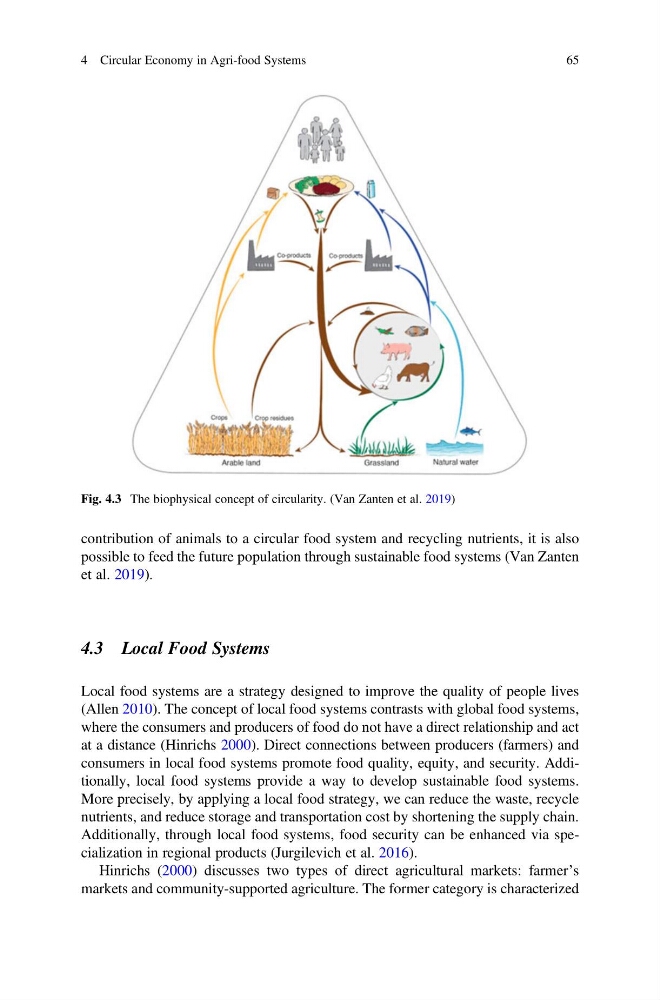
contribution of animals to a circular food system and recycling nutrients, it is also
possible to feed the future population through sustainable food systems (Van Zanten
et al. 2019).
4.3 Local Food Systems
Local food systems are a strategy designed to improve the quality of people lives
(Allen 2010). The concept of local food systems contrasts with global food systems,
where the consumers and producers of food do not have a direct relationship and act
at a distance (Hinrichs 2000). Direct connections between producers (farmers) and
consumers in local food systems promote food quality, equity, and security. Additionally, local food systems provide a way to develop sustainable food systems.
More precisely, by applying a local food strategy, we can reduce the waste, recycle
nutrients, and reduce storage and transportation cost by shortening the supply chain.
Additionally, through local food systems, food security can be enhanced via specialization in regional products (Jurgilevich et al. 2016).
Hinrichs (2000) discusses two types of direct agricultural markets: farmer’s
markets and community-supported agriculture. The former category is characterized
Fig. 4.3 The biophysical concept of circularity. (Van Zanten et al. 2019)
4 Circular Economy in Agri-food Systems
65
possible to feed the future population through sustainable food systems (Van Zanten
et al. 2019).
4.3 Local Food Systems
Local food systems are a strategy designed to improve the quality of people lives
(Allen 2010). The concept of local food systems contrasts with global food systems,
where the consumers and producers of food do not have a direct relationship and act
at a distance (Hinrichs 2000). Direct connections between producers (farmers) and
consumers in local food systems promote food quality, equity, and security. Additionally, local food systems provide a way to develop sustainable food systems.
More precisely, by applying a local food strategy, we can reduce the waste, recycle
nutrients, and reduce storage and transportation cost by shortening the supply chain.
Additionally, through local food systems, food security can be enhanced via specialization in regional products (Jurgilevich et al. 2016).
Hinrichs (2000) discusses two types of direct agricultural markets: farmer’s
markets and community-supported agriculture. The former category is characterized
Fig. 4.3 The biophysical concept of circularity. (Van Zanten et al. 2019)
4 Circular Economy in Agri-food Systems
65