

4 Mathematical Model of Vehicle Dispatching Problem
In the following, we will introduce the mathematical optimization model developed
for the vehicle dispatching problem in a Physical Internet.
Parameters
• T: an upper bound of the number of arcs for a path for each vehicle.
• K: the set of vehicles.
• G(N, A): the graph representation of a Physical Internet; N is the set of Physical
Internet hubs, and A is the set of the arcs connecting hubs.
• δ(a) 2 N: the head node of an arc a 2 A.
• σ(a) 2 N: the tail node of an arc a 2 A.
• c a : the traveling cost of arc a 2 A.
• l k 2 N: the initial location of vehicle k 2 K.
• d a : the transportation demand for arc a.
Decision Variables
• x ka
t : a binary decision variable, 1, if vehicle k takes arc a at tth link, 0, otherwise
• d ka 2 Z
+
: the transportation demand portion that vehicle k takes from transportation demand d a , a 2 A
Model
min:
X
k2K
X
1 t T
X
a2A
c a x
t
ka
ð3:1Þ
s.t.
X
a2A
x
t
ka ¼ 1,
8k 2 K, 1 t T
ð3:2Þ
x
tþ1
k´ a
x
t
ka ,
8k 2 K, 1 t T, a, ´
a 2 A, σ a
ð Þ 6 ¼ δ ´
a
ð Þ
ð3:3Þ
X
a2A:σ a
ð Þ¼l k
x
1
ka ¼ 1,
8k 2 K
ð3:4Þ
X T
t¼1
x
t
ka ! d ka ,
8k 2 K, a 2 A
ð3:5Þ
X
k2K
d ka ¼ d a
8a 2 A
ð3:6Þ
x
t
ka 2 0, 1
f g, d ka 2 Z
þ ,
81 t T, k 2 K, a 2 A
ð3:7Þ
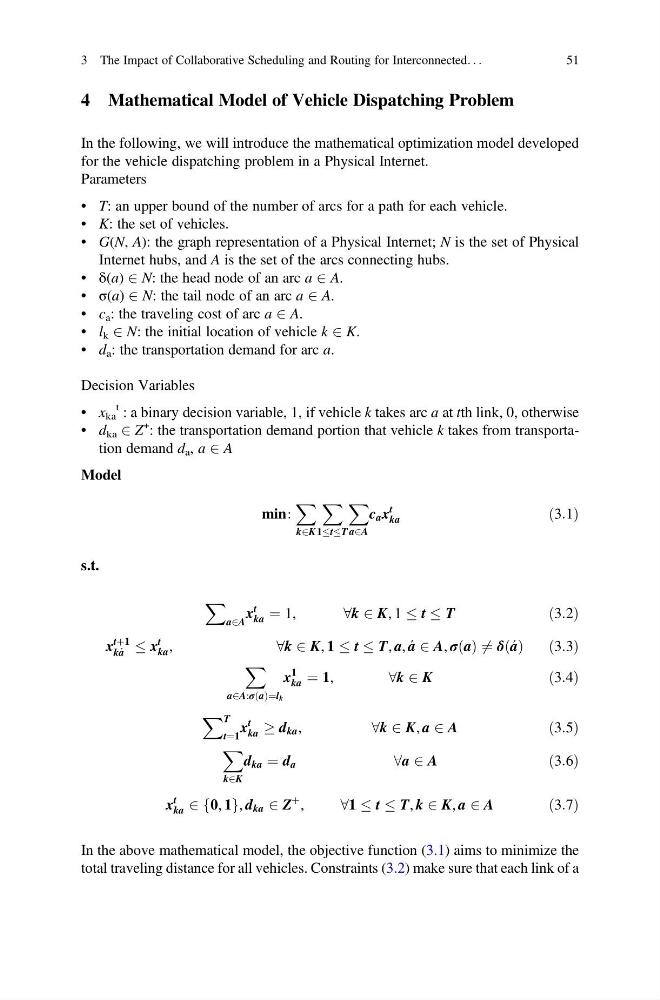
In the above mathematical model, the objective function (3.1) aims to minimize the
total traveling distance for all vehicles. Constraints (3.2) make sure that each link of a
3 The Impact of Collaborative Scheduling and Routing for Interconnected. . .
51
In the following, we will introduce the mathematical optimization model developed
for the vehicle dispatching problem in a Physical Internet.
Parameters
• T: an upper bound of the number of arcs for a path for each vehicle.
• K: the set of vehicles.
• G(N, A): the graph representation of a Physical Internet; N is the set of Physical
Internet hubs, and A is the set of the arcs connecting hubs.
• δ(a) 2 N: the head node of an arc a 2 A.
• σ(a) 2 N: the tail node of an arc a 2 A.
• c a : the traveling cost of arc a 2 A.
• l k 2 N: the initial location of vehicle k 2 K.
• d a : the transportation demand for arc a.
Decision Variables
• x ka
t : a binary decision variable, 1, if vehicle k takes arc a at tth link, 0, otherwise
• d ka 2 Z
+
: the transportation demand portion that vehicle k takes from transportation demand d a , a 2 A
Model
min:
X
k2K
X
1 t T
X
a2A
c a x
t
ka
ð3:1Þ
s.t.
X
a2A
x
t
ka ¼ 1,
8k 2 K, 1 t T
ð3:2Þ
x
tþ1
k´ a
x
t
ka ,
8k 2 K, 1 t T, a, ´
a 2 A, σ a
ð Þ 6 ¼ δ ´
a
ð Þ
ð3:3Þ
X
a2A:σ a
ð Þ¼l k
x
1
ka ¼ 1,
8k 2 K
ð3:4Þ
X T
t¼1
x
t
ka ! d ka ,
8k 2 K, a 2 A
ð3:5Þ
X
k2K
d ka ¼ d a
8a 2 A
ð3:6Þ
x
t
ka 2 0, 1
f g, d ka 2 Z
þ ,
81 t T, k 2 K, a 2 A
ð3:7Þ
In the above mathematical model, the objective function (3.1) aims to minimize the
total traveling distance for all vehicles. Constraints (3.2) make sure that each link of a
3 The Impact of Collaborative Scheduling and Routing for Interconnected. . .
51