

First of all, we examine the performances of both approaches to evaluate
BinPackingFeasible(r,i, j). After some trials, it turns out that even for relatively
small-scale problems, the constraint programming method spent a few dozen of
minutes to get the solutions. In contrast, the Bottom-Left-First heuristic is quite fast.
Hence, we only use the Bottom-Left-First heuristic to evaluate BinPackingFeasible
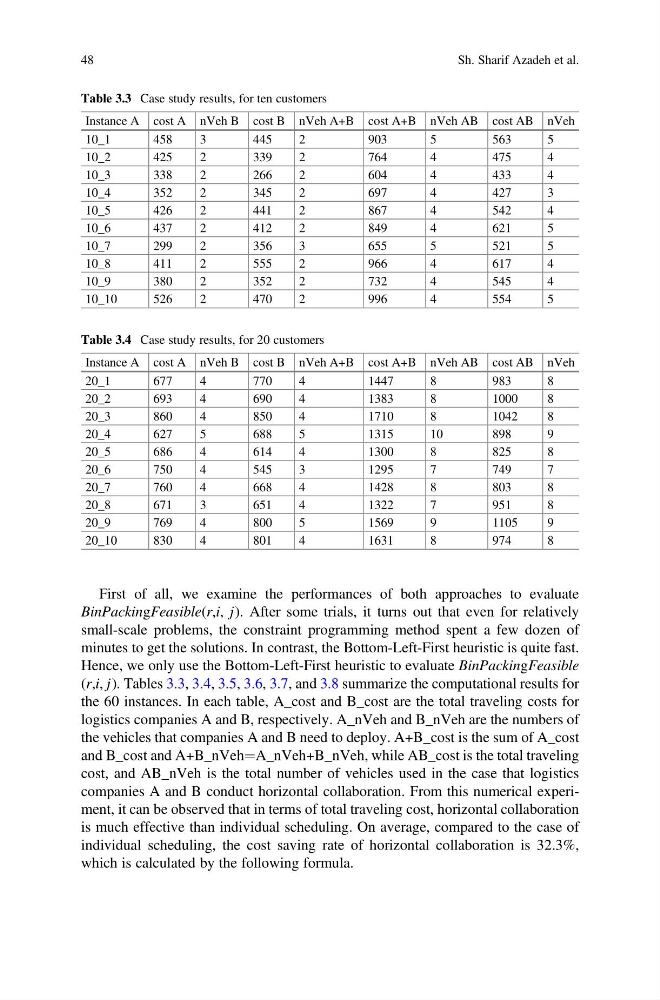
(r,i, j). Tables 3.3, 3.4, 3.5, 3.6, 3.7, and 3.8 summarize the computational results for
the 60 instances. In each table, A_cost and B_cost are the total traveling costs for
logistics companies A and B, respectively. A_nVeh and B_nVeh are the numbers of
the vehicles that companies A and B need to deploy. A+B_cost is the sum of A_cost
and B_cost and A+B_nVeh¼A_nVeh+B_nVeh, while AB_cost is the total traveling
cost, and AB_nVeh is the total number of vehicles used in the case that logistics
companies A and B conduct horizontal collaboration. From this numerical experiment, it can be observed that in terms of total traveling cost, horizontal collaboration
is much effective than individual scheduling. On average, compared to the case of
individual scheduling, the cost saving rate of horizontal collaboration is 32.3%,
which is calculated by the following formula.
Table 3.3 Case study results, for ten customers
Instance A cost A nVeh B cost B nVeh A+B cost A+B nVeh AB cost AB nVeh
10_1
458
3
445
2
903
5
563
5
10_2
425
2
339
2
764
4
475
4
10_3
338
2
266
2
604
4
433
4
10_4
352
2
345
2
697
4
427
3
10_5
426
2
441
2
867
4
542
4
10_6
437
2
412
2
849
4
621
5
10_7
299
2
356
3
655
5
521
5
10_8
411
2
555
2
966
4
617
4
10_9
380
2
352
2
732
4
545
4
10_10
526
2
470
2
996
4
554
5
Table 3.4 Case study results, for 20 customers
Instance A cost A nVeh B cost B nVeh A+B cost A+B nVeh AB cost AB nVeh
20_1
677
4
770
4
1447
8
983
8
20_2
693
4
690
4
1383
8
1000
8
20_3
860
4
850
4
1710
8
1042
8
20_4
627
5
688
5
1315
10
898
9
20_5
686
4
614
4
1300
8
825
8
20_6
750
4
545
3
1295
7
749
7
20_7
760
4
668
4
1428
8
803
8
20_8
671
3
651
4
1322
7
951
8
20_9
769
4
800
5
1569
9
1105
9
20_10
830
4
801
4
1631
8
974
8
48
Sh. Sharif Azadeh et al.
BinPackingFeasible(r,i, j). After some trials, it turns out that even for relatively
small-scale problems, the constraint programming method spent a few dozen of
minutes to get the solutions. In contrast, the Bottom-Left-First heuristic is quite fast.
Hence, we only use the Bottom-Left-First heuristic to evaluate BinPackingFeasible
(r,i, j). Tables 3.3, 3.4, 3.5, 3.6, 3.7, and 3.8 summarize the computational results for
the 60 instances. In each table, A_cost and B_cost are the total traveling costs for
logistics companies A and B, respectively. A_nVeh and B_nVeh are the numbers of
the vehicles that companies A and B need to deploy. A+B_cost is the sum of A_cost
and B_cost and A+B_nVeh¼A_nVeh+B_nVeh, while AB_cost is the total traveling
cost, and AB_nVeh is the total number of vehicles used in the case that logistics
companies A and B conduct horizontal collaboration. From this numerical experiment, it can be observed that in terms of total traveling cost, horizontal collaboration
is much effective than individual scheduling. On average, compared to the case of
individual scheduling, the cost saving rate of horizontal collaboration is 32.3%,
which is calculated by the following formula.
Table 3.3 Case study results, for ten customers
Instance A cost A nVeh B cost B nVeh A+B cost A+B nVeh AB cost AB nVeh
10_1
458
3
445
2
903
5
563
5
10_2
425
2
339
2
764
4
475
4
10_3
338
2
266
2
604
4
433
4
10_4
352
2
345
2
697
4
427
3
10_5
426
2
441
2
867
4
542
4
10_6
437
2
412
2
849
4
621
5
10_7
299
2
356
3
655
5
521
5
10_8
411
2
555
2
966
4
617
4
10_9
380
2
352
2
732
4
545
4
10_10
526
2
470
2
996
4
554
5
Table 3.4 Case study results, for 20 customers
Instance A cost A nVeh B cost B nVeh A+B cost A+B nVeh AB cost AB nVeh
20_1
677
4
770
4
1447
8
983
8
20_2
693
4
690
4
1383
8
1000
8
20_3
860
4
850
4
1710
8
1042
8
20_4
627
5
688
5
1315
10
898
9
20_5
686
4
614
4
1300
8
825
8
20_6
750
4
545
3
1295
7
749
7
20_7
760
4
668
4
1428
8
803
8
20_8
671
3
651
4
1322
7
951
8
20_9
769
4
800
5
1569
9
1105
9
20_10
830
4
801
4
1631
8
974
8
48
Sh. Sharif Azadeh et al.