

he will typically incur relatively high transportation costs. Not only are there more
shipments to move; the unit transport price will typically be higher for smaller
shipments. At the same time, stocks will remain small and inventory costs can be
kept low. Larger shipments will have the reverse effect. Firms will then optimize
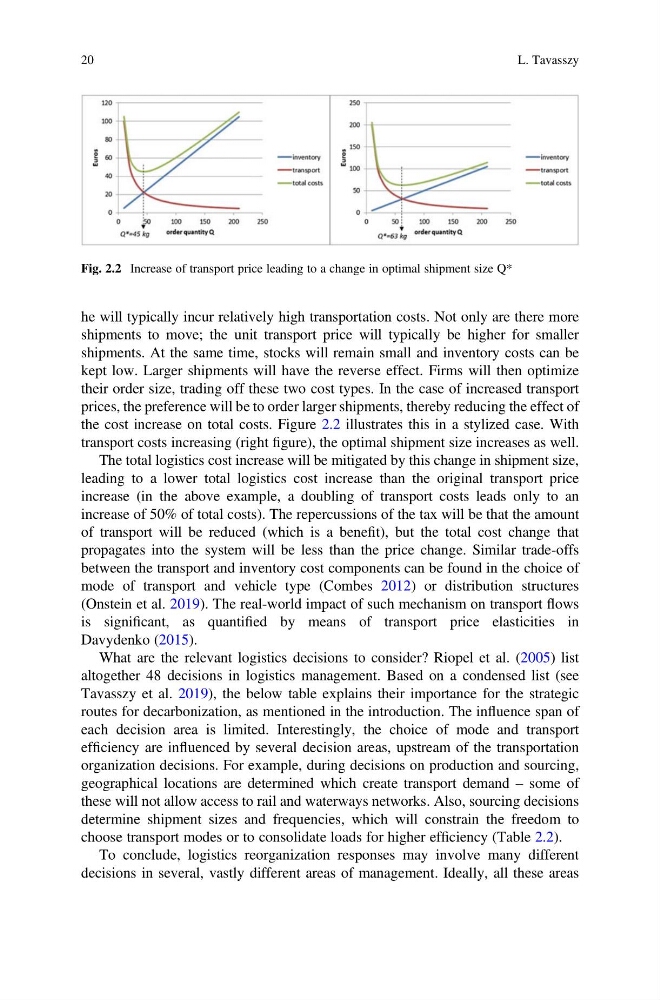
their order size, trading off these two cost types. In the case of increased transport
prices, the preference will be to order larger shipments, thereby reducing the effect of
the cost increase on total costs. Figure 2.2 illustrates this in a stylized case. With
transport costs increasing (right figure), the optimal shipment size increases as well.
The total logistics cost increase will be mitigated by this change in shipment size,
leading to a lower total logistics cost increase than the original transport price
increase (in the above example, a doubling of transport costs leads only to an
increase of 50% of total costs). The repercussions of the tax will be that the amount
of transport will be reduced (which is a benefit), but the total cost change that
propagates into the system will be less than the price change. Similar trade-offs
between the transport and inventory cost components can be found in the choice of
mode of transport and vehicle type (Combes 2012) or distribution structures
(Onstein et al. 2019). The real-world impact of such mechanism on transport flows
is significant, as quantified by means of transport price elasticities in
Davydenko (2015).
What are the relevant logistics decisions to consider? Riopel et al. (2005) list
altogether 48 decisions in logistics management. Based on a condensed list (see
Tavasszy et al. 2019), the below table explains their importance for the strategic
routes for decarbonization, as mentioned in the introduction. The influence span of
each decision area is limited. Interestingly, the choice of mode and transport
efficiency are influenced by several decision areas, upstream of the transportation
organization decisions. For example, during decisions on production and sourcing,
geographical locations are determined which create transport demand – some of
these will not allow access to rail and waterways networks. Also, sourcing decisions
determine shipment sizes and frequencies, which will constrain the freedom to
choose transport modes or to consolidate loads for higher efficiency (Table 2.2).
To conclude, logistics reorganization responses may involve many different
decisions in several, vastly different areas of management. Ideally, all these areas
Fig. 2.2 Increase of transport price leading to a change in optimal shipment size Q*
20
L. Tavasszy
shipments to move; the unit transport price will typically be higher for smaller
shipments. At the same time, stocks will remain small and inventory costs can be
kept low. Larger shipments will have the reverse effect. Firms will then optimize
their order size, trading off these two cost types. In the case of increased transport
prices, the preference will be to order larger shipments, thereby reducing the effect of
the cost increase on total costs. Figure 2.2 illustrates this in a stylized case. With
transport costs increasing (right figure), the optimal shipment size increases as well.
The total logistics cost increase will be mitigated by this change in shipment size,
leading to a lower total logistics cost increase than the original transport price
increase (in the above example, a doubling of transport costs leads only to an
increase of 50% of total costs). The repercussions of the tax will be that the amount
of transport will be reduced (which is a benefit), but the total cost change that
propagates into the system will be less than the price change. Similar trade-offs
between the transport and inventory cost components can be found in the choice of
mode of transport and vehicle type (Combes 2012) or distribution structures
(Onstein et al. 2019). The real-world impact of such mechanism on transport flows
is significant, as quantified by means of transport price elasticities in
Davydenko (2015).
What are the relevant logistics decisions to consider? Riopel et al. (2005) list
altogether 48 decisions in logistics management. Based on a condensed list (see
Tavasszy et al. 2019), the below table explains their importance for the strategic
routes for decarbonization, as mentioned in the introduction. The influence span of
each decision area is limited. Interestingly, the choice of mode and transport
efficiency are influenced by several decision areas, upstream of the transportation
organization decisions. For example, during decisions on production and sourcing,
geographical locations are determined which create transport demand – some of
these will not allow access to rail and waterways networks. Also, sourcing decisions
determine shipment sizes and frequencies, which will constrain the freedom to
choose transport modes or to consolidate loads for higher efficiency (Table 2.2).
To conclude, logistics reorganization responses may involve many different
decisions in several, vastly different areas of management. Ideally, all these areas
Fig. 2.2 Increase of transport price leading to a change in optimal shipment size Q*
20
L. Tavasszy