

2 Logistics Reorganization Responses to Carbon Pricing
The term “logistics reorganization response” was, to our knowledge, first suggested
in the US Federal Highways Administration’s (FHWA’s) Freight Benefit-Cost
Analysis Study (ICF & HLB, 2002). It concisely expresses the phenomenon that
companies will reorganize to try to mitigate adverse effects or reap potential gains of
policies on their business. This reorganization takes place by reviewing the relevant
logistics decisions and implementing changes. Although the context of the FHWA
study was to assess impacts following the principles of benefit-cost analysis, the
systematic introduction it provides to impacts on firm decision-making is valuable
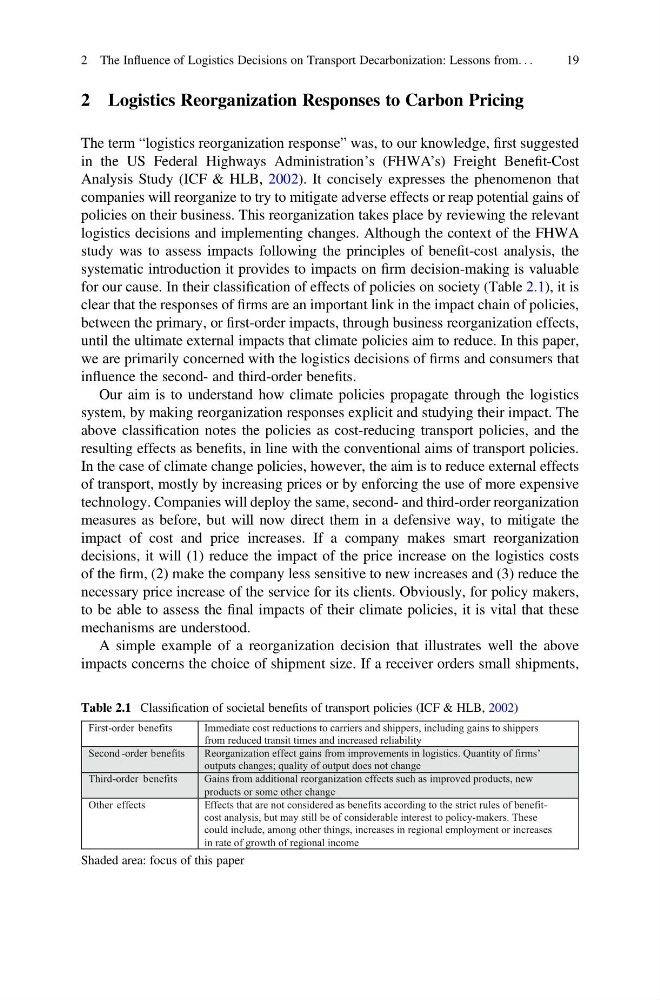
for our cause. In their classification of effects of policies on society (Table 2.1), it is
clear that the responses of firms are an important link in the impact chain of policies,
between the primary, or first-order impacts, through business reorganization effects,
until the ultimate external impacts that climate policies aim to reduce. In this paper,
we are primarily concerned with the logistics decisions of firms and consumers that
influence the second- and third-order benefits.
Our aim is to understand how climate policies propagate through the logistics
system, by making reorganization responses explicit and studying their impact. The
above classification notes the policies as cost-reducing transport policies, and the
resulting effects as benefits, in line with the conventional aims of transport policies.
In the case of climate change policies, however, the aim is to reduce external effects
of transport, mostly by increasing prices or by enforcing the use of more expensive
technology. Companies will deploy the same, second- and third-order reorganization
measures as before, but will now direct them in a defensive way, to mitigate the
impact of cost and price increases. If a company makes smart reorganization
decisions, it will (1) reduce the impact of the price increase on the logistics costs
of the firm, (2) make the company less sensitive to new increases and (3) reduce the
necessary price increase of the service for its clients. Obviously, for policy makers,
to be able to assess the final impacts of their climate policies, it is vital that these
mechanisms are understood.
A simple example of a reorganization decision that illustrates well the above
impacts concerns the choice of shipment size. If a receiver orders small shipments,
Table 2.1 Classification of societal benefits of transport policies (ICF & HLB, 2002)
First-order benefits
Immediate cost reductions to carriers and shippers, including gains to shippers
from reduced transit times and increased reliability
Second -order benefits
Reorganization effect gains from improvements in logistics. Quantity of firms’
outputs changes; quality of output does not change
Third-order benefits
Gains from additional reorganization effects such as improved products, new
products or some other change
Other effects
Effects that are not considered as benefits according to the strict rules of benefitcost analysis, but may still be of considerable interest to policy-makers. These
could include, among other things, increases in regional employment or increases
in rate of growth of regional income
Shaded area: focus of this paper
2 The Influence of Logistics Decisions on Transport Decarbonization: Lessons from. . .
19
The term “logistics reorganization response” was, to our knowledge, first suggested
in the US Federal Highways Administration’s (FHWA’s) Freight Benefit-Cost
Analysis Study (ICF & HLB, 2002). It concisely expresses the phenomenon that
companies will reorganize to try to mitigate adverse effects or reap potential gains of
policies on their business. This reorganization takes place by reviewing the relevant
logistics decisions and implementing changes. Although the context of the FHWA
study was to assess impacts following the principles of benefit-cost analysis, the
systematic introduction it provides to impacts on firm decision-making is valuable
for our cause. In their classification of effects of policies on society (Table 2.1), it is
clear that the responses of firms are an important link in the impact chain of policies,
between the primary, or first-order impacts, through business reorganization effects,
until the ultimate external impacts that climate policies aim to reduce. In this paper,
we are primarily concerned with the logistics decisions of firms and consumers that
influence the second- and third-order benefits.
Our aim is to understand how climate policies propagate through the logistics
system, by making reorganization responses explicit and studying their impact. The
above classification notes the policies as cost-reducing transport policies, and the
resulting effects as benefits, in line with the conventional aims of transport policies.
In the case of climate change policies, however, the aim is to reduce external effects
of transport, mostly by increasing prices or by enforcing the use of more expensive
technology. Companies will deploy the same, second- and third-order reorganization
measures as before, but will now direct them in a defensive way, to mitigate the
impact of cost and price increases. If a company makes smart reorganization
decisions, it will (1) reduce the impact of the price increase on the logistics costs
of the firm, (2) make the company less sensitive to new increases and (3) reduce the
necessary price increase of the service for its clients. Obviously, for policy makers,
to be able to assess the final impacts of their climate policies, it is vital that these
mechanisms are understood.
A simple example of a reorganization decision that illustrates well the above
impacts concerns the choice of shipment size. If a receiver orders small shipments,
Table 2.1 Classification of societal benefits of transport policies (ICF & HLB, 2002)
First-order benefits
Immediate cost reductions to carriers and shippers, including gains to shippers
from reduced transit times and increased reliability
Second -order benefits
Reorganization effect gains from improvements in logistics. Quantity of firms’
outputs changes; quality of output does not change
Third-order benefits
Gains from additional reorganization effects such as improved products, new
products or some other change
Other effects
Effects that are not considered as benefits according to the strict rules of benefitcost analysis, but may still be of considerable interest to policy-makers. These
could include, among other things, increases in regional employment or increases
in rate of growth of regional income
Shaded area: focus of this paper
2 The Influence of Logistics Decisions on Transport Decarbonization: Lessons from. . .
19