

3.1 ISM (Interpretive Structural Modeling)
ISM is a powerful technique for determining the interrelationship among variables
and is backed by the concepts of reachability matrix and transitivity relationship
among variables (Warfield 1974). These two concepts can be understood using the
following example: suppose we have three variables “i,” “j,” and “k”; here we
assume that variable “i” is driving variable “j” and variable “k” is driven by “j” as
well as “i”; then the relationship between “i” and “j” as well as “j” and “k” can be
shown by two arrows with arrowhead pointing toward “j” and “k,” respectively. In
this case, the relationship between “i” and “j” need not be shown using an arrow.
Reachability grid helps in making the different levels in ISM. The different steps
followed in ISM are discussed below (Al-Muftah et al. 2018; Hughes et al. 2019;
Malek and Desai 2019).
Step 1: Development of a Structural Self-Interaction Matrix (SSIM)
In order to analyze the relationship among factors considered in the study, a
contextual relationship of “leads to” type is chosen. For identification of contextual
relationship, a group of experts are consulted. Four different letters are used to
represent the direction of the relationship between the variables i and j:
Literature Review
Field surveys and expert
opinion
Finalization of barriers
Application of ISM to select barriers on the basis of
driving power and also to establish a hierarchal structure among barriers
Application of best worst method to
rank the barriers and obtain weights
of each barrier
Ranking of the organizations w.r.t
these barrier using VIKOR method
Phase 1
Phase 2
Phase 3
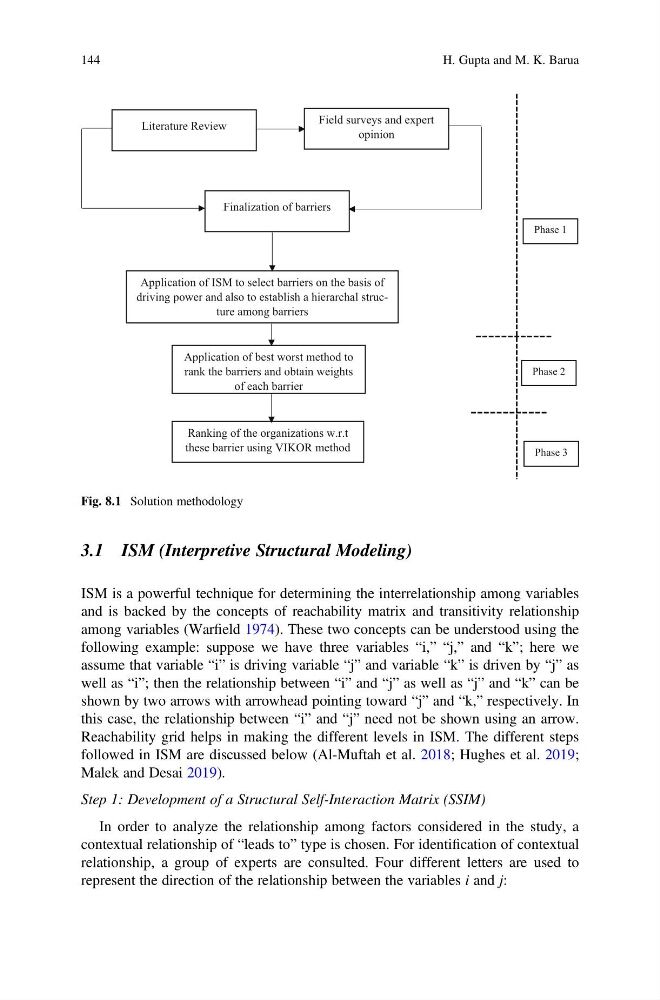
Fig. 8.1 Solution methodology
144
H. Gupta and M. K. Barua
ISM is a powerful technique for determining the interrelationship among variables
and is backed by the concepts of reachability matrix and transitivity relationship
among variables (Warfield 1974). These two concepts can be understood using the
following example: suppose we have three variables “i,” “j,” and “k”; here we
assume that variable “i” is driving variable “j” and variable “k” is driven by “j” as
well as “i”; then the relationship between “i” and “j” as well as “j” and “k” can be
shown by two arrows with arrowhead pointing toward “j” and “k,” respectively. In
this case, the relationship between “i” and “j” need not be shown using an arrow.
Reachability grid helps in making the different levels in ISM. The different steps
followed in ISM are discussed below (Al-Muftah et al. 2018; Hughes et al. 2019;
Malek and Desai 2019).
Step 1: Development of a Structural Self-Interaction Matrix (SSIM)
In order to analyze the relationship among factors considered in the study, a
contextual relationship of “leads to” type is chosen. For identification of contextual
relationship, a group of experts are consulted. Four different letters are used to
represent the direction of the relationship between the variables i and j:
Literature Review
Field surveys and expert
opinion
Finalization of barriers
Application of ISM to select barriers on the basis of
driving power and also to establish a hierarchal structure among barriers
Application of best worst method to
rank the barriers and obtain weights
of each barrier
Ranking of the organizations w.r.t
these barrier using VIKOR method
Phase 1
Phase 2
Phase 3
Fig. 8.1 Solution methodology
144
H. Gupta and M. K. Barua