

for supplier development and improvement strategies, providing feedback to suppliers after evaluation is very crucial and important, and it can help suppliers in
identifying their own weaknesses.
4 Challenges in Implementing Sustainable Supplier
Segmentation
Most buyer companies in the supplier relationship process only consider the stages
up to supplier selection and ignore or fail in implementing the stages of segmentation, improvement, and evaluation, which are among the key stages in the supplier
relationship process. Therefore, the sustainable supplier segmentation faces challenges, most of which are related to supplier development and improvement stage.
The most important challenges in this respect include lack of support from senior
management of both buyer and supplier companies, unwillingness to share knowledge and information, lack of sufficient knowledge related to sustainability issues,
suppliers’ lack of innovative capabilities, lack of effective communications between
buyer and supplier, lack of open and interactive corporate culture, locational distance
between buyer and supplier, economic and social differences between buyer and
supplier, supplier’s unwillingness to cooperate and improve relationships, and
inconsistency of the buyer and supplier companies’ long-term goals of corporate
supply chain (Ağan et al. 2018; Rezaei 2018). By managing and improving the set of
factors identified by buyer and supplier companies for development, both supplier
and buyer benefit from positive performance impacts. On the other hand, some buyer
companies are also unable to make a balance between sustainability dimensions for
segmentation and to determine improvement strategies in each dimension and
cannot provide an appropriate solution for supplier evaluation and segmentation.
Companies should note that at the time of evaluating suppliers, paying simultaneous
attention to all three dimensions of sustainability may affect the required allocated
resources. In other words, paying attention to social and environmental indicators
may lead to higher costs and affect the economic dimension of the evaluation.
Therefore, the use of proper decision-making techniques can minimize the negative
effects of decision-making.
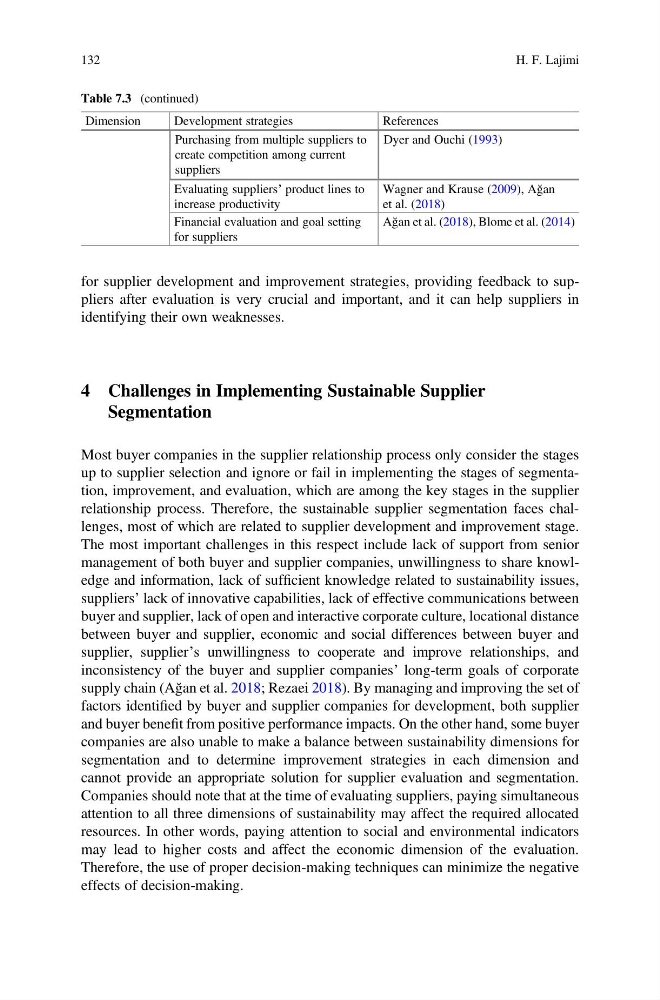
Table 7.3 (continued)
Dimension
Development strategies
References
Purchasing from multiple suppliers to
create competition among current
suppliers
Dyer and Ouchi (1993)
Evaluating suppliers’ product lines to
increase productivity
Wagner and Krause (2009), Ağan
et al. (2018)
Financial evaluation and goal setting
for suppliers
Ağan et al. (2018), Blome et al. (2014)
132
H. F. Lajimi
identifying their own weaknesses.
4 Challenges in Implementing Sustainable Supplier
Segmentation
Most buyer companies in the supplier relationship process only consider the stages
up to supplier selection and ignore or fail in implementing the stages of segmentation, improvement, and evaluation, which are among the key stages in the supplier
relationship process. Therefore, the sustainable supplier segmentation faces challenges, most of which are related to supplier development and improvement stage.
The most important challenges in this respect include lack of support from senior
management of both buyer and supplier companies, unwillingness to share knowledge and information, lack of sufficient knowledge related to sustainability issues,
suppliers’ lack of innovative capabilities, lack of effective communications between
buyer and supplier, lack of open and interactive corporate culture, locational distance
between buyer and supplier, economic and social differences between buyer and
supplier, supplier’s unwillingness to cooperate and improve relationships, and
inconsistency of the buyer and supplier companies’ long-term goals of corporate
supply chain (Ağan et al. 2018; Rezaei 2018). By managing and improving the set of
factors identified by buyer and supplier companies for development, both supplier
and buyer benefit from positive performance impacts. On the other hand, some buyer
companies are also unable to make a balance between sustainability dimensions for
segmentation and to determine improvement strategies in each dimension and
cannot provide an appropriate solution for supplier evaluation and segmentation.
Companies should note that at the time of evaluating suppliers, paying simultaneous
attention to all three dimensions of sustainability may affect the required allocated
resources. In other words, paying attention to social and environmental indicators
may lead to higher costs and affect the economic dimension of the evaluation.
Therefore, the use of proper decision-making techniques can minimize the negative
effects of decision-making.
Table 7.3 (continued)
Dimension
Development strategies
References
Purchasing from multiple suppliers to
create competition among current
suppliers
Dyer and Ouchi (1993)
Evaluating suppliers’ product lines to
increase productivity
Wagner and Krause (2009), Ağan
et al. (2018)
Financial evaluation and goal setting
for suppliers
Ağan et al. (2018), Blome et al. (2014)
132
H. F. Lajimi