

these techniques are analytic hierarchy process (AHP) (Luthra et al. 2017), analytic
network process (ANP) (Tavana et al. 2017), DEMATEL (Su et al. 2016), and BestWorst Method (BWM) (Garg and Sharma 2018). After determining the technique,
the related questionnaire will be prepared and given to the experts/decision-makers
to rate the criteria. After collecting the data, in accordance with the rules governing
the technique, weights of indices will be obtained. The importance of each indicator
varies according to its role in different industries.
3.3 Selection of the Qualified Suppliers
At this stage, it is necessary to select the suppliers that meet the minimum requirements and then evaluate them in the next stage (segmentation). Some companies,
empirically and based on the previous operating experience of the suppliers, determine this list of suppliers. But recent approaches to supplier selection indicate that
companies such as Deutsche Bahn identify qualified suppliers using scientific
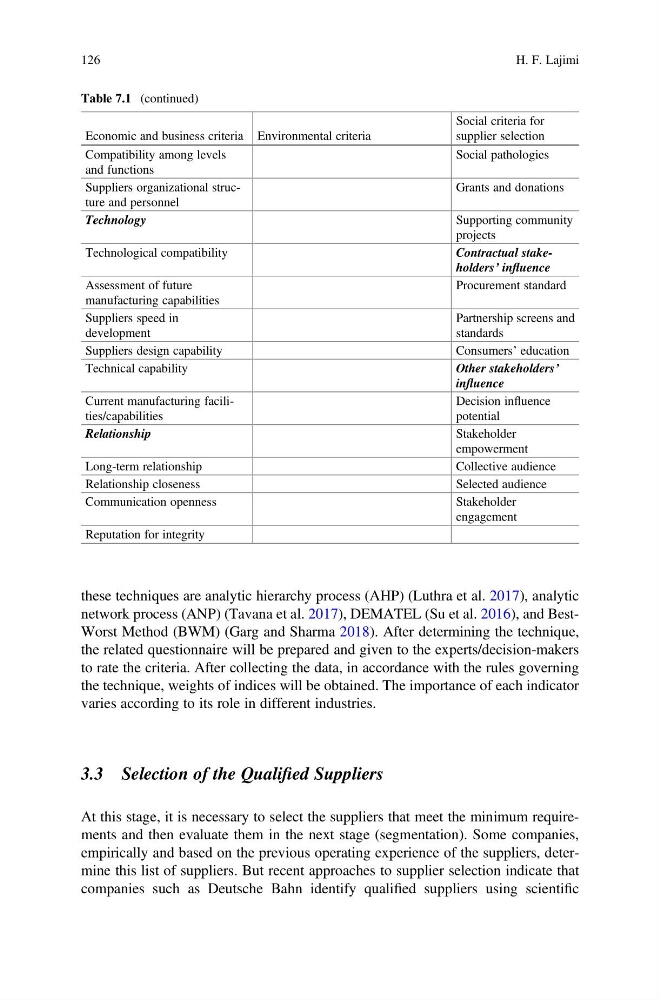
Table 7.1 (continued)
Economic and business criteria Environmental criteria
Social criteria for
supplier selection
Compatibility among levels
and functions
Social pathologies
Suppliers organizational structure and personnel
Grants and donations
Technology
Supporting community
projects
Technological compatibility
Contractual stakeholders’ influence
Assessment of future
manufacturing capabilities
Procurement standard
Suppliers speed in
development
Partnership screens and
standards
Suppliers design capability
Consumers’ education
Technical capability
Other stakeholders’
influence
Current manufacturing facilities/capabilities
Decision influence
potential
Relationship
Stakeholder
empowerment
Long-term relationship
Collective audience
Relationship closeness
Selected audience
Communication openness
Stakeholder
engagement
Reputation for integrity
126
H. F. Lajimi
network process (ANP) (Tavana et al. 2017), DEMATEL (Su et al. 2016), and BestWorst Method (BWM) (Garg and Sharma 2018). After determining the technique,
the related questionnaire will be prepared and given to the experts/decision-makers
to rate the criteria. After collecting the data, in accordance with the rules governing
the technique, weights of indices will be obtained. The importance of each indicator
varies according to its role in different industries.
3.3 Selection of the Qualified Suppliers
At this stage, it is necessary to select the suppliers that meet the minimum requirements and then evaluate them in the next stage (segmentation). Some companies,
empirically and based on the previous operating experience of the suppliers, determine this list of suppliers. But recent approaches to supplier selection indicate that
companies such as Deutsche Bahn identify qualified suppliers using scientific
Table 7.1 (continued)
Economic and business criteria Environmental criteria
Social criteria for
supplier selection
Compatibility among levels
and functions
Social pathologies
Suppliers organizational structure and personnel
Grants and donations
Technology
Supporting community
projects
Technological compatibility
Contractual stakeholders’ influence
Assessment of future
manufacturing capabilities
Procurement standard
Suppliers speed in
development
Partnership screens and
standards
Suppliers design capability
Consumers’ education
Technical capability
Other stakeholders’
influence
Current manufacturing facilities/capabilities
Decision influence
potential
Relationship
Stakeholder
empowerment
Long-term relationship
Collective audience
Relationship closeness
Selected audience
Communication openness
Stakeholder
engagement
Reputation for integrity
126
H. F. Lajimi