

4.7.2 MCDA Method
An extension of the ELECTRE III method for taking into account criteria interactions has been applied for the problem under examination (Figueira et al. 2009). In
particular, three types of interaction are considered in the evaluation: mutual
strengthening, mutual weakening and antagonistic effect. A mutual strengthening
(or synergy) between two criteria occurs when the importance of the criteria together
is greater than the sum of the importance of the two criteria considered separately;
conversely, a mutual weakening (or redundancy) between two criteria occurs when
the importance of the criteria together is smaller than the sum of the importance of
the two criteria considered separately; finally, the antagonistic effect is able to model
the situations in which two criteria are strongly divergent.
Starting from the overall objective of the analysis, which is the identification of
the most sustainable project for the reuse of the abandoned quarry, a coherent set or
family of criteria that reflects all the concerns relevant to the decision problem has
been identified, considering the relevant literature in the field of environmental
planning and the requirements coming from the legislative framework in the context
of Environmental Impact Assessment. The model is based on qualitative and
quantitative criteria which include investment cost, profitability, new services for
the population, landscape ecology effects, environmental impacts and consistency
with local planning requirements. A focus group of experts (in economic evaluation,
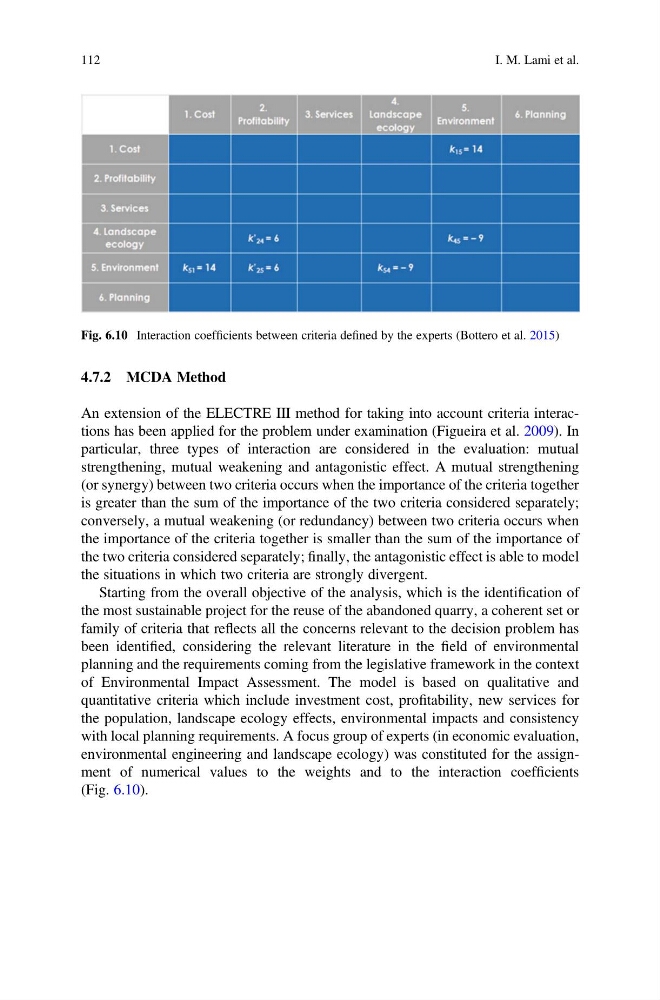
environmental engineering and landscape ecology) was constituted for the assignment of numerical values to the weights and to the interaction coefficients
(Fig. 6.10).
Fig. 6.10 Interaction coefficients between criteria defined by the experts (Bottero et al. 2015)
112
I. M. Lami et al.
An extension of the ELECTRE III method for taking into account criteria interactions has been applied for the problem under examination (Figueira et al. 2009). In
particular, three types of interaction are considered in the evaluation: mutual
strengthening, mutual weakening and antagonistic effect. A mutual strengthening
(or synergy) between two criteria occurs when the importance of the criteria together
is greater than the sum of the importance of the two criteria considered separately;
conversely, a mutual weakening (or redundancy) between two criteria occurs when
the importance of the criteria together is smaller than the sum of the importance of
the two criteria considered separately; finally, the antagonistic effect is able to model
the situations in which two criteria are strongly divergent.
Starting from the overall objective of the analysis, which is the identification of
the most sustainable project for the reuse of the abandoned quarry, a coherent set or
family of criteria that reflects all the concerns relevant to the decision problem has
been identified, considering the relevant literature in the field of environmental
planning and the requirements coming from the legislative framework in the context
of Environmental Impact Assessment. The model is based on qualitative and
quantitative criteria which include investment cost, profitability, new services for
the population, landscape ecology effects, environmental impacts and consistency
with local planning requirements. A focus group of experts (in economic evaluation,
environmental engineering and landscape ecology) was constituted for the assignment of numerical values to the weights and to the interaction coefficients
(Fig. 6.10).
Fig. 6.10 Interaction coefficients between criteria defined by the experts (Bottero et al. 2015)
112
I. M. Lami et al.