

repositioning the city of Turin was the decision to put culture—intended primarily as
an identity element of the territory—at the centre of its transformation and internationalization process. In this perspective, a set of 15 places was considered, including
underused buildings and abandoned open spaces characterized by a current state of
disuse, but with different surfaces and conditions. They included former factories,
churches, villas, public buildings, entertainment buildings and open-air spaces. In
this context, the DM wanted to define the most appropriate cultural destination
(among six categories defined) for the fifteen places considered.
4.5.2 MCDA Method
The problem at hand was a nominal classification problem, in which the categories
are not preferentially ordered. In fact, no preference order exists among the kind of
events to each building to be reused can be assigned. The aim was to know which are
the most appropriate events to each building taking into account its specific characteristics. The CAT-SD (CATegorization by Similarity-Dissimilarity) method has
been used, based on similarity and dissimilarity concepts, in order to help a DM to
deal with multiple criteria nominal classification problems (Costa et al. 2018). This
method was designed for aiding the DM to classify actions (or alternatives) into not
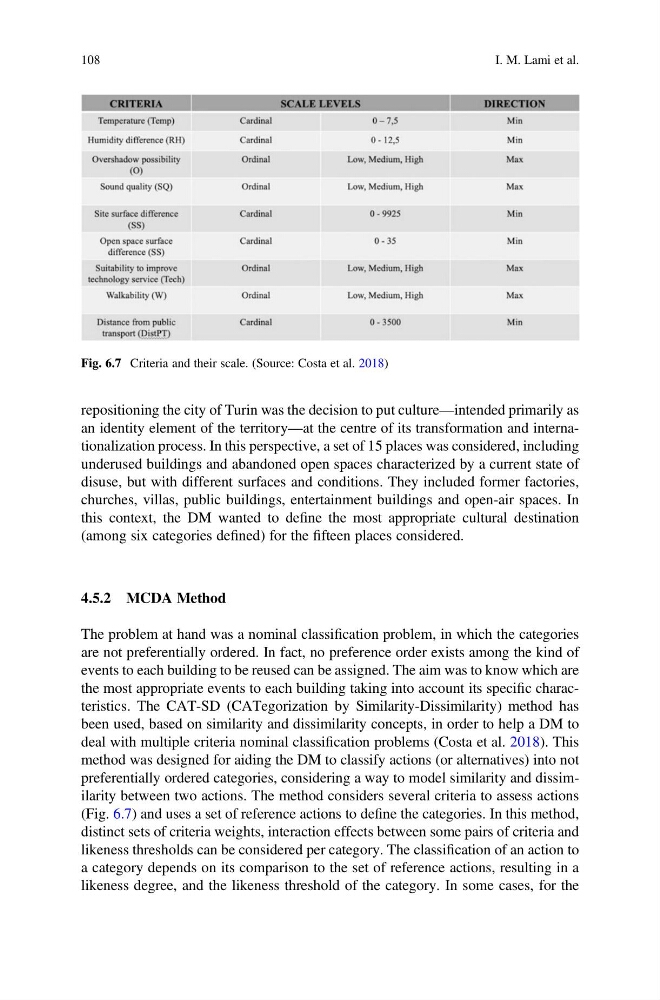
preferentially ordered categories, considering a way to model similarity and dissimilarity between two actions. The method considers several criteria to assess actions
(Fig. 6.7) and uses a set of reference actions to define the categories. In this method,
distinct sets of criteria weights, interaction effects between some pairs of criteria and
likeness thresholds can be considered per category. The classification of an action to
a category depends on its comparison to the set of reference actions, resulting in a
likeness degree, and the likeness threshold of the category. In some cases, for the
Fig. 6.7 Criteria and their scale. (Source: Costa et al. 2018)
108
I. M. Lami et al.
an identity element of the territory—at the centre of its transformation and internationalization process. In this perspective, a set of 15 places was considered, including
underused buildings and abandoned open spaces characterized by a current state of
disuse, but with different surfaces and conditions. They included former factories,
churches, villas, public buildings, entertainment buildings and open-air spaces. In
this context, the DM wanted to define the most appropriate cultural destination
(among six categories defined) for the fifteen places considered.
4.5.2 MCDA Method
The problem at hand was a nominal classification problem, in which the categories
are not preferentially ordered. In fact, no preference order exists among the kind of
events to each building to be reused can be assigned. The aim was to know which are
the most appropriate events to each building taking into account its specific characteristics. The CAT-SD (CATegorization by Similarity-Dissimilarity) method has
been used, based on similarity and dissimilarity concepts, in order to help a DM to
deal with multiple criteria nominal classification problems (Costa et al. 2018). This
method was designed for aiding the DM to classify actions (or alternatives) into not
preferentially ordered categories, considering a way to model similarity and dissimilarity between two actions. The method considers several criteria to assess actions
(Fig. 6.7) and uses a set of reference actions to define the categories. In this method,
distinct sets of criteria weights, interaction effects between some pairs of criteria and
likeness thresholds can be considered per category. The classification of an action to
a category depends on its comparison to the set of reference actions, resulting in a
likeness degree, and the likeness threshold of the category. In some cases, for the
Fig. 6.7 Criteria and their scale. (Source: Costa et al. 2018)
108
I. M. Lami et al.