

4.2.3 Results and Role Played by the MCDA
The reduction from 39 sites to 2 satisfactory solutions is a remarkable achievement
for this kind of decision problem. This is particularly true since the selection process
is based on arguments supported by a mathematical model allowing the DM to
increase the awareness of the problem and to be able to justify the selection with
strong arguments that can be clearly communicated.
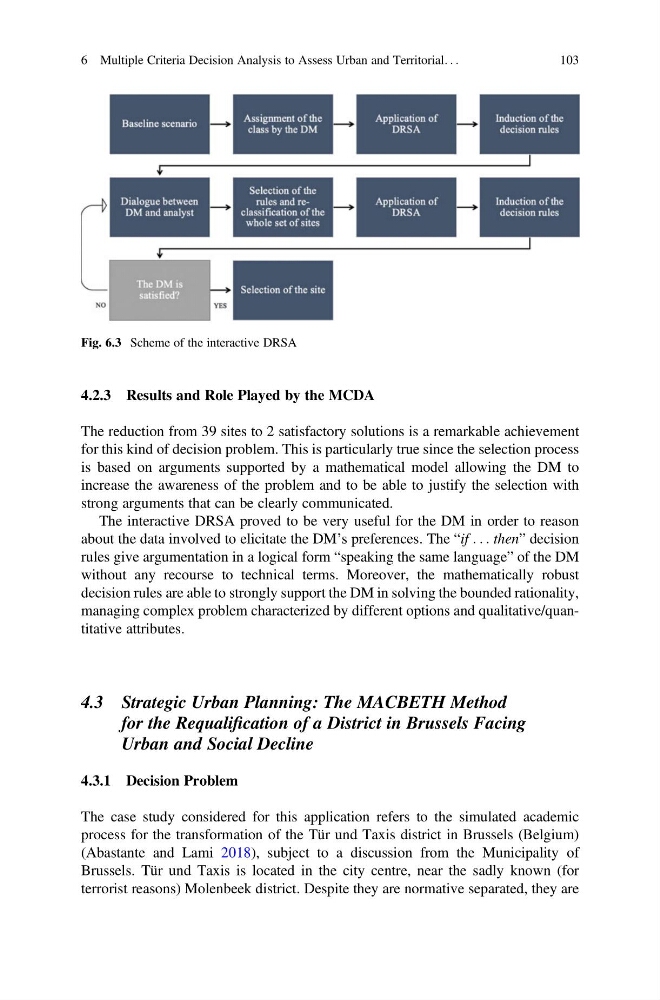
The interactive DRSA proved to be very useful for the DM in order to reason
about the data involved to elicitate the DM’s preferences. The “if . . . then” decision
rules give argumentation in a logical form “speaking the same language” of the DM
without any recourse to technical terms. Moreover, the mathematically robust
decision rules are able to strongly support the DM in solving the bounded rationality,
managing complex problem characterized by different options and qualitative/quantitative attributes.
4.3 Strategic Urban Planning: The MACBETH Method
for the Requalification of a District in Brussels Facing
Urban and Social Decline
4.3.1 Decision Problem
The case study considered for this application refers to the simulated academic
process for the transformation of the Tür und Taxis district in Brussels (Belgium)
(Abastante and Lami 2018), subject to a discussion from the Municipality of
Brussels. Tür und Taxis is located in the city centre, near the sadly known (for
terrorist reasons) Molenbeek district. Despite they are normative separated, they are
Fig. 6.3 Scheme of the interactive DRSA
6 Multiple Criteria Decision Analysis to Assess Urban and Territorial. . .
103
The reduction from 39 sites to 2 satisfactory solutions is a remarkable achievement
for this kind of decision problem. This is particularly true since the selection process
is based on arguments supported by a mathematical model allowing the DM to
increase the awareness of the problem and to be able to justify the selection with
strong arguments that can be clearly communicated.
The interactive DRSA proved to be very useful for the DM in order to reason
about the data involved to elicitate the DM’s preferences. The “if . . . then” decision
rules give argumentation in a logical form “speaking the same language” of the DM
without any recourse to technical terms. Moreover, the mathematically robust
decision rules are able to strongly support the DM in solving the bounded rationality,
managing complex problem characterized by different options and qualitative/quantitative attributes.
4.3 Strategic Urban Planning: The MACBETH Method
for the Requalification of a District in Brussels Facing
Urban and Social Decline
4.3.1 Decision Problem
The case study considered for this application refers to the simulated academic
process for the transformation of the Tür und Taxis district in Brussels (Belgium)
(Abastante and Lami 2018), subject to a discussion from the Municipality of
Brussels. Tür und Taxis is located in the city centre, near the sadly known (for
terrorist reasons) Molenbeek district. Despite they are normative separated, they are
Fig. 6.3 Scheme of the interactive DRSA
6 Multiple Criteria Decision Analysis to Assess Urban and Territorial. . .
103