

90
3 Luminescent Mechanochromism of a Chiral Complex: Distinct …
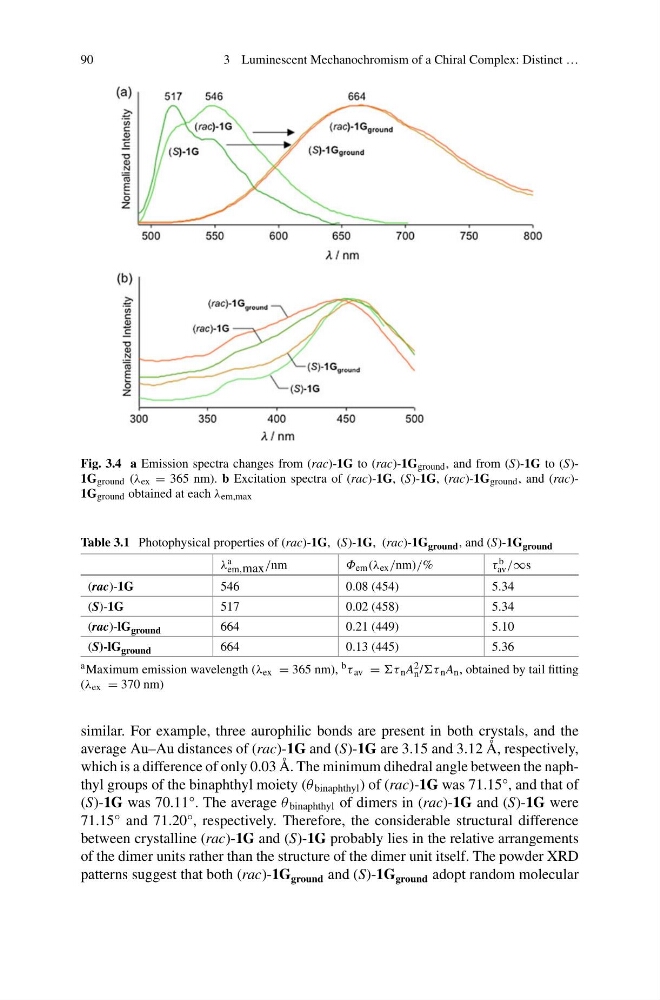
Fig. 3.4 a Emission spectra changes from (rac)-1G to (rac)-1G ground , and from (S)-1G to (S)1G ground (λ ex = 365 nm). b Excitation spectra of (rac)-1G, (S)-1G, (rac)-1G ground , and (rac)1G ground obtained at each λ em,max
Table 3.1 Photophysical properties of (rac)-1G, (S)-1G, (rac)-1G ground , and (S)-1G ground
λ a
em,max /nm
Φ em (λ ex /nm)/%
τ b
av /∞s
(rac)-1G
546
0.08 (454)
5.34
(S)-1G
517
0.02 (458)
5.34
(rac)-lG ground
664
0.21 (449)
5.10
(S)-lG ground
664
0.13 (445)
5.36
a Maximum emission wavelength (λ ex = 365 nm), b τ av = τ n A 2
n /τ n A n , obtained by tail fitting
(λ ex = 370 nm)
similar. For example, three aurophilic bonds are present in both crystals, and the
average Au–Au distances of (rac)-1G and (S)-1G are 3.15 and 3.12 Å, respectively,
which is a difference of only 0.03 Å. The minimum dihedral angle between the naphthyl groups of the binaphthyl moiety (θ binaphthyl ) of (rac)-1G was 71.15°, and that of
(S)-1G was 70.11°. The average θ binaphthyl of dimers in (rac)-1G and (S)-1G were
71.15° and 71.20°, respectively. Therefore, the considerable structural difference
between crystalline (rac)-1G and (S)-1G probably lies in the relative arrangements
of the dimer units rather than the structure of the dimer unit itself. The powder XRD
patterns suggest that both (rac)-1G ground and (S)-1G ground adopt random molecular
3 Luminescent Mechanochromism of a Chiral Complex: Distinct …
Fig. 3.4 a Emission spectra changes from (rac)-1G to (rac)-1G ground , and from (S)-1G to (S)1G ground (λ ex = 365 nm). b Excitation spectra of (rac)-1G, (S)-1G, (rac)-1G ground , and (rac)1G ground obtained at each λ em,max
Table 3.1 Photophysical properties of (rac)-1G, (S)-1G, (rac)-1G ground , and (S)-1G ground
λ a
em,max /nm
Φ em (λ ex /nm)/%
τ b
av /∞s
(rac)-1G
546
0.08 (454)
5.34
(S)-1G
517
0.02 (458)
5.34
(rac)-lG ground
664
0.21 (449)
5.10
(S)-lG ground
664
0.13 (445)
5.36
a Maximum emission wavelength (λ ex = 365 nm), b τ av = τ n A 2
n /τ n A n , obtained by tail fitting
(λ ex = 370 nm)
similar. For example, three aurophilic bonds are present in both crystals, and the
average Au–Au distances of (rac)-1G and (S)-1G are 3.15 and 3.12 Å, respectively,
which is a difference of only 0.03 Å. The minimum dihedral angle between the naphthyl groups of the binaphthyl moiety (θ binaphthyl ) of (rac)-1G was 71.15°, and that of
(S)-1G was 70.11°. The average θ binaphthyl of dimers in (rac)-1G and (S)-1G were
71.15° and 71.20°, respectively. Therefore, the considerable structural difference
between crystalline (rac)-1G and (S)-1G probably lies in the relative arrangements
of the dimer units rather than the structure of the dimer unit itself. The powder XRD
patterns suggest that both (rac)-1G ground and (S)-1G ground adopt random molecular