

3.5 Luminescent Mechanochromism of (rac)-1G and (S)-1G
91
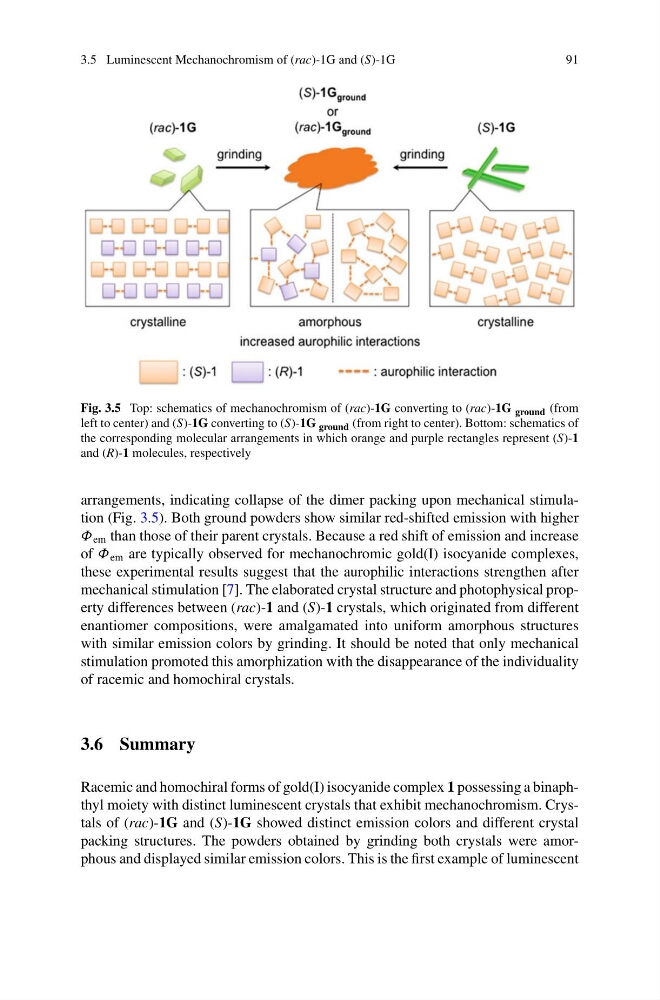
Fig. 3.5 Top: schematics of mechanochromism of (rac)-1G converting to (rac)-1G ground (from
left to center) and (S)-1G converting to (S)-1G ground (from right to center). Bottom: schematics of
the corresponding molecular arrangements in which orange and purple rectangles represent (S)-1
and (R)-1 molecules, respectively
arrangements, indicating collapse of the dimer packing upon mechanical stimulation (Fig. 3.5). Both ground powders show similar red-shifted emission with higher
Φ em than those of their parent crystals. Because a red shift of emission and increase
of Φ em are typically observed for mechanochromic gold(I) isocyanide complexes,
these experimental results suggest that the aurophilic interactions strengthen after
mechanical stimulation [7]. The elaborated crystal structure and photophysical property differences between (rac)-1 and (S)-1 crystals, which originated from different
enantiomer compositions, were amalgamated into uniform amorphous structures
with similar emission colors by grinding. It should be noted that only mechanical
stimulation promoted this amorphization with the disappearance of the individuality
of racemic and homochiral crystals.
3.6 Summary
Racemic and homochiral forms of gold(I) isocyanide complex 1 possessing a binaphthyl moiety with distinct luminescent crystals that exhibit mechanochromism. Crystals of (rac)-1G and (S)-1G showed distinct emission colors and different crystal
packing structures. The powders obtained by grinding both crystals were amorphous and displayed similar emission colors. This is the first example of luminescent
91
Fig. 3.5 Top: schematics of mechanochromism of (rac)-1G converting to (rac)-1G ground (from
left to center) and (S)-1G converting to (S)-1G ground (from right to center). Bottom: schematics of
the corresponding molecular arrangements in which orange and purple rectangles represent (S)-1
and (R)-1 molecules, respectively
arrangements, indicating collapse of the dimer packing upon mechanical stimulation (Fig. 3.5). Both ground powders show similar red-shifted emission with higher
Φ em than those of their parent crystals. Because a red shift of emission and increase
of Φ em are typically observed for mechanochromic gold(I) isocyanide complexes,
these experimental results suggest that the aurophilic interactions strengthen after
mechanical stimulation [7]. The elaborated crystal structure and photophysical property differences between (rac)-1 and (S)-1 crystals, which originated from different
enantiomer compositions, were amalgamated into uniform amorphous structures
with similar emission colors by grinding. It should be noted that only mechanical
stimulation promoted this amorphization with the disappearance of the individuality
of racemic and homochiral crystals.
3.6 Summary
Racemic and homochiral forms of gold(I) isocyanide complex 1 possessing a binaphthyl moiety with distinct luminescent crystals that exhibit mechanochromism. Crystals of (rac)-1G and (S)-1G showed distinct emission colors and different crystal
packing structures. The powders obtained by grinding both crystals were amorphous and displayed similar emission colors. This is the first example of luminescent