

88
3 Luminescent Mechanochromism of a Chiral Complex: Distinct …
3.4 Studies of Crystal Structure Alterations by Mechanical
Stimulation
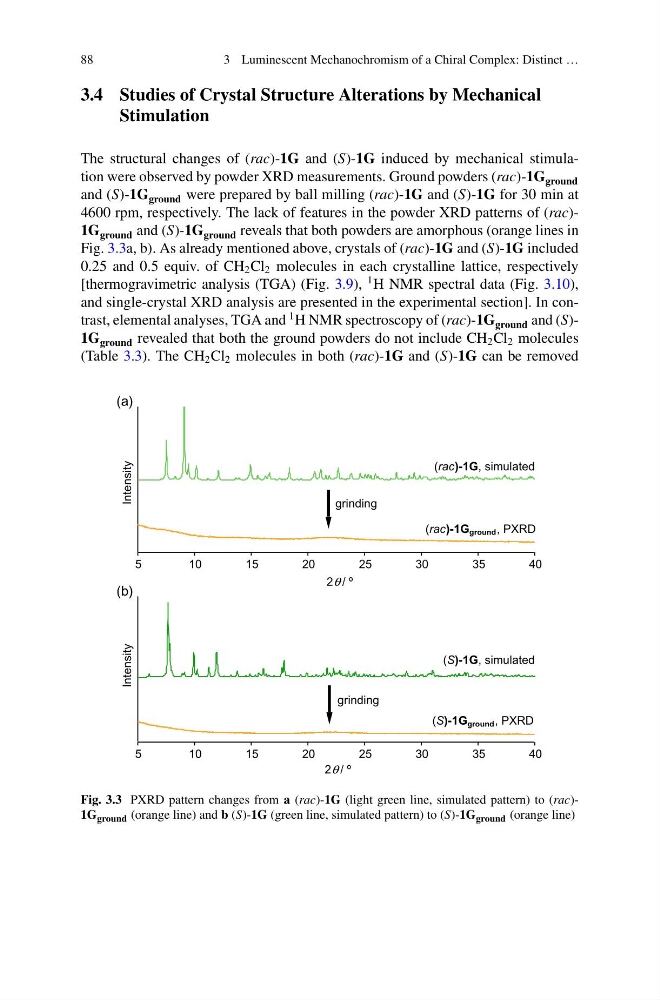
The structural changes of (rac)-1G and (S)-1G induced by mechanical stimulation were observed by powder XRD measurements. Ground powders (rac)-1G ground
and (S)-1G ground were prepared by ball milling (rac)-1G and (S)-1G for 30 min at
4600 rpm, respectively. The lack of features in the powder XRD patterns of (rac)1G ground and (S)-1G ground reveals that both powders are amorphous (orange lines in
Fig. 3.3a, b). As already mentioned above, crystals of (rac)-1G and (S)-1G included
0.25 and 0.5 equiv. of CH 2 Cl 2 molecules in each crystalline lattice, respectively
[thermogravimetric analysis (TGA) (Fig. 3.9),
1 H NMR spectral data (Fig. 3.10),
and single-crystal XRD analysis are presented in the experimental section]. In contrast, elemental analyses, TGA and
1 H NMR spectroscopy of (rac)-1G ground and (S)1G ground revealed that both the ground powders do not include CH 2 Cl 2 molecules
(Table 3.3). The CH 2 Cl 2 molecules in both (rac)-1G and (S)-1G can be removed
2θ / º
Intensity
40
35
30
25
20
15
10
5
(a)
(b)
(rac)-1G, simulated
(rac)-1G ground , PXRD
40
35
30
25
20
15
10
5
2θ / º
Intensity
(S)-1G, simulated
(S)-1G ground , PXRD
grinding
grinding
Fig. 3.3 PXRD pattern changes from a (rac)-1G (light green line, simulated pattern) to (rac)1G ground (orange line) and b (S)-1G (green line, simulated pattern) to (S)-1G ground (orange line)
3 Luminescent Mechanochromism of a Chiral Complex: Distinct …
3.4 Studies of Crystal Structure Alterations by Mechanical
Stimulation
The structural changes of (rac)-1G and (S)-1G induced by mechanical stimulation were observed by powder XRD measurements. Ground powders (rac)-1G ground
and (S)-1G ground were prepared by ball milling (rac)-1G and (S)-1G for 30 min at
4600 rpm, respectively. The lack of features in the powder XRD patterns of (rac)1G ground and (S)-1G ground reveals that both powders are amorphous (orange lines in
Fig. 3.3a, b). As already mentioned above, crystals of (rac)-1G and (S)-1G included
0.25 and 0.5 equiv. of CH 2 Cl 2 molecules in each crystalline lattice, respectively
[thermogravimetric analysis (TGA) (Fig. 3.9),
1 H NMR spectral data (Fig. 3.10),
and single-crystal XRD analysis are presented in the experimental section]. In contrast, elemental analyses, TGA and
1 H NMR spectroscopy of (rac)-1G ground and (S)1G ground revealed that both the ground powders do not include CH 2 Cl 2 molecules
(Table 3.3). The CH 2 Cl 2 molecules in both (rac)-1G and (S)-1G can be removed
2θ / º
Intensity
40
35
30
25
20
15
10
5
(a)
(b)
(rac)-1G, simulated
(rac)-1G ground , PXRD
40
35
30
25
20
15
10
5
2θ / º
Intensity
(S)-1G, simulated
(S)-1G ground , PXRD
grinding
grinding
Fig. 3.3 PXRD pattern changes from a (rac)-1G (light green line, simulated pattern) to (rac)1G ground (orange line) and b (S)-1G (green line, simulated pattern) to (S)-1G ground (orange line)