

84
3 Luminescent Mechanochromism of a Chiral Complex: Distinct …
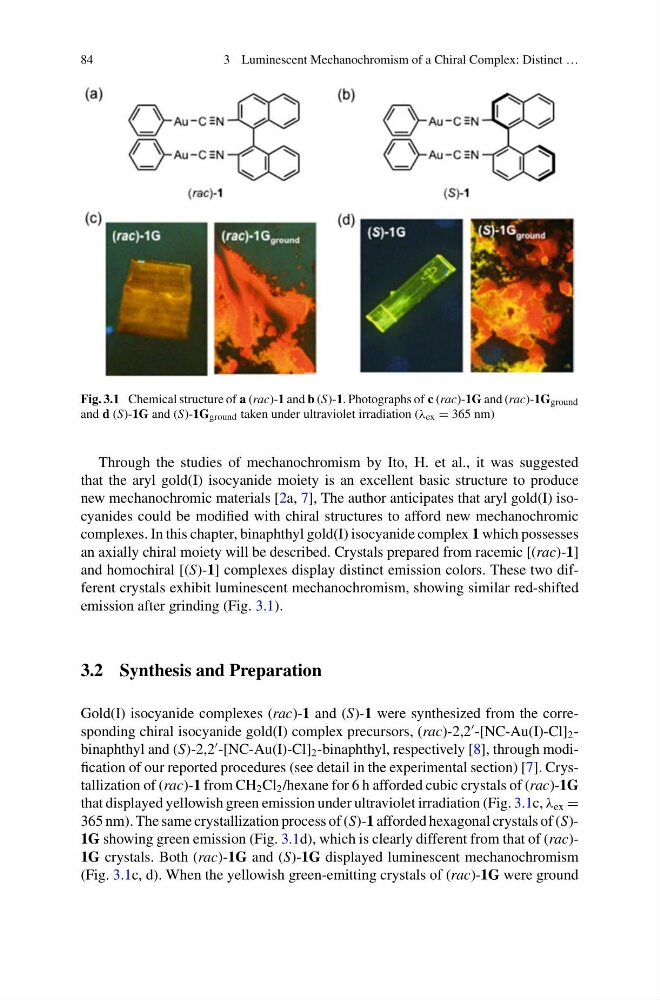
Fig. 3.1 Chemical structure of a (rac)-1 and b (S)-1. Photographs of c (rac)-1G and (rac)-1G ground
and d (S)-1G and (S)-1G ground taken under ultraviolet irradiation (λ ex = 365 nm)
Through the studies of mechanochromism by Ito, H. et al., it was suggested
that the aryl gold(I) isocyanide moiety is an excellent basic structure to produce
new mechanochromic materials [2a, 7], The author anticipates that aryl gold(I) isocyanides could be modified with chiral structures to afford new mechanochromic
complexes. In this chapter, binaphthyl gold(I) isocyanide complex 1 which possesses
an axially chiral moiety will be described. Crystals prepared from racemic [(rac)-1]
and homochiral [(S)-1] complexes display distinct emission colors. These two different crystals exhibit luminescent mechanochromism, showing similar red-shifted
emission after grinding (Fig. 3.1).
3.2 Synthesis and Preparation
Gold(I) isocyanide complexes (rac)-1 and (S)-1 were synthesized from the corresponding chiral isocyanide gold(I) complex precursors, (rac)-2,2
-[NC-Au(I)-Cl] 2 -
binaphthyl and (S)-2,2
-[NC-Au(I)-Cl] 2 -binaphthyl, respectively [8], through modification of our reported procedures (see detail in the experimental section) [7]. Crystallization of (rac)-1 from CH 2 Cl 2 /hexane for 6 h afforded cubic crystals of (rac)-1G
that displayed yellowish green emission under ultraviolet irradiation (Fig. 3.1c, λ ex =
365 nm). The same crystallization process of (S)-1 afforded hexagonal crystals of (S)1G showing green emission (Fig. 3.1d), which is clearly different from that of (rac)1G crystals. Both (rac)-1G and (S)-1G displayed luminescent mechanochromism
(Fig. 3.1c, d). When the yellowish green-emitting crystals of (rac)-1G were ground
3 Luminescent Mechanochromism of a Chiral Complex: Distinct …
Fig. 3.1 Chemical structure of a (rac)-1 and b (S)-1. Photographs of c (rac)-1G and (rac)-1G ground
and d (S)-1G and (S)-1G ground taken under ultraviolet irradiation (λ ex = 365 nm)
Through the studies of mechanochromism by Ito, H. et al., it was suggested
that the aryl gold(I) isocyanide moiety is an excellent basic structure to produce
new mechanochromic materials [2a, 7], The author anticipates that aryl gold(I) isocyanides could be modified with chiral structures to afford new mechanochromic
complexes. In this chapter, binaphthyl gold(I) isocyanide complex 1 which possesses
an axially chiral moiety will be described. Crystals prepared from racemic [(rac)-1]
and homochiral [(S)-1] complexes display distinct emission colors. These two different crystals exhibit luminescent mechanochromism, showing similar red-shifted
emission after grinding (Fig. 3.1).
3.2 Synthesis and Preparation
Gold(I) isocyanide complexes (rac)-1 and (S)-1 were synthesized from the corresponding chiral isocyanide gold(I) complex precursors, (rac)-2,2
-[NC-Au(I)-Cl] 2 -
binaphthyl and (S)-2,2
-[NC-Au(I)-Cl] 2 -binaphthyl, respectively [8], through modification of our reported procedures (see detail in the experimental section) [7]. Crystallization of (rac)-1 from CH 2 Cl 2 /hexane for 6 h afforded cubic crystals of (rac)-1G
that displayed yellowish green emission under ultraviolet irradiation (Fig. 3.1c, λ ex =
365 nm). The same crystallization process of (S)-1 afforded hexagonal crystals of (S)1G showing green emission (Fig. 3.1d), which is clearly different from that of (rac)1G crystals. Both (rac)-1G and (S)-1G displayed luminescent mechanochromism
(Fig. 3.1c, d). When the yellowish green-emitting crystals of (rac)-1G were ground