

34
2 Biphenyl Moiety for a Solvent Responsive Aryl Gold(I) …
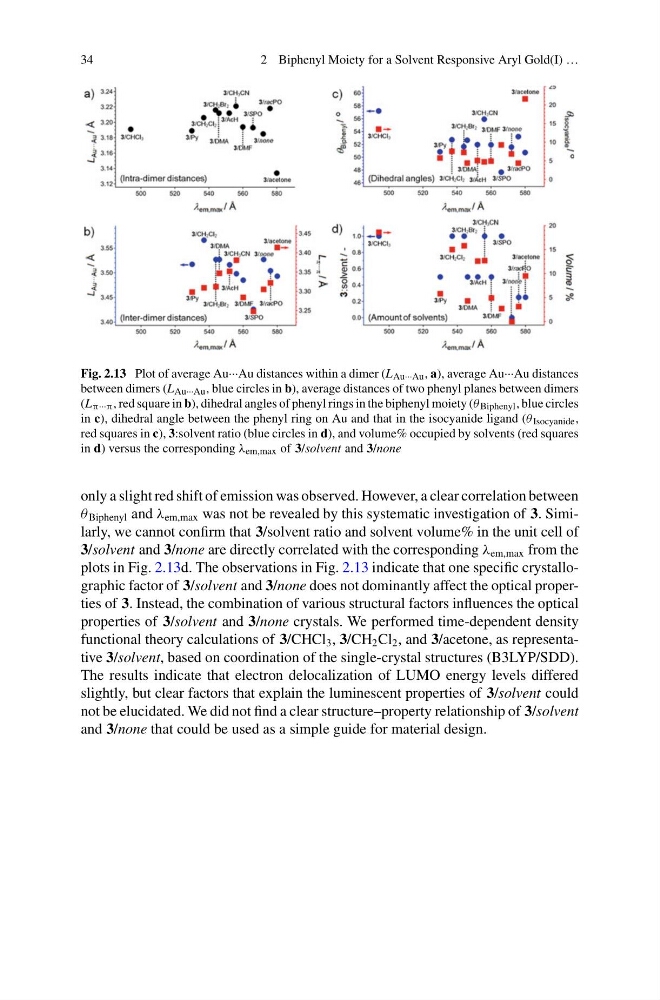
Fig. 2.13 Plot of average Au···Au distances within a dimer (L Au···Au , a), average Au···Au distances
between dimers (L Au···Au , blue circles in b), average distances of two phenyl planes between dimers
(L π···π , red square in b), dihedral angles of phenyl rings in the biphenyl moiety (θ Biphenyl , blue circles
in c), dihedral angle between the phenyl ring on Au and that in the isocyanide ligand (θ Isocyanide ,
red squares in c), 3:solvent ratio (blue circles in d), and volume% occupied by solvents (red squares
in d) versus the corresponding λ em,max of 3/solvent and 3/none
only a slight red shift of emission was observed. However, a clear correlation between
θ Biphenyl and λ em,max was not be revealed by this systematic investigation of 3. Similarly, we cannot confirm that 3/solvent ratio and solvent volume% in the unit cell of
3/solvent and 3/none are directly correlated with the corresponding λ em,max from the
plots in Fig. 2.13d. The observations in Fig. 2.13 indicate that one specific crystallographic factor of 3/solvent and 3/none does not dominantly affect the optical properties of 3. Instead, the combination of various structural factors influences the optical
properties of 3/solvent and 3/none crystals. We performed time-dependent density
functional theory calculations of 3/CHCl 3 , 3/CH 2 Cl 2 , and 3/acetone, as representative 3/solvent, based on coordination of the single-crystal structures (B3LYP/SDD).
The results indicate that electron delocalization of LUMO energy levels differed
slightly, but clear factors that explain the luminescent properties of 3/solvent could
not be elucidated. We did not find a clear structure–property relationship of 3/solvent
and 3/none that could be used as a simple guide for material design.
2 Biphenyl Moiety for a Solvent Responsive Aryl Gold(I) …
Fig. 2.13 Plot of average Au···Au distances within a dimer (L Au···Au , a), average Au···Au distances
between dimers (L Au···Au , blue circles in b), average distances of two phenyl planes between dimers
(L π···π , red square in b), dihedral angles of phenyl rings in the biphenyl moiety (θ Biphenyl , blue circles
in c), dihedral angle between the phenyl ring on Au and that in the isocyanide ligand (θ Isocyanide ,
red squares in c), 3:solvent ratio (blue circles in d), and volume% occupied by solvents (red squares
in d) versus the corresponding λ em,max of 3/solvent and 3/none
only a slight red shift of emission was observed. However, a clear correlation between
θ Biphenyl and λ em,max was not be revealed by this systematic investigation of 3. Similarly, we cannot confirm that 3/solvent ratio and solvent volume% in the unit cell of
3/solvent and 3/none are directly correlated with the corresponding λ em,max from the
plots in Fig. 2.13d. The observations in Fig. 2.13 indicate that one specific crystallographic factor of 3/solvent and 3/none does not dominantly affect the optical properties of 3. Instead, the combination of various structural factors influences the optical
properties of 3/solvent and 3/none crystals. We performed time-dependent density
functional theory calculations of 3/CHCl 3 , 3/CH 2 Cl 2 , and 3/acetone, as representative 3/solvent, based on coordination of the single-crystal structures (B3LYP/SDD).
The results indicate that electron delocalization of LUMO energy levels differed
slightly, but clear factors that explain the luminescent properties of 3/solvent could
not be elucidated. We did not find a clear structure–property relationship of 3/solvent
and 3/none that could be used as a simple guide for material design.