

2.5 Structure–Property Relationship
33
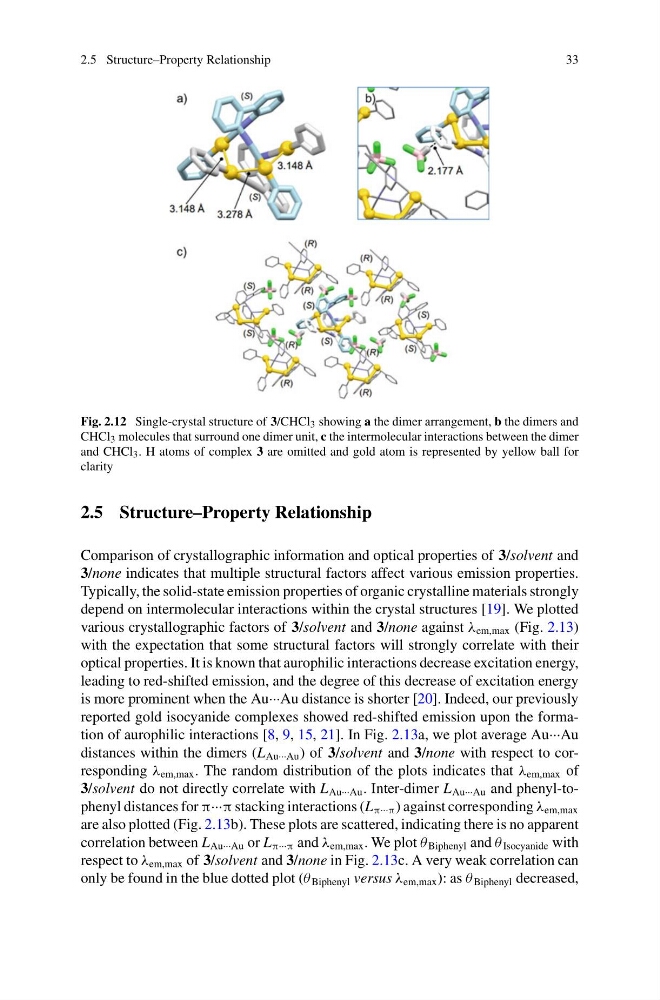
Fig. 2.12 Single-crystal structure of 3/CHCl 3 showing a the dimer arrangement, b the dimers and
CHCl 3 molecules that surround one dimer unit, c the intermolecular interactions between the dimer
and CHCl 3 . H atoms of complex 3 are omitted and gold atom is represented by yellow ball for
clarity
2.5 Structure–Property Relationship
Comparison of crystallographic information and optical properties of 3/solvent and
3/none indicates that multiple structural factors affect various emission properties.
Typically, the solid-state emission properties of organic crystalline materials strongly
depend on intermolecular interactions within the crystal structures [19]. We plotted
various crystallographic factors of 3/solvent and 3/none against λ em,max (Fig. 2.13)
with the expectation that some structural factors will strongly correlate with their
optical properties. It is known that aurophilic interactions decrease excitation energy,
leading to red-shifted emission, and the degree of this decrease of excitation energy
is more prominent when the Au···Au distance is shorter [20]. Indeed, our previously
reported gold isocyanide complexes showed red-shifted emission upon the formation of aurophilic interactions [8, 9, 15, 21]. In Fig. 2.13a, we plot average Au···Au
distances within the dimers (L Au···Au ) of 3/solvent and 3/none with respect to corresponding λ em,max . The random distribution of the plots indicates that λ em,max of
3/solvent do not directly correlate with L Au···Au . Inter-dimer L Au···Au and phenyl-tophenyl distances for π···π stacking interactions (L π···π ) against corresponding λ em,max
are also plotted (Fig. 2.13b). These plots are scattered, indicating there is no apparent
correlation between L Au···Au or L π···π and λ em,max . We plot θ Biphenyl and θ Isocyanide with
respect to λ em,max of 3/solvent and 3/none in Fig. 2.13c. A very weak correlation can
only be found in the blue dotted plot (θ Biphenyl versus λ em,max ): as θ Biphenyl decreased,
33
Fig. 2.12 Single-crystal structure of 3/CHCl 3 showing a the dimer arrangement, b the dimers and
CHCl 3 molecules that surround one dimer unit, c the intermolecular interactions between the dimer
and CHCl 3 . H atoms of complex 3 are omitted and gold atom is represented by yellow ball for
clarity
2.5 Structure–Property Relationship
Comparison of crystallographic information and optical properties of 3/solvent and
3/none indicates that multiple structural factors affect various emission properties.
Typically, the solid-state emission properties of organic crystalline materials strongly
depend on intermolecular interactions within the crystal structures [19]. We plotted
various crystallographic factors of 3/solvent and 3/none against λ em,max (Fig. 2.13)
with the expectation that some structural factors will strongly correlate with their
optical properties. It is known that aurophilic interactions decrease excitation energy,
leading to red-shifted emission, and the degree of this decrease of excitation energy
is more prominent when the Au···Au distance is shorter [20]. Indeed, our previously
reported gold isocyanide complexes showed red-shifted emission upon the formation of aurophilic interactions [8, 9, 15, 21]. In Fig. 2.13a, we plot average Au···Au
distances within the dimers (L Au···Au ) of 3/solvent and 3/none with respect to corresponding λ em,max . The random distribution of the plots indicates that λ em,max of
3/solvent do not directly correlate with L Au···Au . Inter-dimer L Au···Au and phenyl-tophenyl distances for π···π stacking interactions (L π···π ) against corresponding λ em,max
are also plotted (Fig. 2.13b). These plots are scattered, indicating there is no apparent
correlation between L Au···Au or L π···π and λ em,max . We plot θ Biphenyl and θ Isocyanide with
respect to λ em,max of 3/solvent and 3/none in Fig. 2.13c. A very weak correlation can
only be found in the blue dotted plot (θ Biphenyl versus λ em,max ): as θ Biphenyl decreased,