

20
2 Biphenyl Moiety for a Solvent Responsive Aryl Gold(I) …
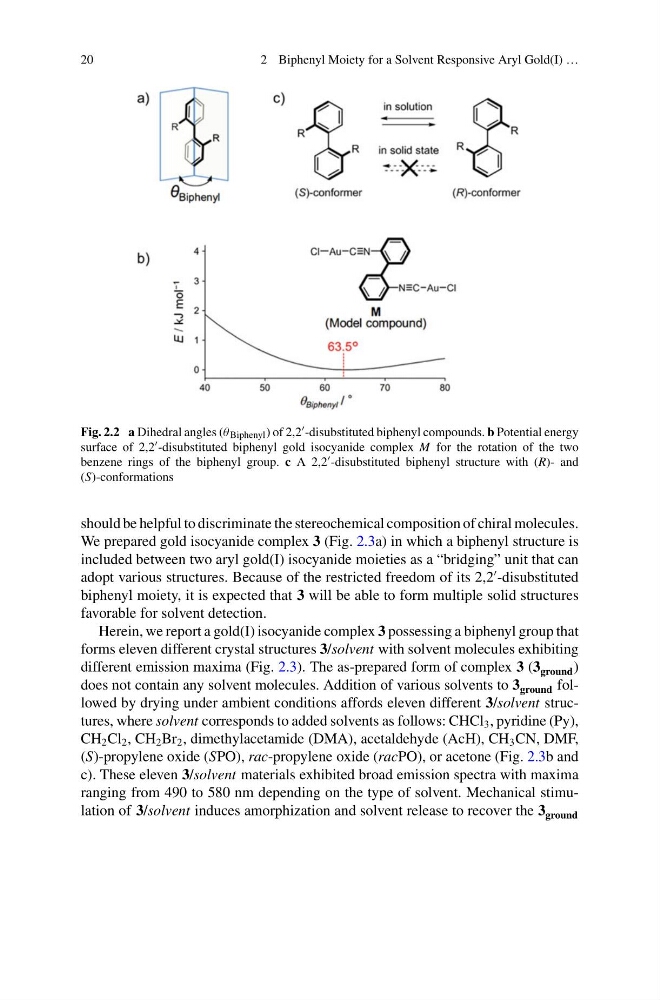
Fig. 2.2 a Dihedral angles (θ Biphenyl ) of 2,2 -disubstituted biphenyl compounds. b Potential energy
surface of 2,2 -disubstituted biphenyl gold isocyanide complex M for the rotation of the two
benzene rings of the biphenyl group. c A 2,2 -disubstituted biphenyl structure with (R)- and
(S)-conformations
should be helpful to discriminate the stereochemical composition of chiral molecules.
We prepared gold isocyanide complex 3 (Fig. 2.3a) in which a biphenyl structure is
included between two aryl gold(I) isocyanide moieties as a “bridging” unit that can
adopt various structures. Because of the restricted freedom of its 2,2
-disubstituted
biphenyl moiety, it is expected that 3 will be able to form multiple solid structures
favorable for solvent detection.
Herein, we report a gold(I) isocyanide complex 3 possessing a biphenyl group that
forms eleven different crystal structures 3/solvent with solvent molecules exhibiting
different emission maxima (Fig. 2.3). The as-prepared form of complex 3 (3 ground )
does not contain any solvent molecules. Addition of various solvents to 3 ground followed by drying under ambient conditions affords eleven different 3/solvent structures, where solvent corresponds to added solvents as follows: CHCl 3 , pyridine (Py),
CH 2 Cl 2 , CH 2 Br 2 , dimethylacetamide (DMA), acetaldehyde (AcH), CH 3 CN, DMF,
(S)-propylene oxide (SPO), rac-propylene oxide (racPO), or acetone (Fig. 2.3b and
c). These eleven 3/solvent materials exhibited broad emission spectra with maxima
ranging from 490 to 580 nm depending on the type of solvent. Mechanical stimulation of 3/solvent induces amorphization and solvent release to recover the 3 ground
2 Biphenyl Moiety for a Solvent Responsive Aryl Gold(I) …
Fig. 2.2 a Dihedral angles (θ Biphenyl ) of 2,2 -disubstituted biphenyl compounds. b Potential energy
surface of 2,2 -disubstituted biphenyl gold isocyanide complex M for the rotation of the two
benzene rings of the biphenyl group. c A 2,2 -disubstituted biphenyl structure with (R)- and
(S)-conformations
should be helpful to discriminate the stereochemical composition of chiral molecules.
We prepared gold isocyanide complex 3 (Fig. 2.3a) in which a biphenyl structure is
included between two aryl gold(I) isocyanide moieties as a “bridging” unit that can
adopt various structures. Because of the restricted freedom of its 2,2
-disubstituted
biphenyl moiety, it is expected that 3 will be able to form multiple solid structures
favorable for solvent detection.
Herein, we report a gold(I) isocyanide complex 3 possessing a biphenyl group that
forms eleven different crystal structures 3/solvent with solvent molecules exhibiting
different emission maxima (Fig. 2.3). The as-prepared form of complex 3 (3 ground )
does not contain any solvent molecules. Addition of various solvents to 3 ground followed by drying under ambient conditions affords eleven different 3/solvent structures, where solvent corresponds to added solvents as follows: CHCl 3 , pyridine (Py),
CH 2 Cl 2 , CH 2 Br 2 , dimethylacetamide (DMA), acetaldehyde (AcH), CH 3 CN, DMF,
(S)-propylene oxide (SPO), rac-propylene oxide (racPO), or acetone (Fig. 2.3b and
c). These eleven 3/solvent materials exhibited broad emission spectra with maxima
ranging from 490 to 580 nm depending on the type of solvent. Mechanical stimulation of 3/solvent induces amorphization and solvent release to recover the 3 ground