

18
2 Biphenyl Moiety for a Solvent Responsive Aryl Gold(I) …
inform us of the existence of specific substances, including harmful volatile chemical
substances [4]. However, there are several issues that limit general use of solventresponsive compounds. For example, uptake of solvents is often required for these
compounds to change their emission properties. In many cases, detection relies on
the specific intermolecular interactions between solvent-responsive compounds and
solvents. Thus, a single compound only tends to be able to detect a limited number
of solvents [5]. Moreover, to allow repeated use of these compounds, removal of
included solvents is required, which typically involves increasing temperature and
reduced pressure [4d]. It is important to design solid–state emitting materials that
can discriminate multiple volatile materials and be reused following an easy reactivation procedure to remove the volatile compounds after their detection. Moreover, for
many emission materials used for solvent detection, their molecular-level structures
in the recognition process are unknown. This hampers the understanding of detailed
detection mechanisms, which is critical for the further design of these materials.
Detailed structure analysis by single-crystal X-ray diffraction (XRD) is required to
elucidate the detection mechanisms of solvent-responsive emissive materials.
We have explored solid-state emissive gold complexes that change their emission color in response to mechanical stimulation and solvent addition. Compared
with halogenated [6] and alkynyl [7] gold isocyanide complexes, aryl gold isocyanide complexes have seldom been studied [8]. In 2008, we reported the pioneering
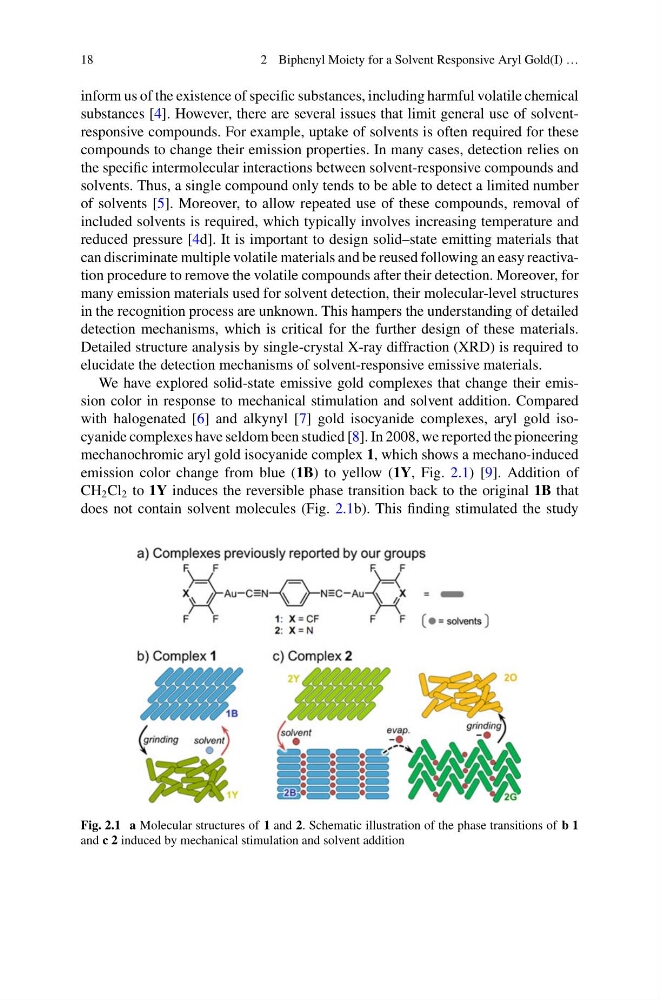
mechanochromic aryl gold isocyanide complex 1, which shows a mechano-induced
emission color change from blue (1B) to yellow (1Y, Fig. 2.1) [9]. Addition of
CH 2 Cl 2 to 1Y induces the reversible phase transition back to the original 1B that
does not contain solvent molecules (Fig. 2.1b). This finding stimulated the study
Fig. 2.1 a Molecular structures of 1 and 2. Schematic illustration of the phase transitions of b 1
and c 2 induced by mechanical stimulation and solvent addition
2 Biphenyl Moiety for a Solvent Responsive Aryl Gold(I) …
inform us of the existence of specific substances, including harmful volatile chemical
substances [4]. However, there are several issues that limit general use of solventresponsive compounds. For example, uptake of solvents is often required for these
compounds to change their emission properties. In many cases, detection relies on
the specific intermolecular interactions between solvent-responsive compounds and
solvents. Thus, a single compound only tends to be able to detect a limited number
of solvents [5]. Moreover, to allow repeated use of these compounds, removal of
included solvents is required, which typically involves increasing temperature and
reduced pressure [4d]. It is important to design solid–state emitting materials that
can discriminate multiple volatile materials and be reused following an easy reactivation procedure to remove the volatile compounds after their detection. Moreover, for
many emission materials used for solvent detection, their molecular-level structures
in the recognition process are unknown. This hampers the understanding of detailed
detection mechanisms, which is critical for the further design of these materials.
Detailed structure analysis by single-crystal X-ray diffraction (XRD) is required to
elucidate the detection mechanisms of solvent-responsive emissive materials.
We have explored solid-state emissive gold complexes that change their emission color in response to mechanical stimulation and solvent addition. Compared
with halogenated [6] and alkynyl [7] gold isocyanide complexes, aryl gold isocyanide complexes have seldom been studied [8]. In 2008, we reported the pioneering
mechanochromic aryl gold isocyanide complex 1, which shows a mechano-induced
emission color change from blue (1B) to yellow (1Y, Fig. 2.1) [9]. Addition of
CH 2 Cl 2 to 1Y induces the reversible phase transition back to the original 1B that
does not contain solvent molecules (Fig. 2.1b). This finding stimulated the study
Fig. 2.1 a Molecular structures of 1 and 2. Schematic illustration of the phase transitions of b 1
and c 2 induced by mechanical stimulation and solvent addition