

6.6 Emission Properties of 1 and 2
171
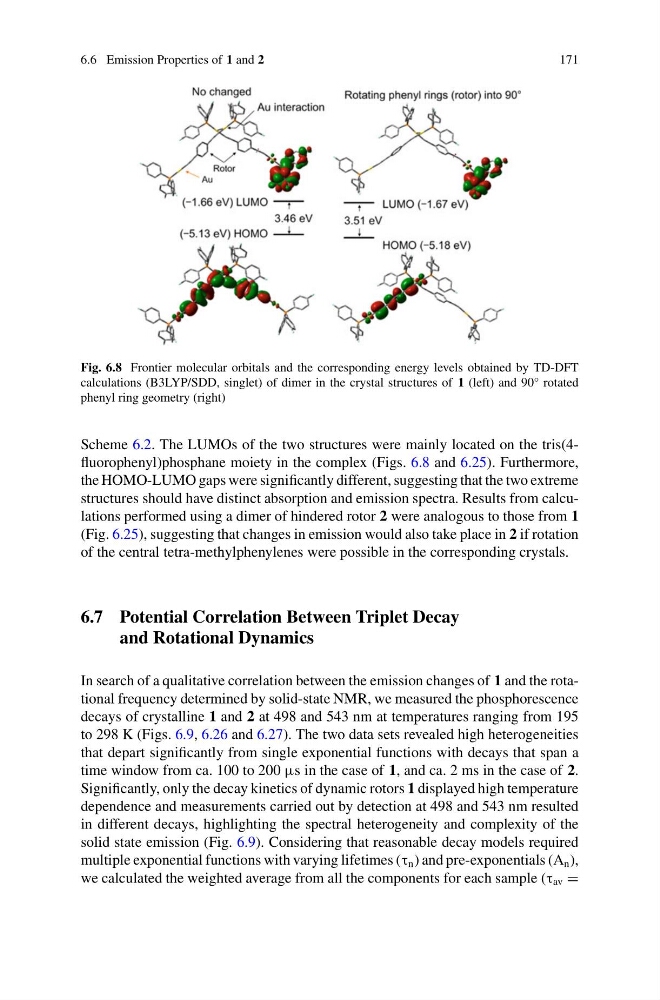
Fig. 6.8 Frontier molecular orbitals and the corresponding energy levels obtained by TD-DFT
calculations (B3LYP/SDD, singlet) of dimer in the crystal structures of 1 (left) and 90° rotated
phenyl ring geometry (right)
Scheme 6.2. The LUMOs of the two structures were mainly located on the tris(4fluorophenyl)phosphane moiety in the complex (Figs. 6.8 and 6.25). Furthermore,
the HOMO-LUMO gaps were significantly different, suggesting that the two extreme
structures should have distinct absorption and emission spectra. Results from calculations performed using a dimer of hindered rotor 2 were analogous to those from 1
(Fig. 6.25), suggesting that changes in emission would also take place in 2 if rotation
of the central tetra-methylphenylenes were possible in the corresponding crystals.
6.7 Potential Correlation Between Triplet Decay
and Rotational Dynamics
In search of a qualitative correlation between the emission changes of 1 and the rotational frequency determined by solid-state NMR, we measured the phosphorescence
decays of crystalline 1 and 2 at 498 and 543 nm at temperatures ranging from 195
to 298 K (Figs. 6.9, 6.26 and 6.27). The two data sets revealed high heterogeneities
that depart significantly from single exponential functions with decays that span a
time window from ca. 100 to 200 μs in the case of 1, and ca. 2 ms in the case of 2.
Significantly, only the decay kinetics of dynamic rotors 1 displayed high temperature
dependence and measurements carried out by detection at 498 and 543 nm resulted
in different decays, highlighting the spectral heterogeneity and complexity of the
solid state emission (Fig. 6.9). Considering that reasonable decay models required
multiple exponential functions with varying lifetimes (τ n ) and pre-exponentials (A n ),
we calculated the weighted average from all the components for each sample (τ av =
171
Fig. 6.8 Frontier molecular orbitals and the corresponding energy levels obtained by TD-DFT
calculations (B3LYP/SDD, singlet) of dimer in the crystal structures of 1 (left) and 90° rotated
phenyl ring geometry (right)
Scheme 6.2. The LUMOs of the two structures were mainly located on the tris(4fluorophenyl)phosphane moiety in the complex (Figs. 6.8 and 6.25). Furthermore,
the HOMO-LUMO gaps were significantly different, suggesting that the two extreme
structures should have distinct absorption and emission spectra. Results from calculations performed using a dimer of hindered rotor 2 were analogous to those from 1
(Fig. 6.25), suggesting that changes in emission would also take place in 2 if rotation
of the central tetra-methylphenylenes were possible in the corresponding crystals.
6.7 Potential Correlation Between Triplet Decay
and Rotational Dynamics
In search of a qualitative correlation between the emission changes of 1 and the rotational frequency determined by solid-state NMR, we measured the phosphorescence
decays of crystalline 1 and 2 at 498 and 543 nm at temperatures ranging from 195
to 298 K (Figs. 6.9, 6.26 and 6.27). The two data sets revealed high heterogeneities
that depart significantly from single exponential functions with decays that span a
time window from ca. 100 to 200 μs in the case of 1, and ca. 2 ms in the case of 2.
Significantly, only the decay kinetics of dynamic rotors 1 displayed high temperature
dependence and measurements carried out by detection at 498 and 543 nm resulted
in different decays, highlighting the spectral heterogeneity and complexity of the
solid state emission (Fig. 6.9). Considering that reasonable decay models required
multiple exponential functions with varying lifetimes (τ n ) and pre-exponentials (A n ),
we calculated the weighted average from all the components for each sample (τ av =