

170
6 Thermo-Responsive Phosphorescence Control Mediated …
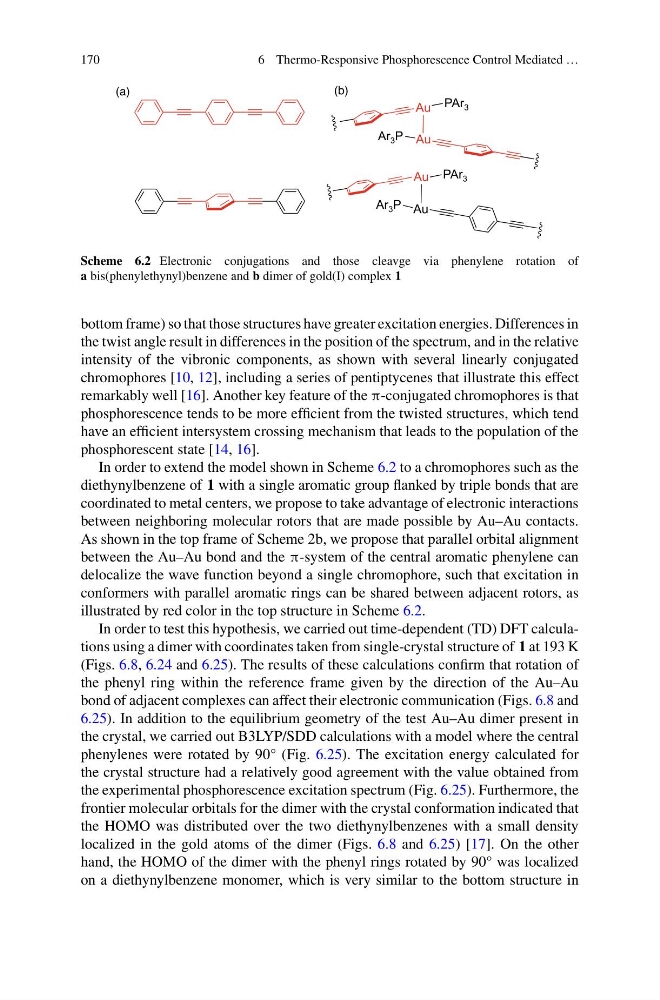
Scheme 6.2 Electronic conjugations and those cleavge via phenylene rotation of
a bis(phenylethynyl)benzene and b dimer of gold(I) complex 1
bottom frame) so that those structures have greater excitation energies. Differences in
the twist angle result in differences in the position of the spectrum, and in the relative
intensity of the vibronic components, as shown with several linearly conjugated
chromophores [10, 12], including a series of pentiptycenes that illustrate this effect
remarkably well [16]. Another key feature of the π-conjugated chromophores is that
phosphorescence tends to be more efficient from the twisted structures, which tend
have an efficient intersystem crossing mechanism that leads to the population of the
phosphorescent state [14, 16].
In order to extend the model shown in Scheme 6.2 to a chromophores such as the
diethynylbenzene of 1 with a single aromatic group flanked by triple bonds that are
coordinated to metal centers, we propose to take advantage of electronic interactions
between neighboring molecular rotors that are made possible by Au–Au contacts.
As shown in the top frame of Scheme 2b, we propose that parallel orbital alignment
between the Au–Au bond and the π-system of the central aromatic phenylene can
delocalize the wave function beyond a single chromophore, such that excitation in
conformers with parallel aromatic rings can be shared between adjacent rotors, as
illustrated by red color in the top structure in Scheme 6.2.
In order to test this hypothesis, we carried out time-dependent (TD) DFT calculations using a dimer with coordinates taken from single-crystal structure of 1 at 193 K
(Figs. 6.8, 6.24 and 6.25). The results of these calculations confirm that rotation of
the phenyl ring within the reference frame given by the direction of the Au–Au
bond of adjacent complexes can affect their electronic communication (Figs. 6.8 and
6.25). In addition to the equilibrium geometry of the test Au–Au dimer present in
the crystal, we carried out B3LYP/SDD calculations with a model where the central
phenylenes were rotated by 90° (Fig. 6.25). The excitation energy calculated for
the crystal structure had a relatively good agreement with the value obtained from
the experimental phosphorescence excitation spectrum (Fig. 6.25). Furthermore, the
frontier molecular orbitals for the dimer with the crystal conformation indicated that
the HOMO was distributed over the two diethynylbenzenes with a small density
localized in the gold atoms of the dimer (Figs. 6.8 and 6.25) [17]. On the other
hand, the HOMO of the dimer with the phenyl rings rotated by 90° was localized
on a diethynylbenzene monomer, which is very similar to the bottom structure in
6 Thermo-Responsive Phosphorescence Control Mediated …
Scheme 6.2 Electronic conjugations and those cleavge via phenylene rotation of
a bis(phenylethynyl)benzene and b dimer of gold(I) complex 1
bottom frame) so that those structures have greater excitation energies. Differences in
the twist angle result in differences in the position of the spectrum, and in the relative
intensity of the vibronic components, as shown with several linearly conjugated
chromophores [10, 12], including a series of pentiptycenes that illustrate this effect
remarkably well [16]. Another key feature of the π-conjugated chromophores is that
phosphorescence tends to be more efficient from the twisted structures, which tend
have an efficient intersystem crossing mechanism that leads to the population of the
phosphorescent state [14, 16].
In order to extend the model shown in Scheme 6.2 to a chromophores such as the
diethynylbenzene of 1 with a single aromatic group flanked by triple bonds that are
coordinated to metal centers, we propose to take advantage of electronic interactions
between neighboring molecular rotors that are made possible by Au–Au contacts.
As shown in the top frame of Scheme 2b, we propose that parallel orbital alignment
between the Au–Au bond and the π-system of the central aromatic phenylene can
delocalize the wave function beyond a single chromophore, such that excitation in
conformers with parallel aromatic rings can be shared between adjacent rotors, as
illustrated by red color in the top structure in Scheme 6.2.
In order to test this hypothesis, we carried out time-dependent (TD) DFT calculations using a dimer with coordinates taken from single-crystal structure of 1 at 193 K
(Figs. 6.8, 6.24 and 6.25). The results of these calculations confirm that rotation of
the phenyl ring within the reference frame given by the direction of the Au–Au
bond of adjacent complexes can affect their electronic communication (Figs. 6.8 and
6.25). In addition to the equilibrium geometry of the test Au–Au dimer present in
the crystal, we carried out B3LYP/SDD calculations with a model where the central
phenylenes were rotated by 90° (Fig. 6.25). The excitation energy calculated for
the crystal structure had a relatively good agreement with the value obtained from
the experimental phosphorescence excitation spectrum (Fig. 6.25). Furthermore, the
frontier molecular orbitals for the dimer with the crystal conformation indicated that
the HOMO was distributed over the two diethynylbenzenes with a small density
localized in the gold atoms of the dimer (Figs. 6.8 and 6.25) [17]. On the other
hand, the HOMO of the dimer with the phenyl rings rotated by 90° was localized
on a diethynylbenzene monomer, which is very similar to the bottom structure in