

164
6 Thermo-Responsive Phosphorescence Control Mediated …
Table 6.2 (continued)
Compound
2 at 253 K
2 at 273 K
2 at 298 K
wR 2
b
0.1774
0.1959
0.2038
GOF c
0.968
1.015
0.972
Max./mini. peak I d
(Å 3 )
1.79 e − /−1.51 e −
1.62 e − /−1.25 e −
1.53 e − /−1.32 e −
a I > 2.00σ(I)
b All reflections
c Goodness of fit indicator
d In final diff. map
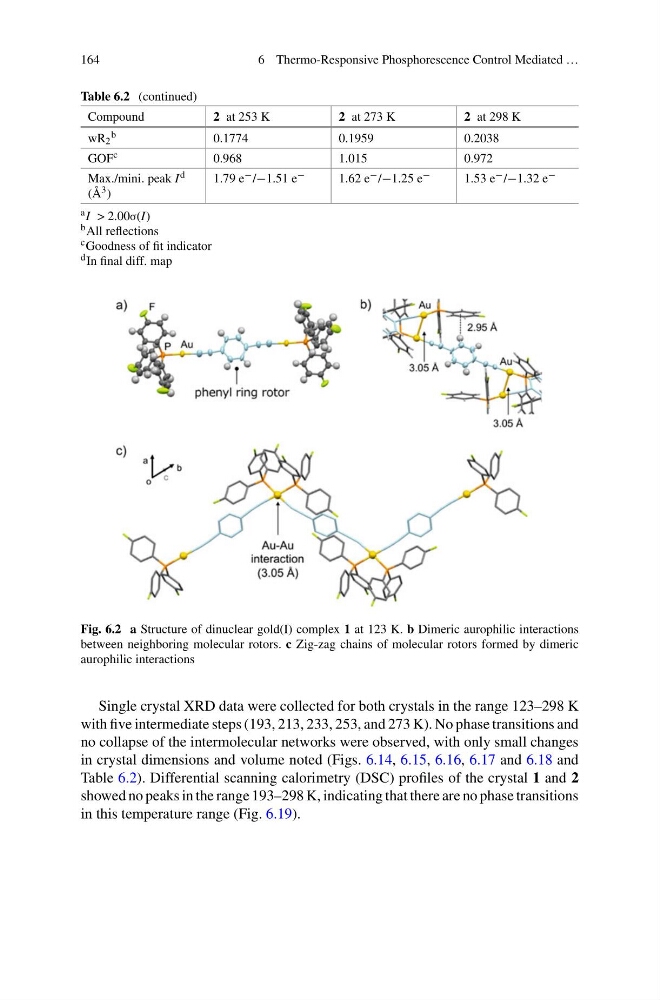
Fig. 6.2 a Structure of dinuclear gold(I) complex 1 at 123 K. b Dimeric aurophilic interactions
between neighboring molecular rotors. c Zig-zag chains of molecular rotors formed by dimeric
aurophilic interactions
Single crystal XRD data were collected for both crystals in the range 123–298 K
with five intermediate steps (193, 213, 233, 253, and 273 K). No phase transitions and
no collapse of the intermolecular networks were observed, with only small changes
in crystal dimensions and volume noted (Figs. 6.14, 6.15, 6.16, 6.17 and 6.18 and
Table 6.2). Differential scanning calorimetry (DSC) profiles of the crystal 1 and 2
showed no peaks in the range 193–298 K, indicating that there are no phase transitions
in this temperature range (Fig. 6.19).
6 Thermo-Responsive Phosphorescence Control Mediated …
Table 6.2 (continued)
Compound
2 at 253 K
2 at 273 K
2 at 298 K
wR 2
b
0.1774
0.1959
0.2038
GOF c
0.968
1.015
0.972
Max./mini. peak I d
(Å 3 )
1.79 e − /−1.51 e −
1.62 e − /−1.25 e −
1.53 e − /−1.32 e −
a I > 2.00σ(I)
b All reflections
c Goodness of fit indicator
d In final diff. map
Fig. 6.2 a Structure of dinuclear gold(I) complex 1 at 123 K. b Dimeric aurophilic interactions
between neighboring molecular rotors. c Zig-zag chains of molecular rotors formed by dimeric
aurophilic interactions
Single crystal XRD data were collected for both crystals in the range 123–298 K
with five intermediate steps (193, 213, 233, 253, and 273 K). No phase transitions and
no collapse of the intermolecular networks were observed, with only small changes
in crystal dimensions and volume noted (Figs. 6.14, 6.15, 6.16, 6.17 and 6.18 and
Table 6.2). Differential scanning calorimetry (DSC) profiles of the crystal 1 and 2
showed no peaks in the range 193–298 K, indicating that there are no phase transitions
in this temperature range (Fig. 6.19).