

5.7 Experimental Section
139
analytically pure white solid of 5 (0.166 g, 0.36 mmol, 72%).
1 H NMR (400 MHz,
CDCl 3 , δ): 7.40–7.50 (m, 3H), 7.54–7.62 (m, 4H), 7.68–7.74 (m, 2H), 7.97–8.00
(m, 2H).
13 C NMR (100 MHz, CDCl 3 , δ): 124.4 (C), 124.7 (CH), 125.4 (CH), 126.6
(CH), 127.2 (CH), 127.5 (CH), 127.7 (CH), 129.0 (CH), 129.2 (CH), 129.9 (CH),
130.9 (C), 131.6 (CH), 132.3 (CH), 133.3 (C), 133.7 (C), 139.4 (C), 142.8 (C).
Anal. MS-EI (m/z): [M+H]
+ calcd for C 17 H 11 AuClN, 461.02455; found, 461.01432.
Calcd for C 17 H 11 AuClN: C, 44.23; H, 2.40; N, 3.03. Found: C, 44.12; H, 2.22; N,
2.92.
I
THF, r.t.
ZnI·LiCl
+ LiCl + Zn
6
F 3 C
F 3 C
BrCH 2 CH 2 Br
Me 3 SiCl
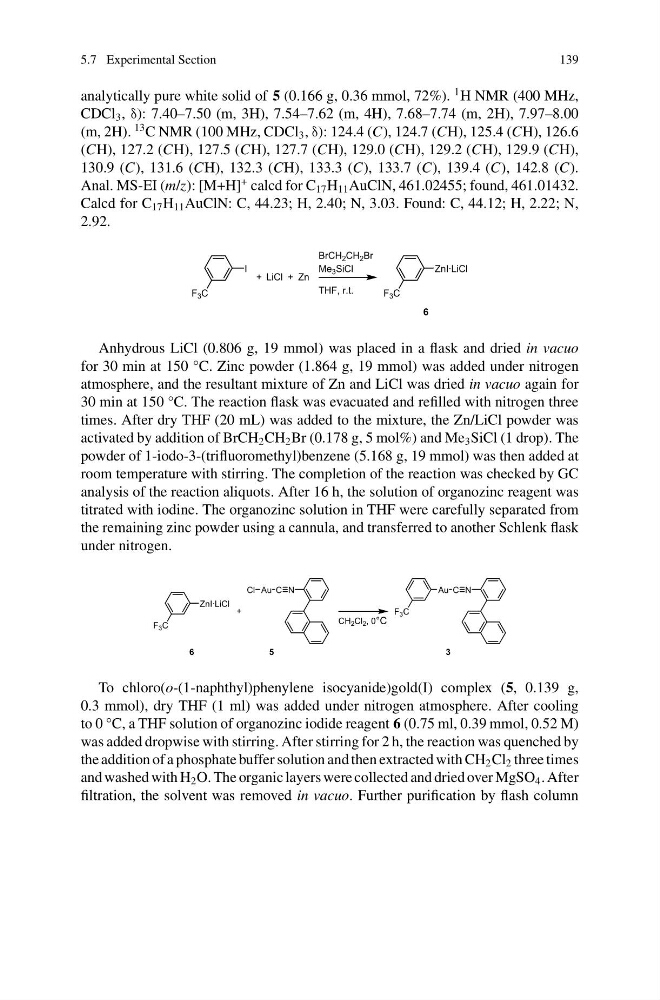
Anhydrous LiCl (0.806 g, 19 mmol) was placed in a flask and dried in vacuo
for 30 min at 150 °C. Zinc powder (1.864 g, 19 mmol) was added under nitrogen
atmosphere, and the resultant mixture of Zn and LiCl was dried in vacuo again for
30 min at 150 °C. The reaction flask was evacuated and refilled with nitrogen three
times. After dry THF (20 mL) was added to the mixture, the Zn/LiCl powder was
activated by addition of BrCH 2 CH 2 Br (0.178 g, 5 mol%) and Me 3 SiCl (1 drop). The
powder of 1-iodo-3-(trifluoromethyl)benzene (5.168 g, 19 mmol) was then added at
room temperature with stirring. The completion of the reaction was checked by GC
analysis of the reaction aliquots. After 16 h, the solution of organozinc reagent was
titrated with iodine. The organozinc solution in THF were carefully separated from
the remaining zinc powder using a cannula, and transferred to another Schlenk flask
under nitrogen.
ZnI·LiCl
+
N
C
Au
N
C
Au
Cl
CH 2 Cl 2 , 0°C
6
5
3
F 3 C
F 3 C
To chloro(o-(1-naphthyl)phenylene isocyanide)gold(I) complex (5, 0.139 g,
0.3 mmol), dry THF (1 ml) was added under nitrogen atmosphere. After cooling
to 0 °C, a THF solution of organozinc iodide reagent 6 (0.75 ml, 0.39 mmol, 0.52 M)
was added dropwise with stirring. After stirring for 2 h, the reaction was quenched by
the addition of a phosphate buffer solution and then extracted with CH 2 Cl 2 three times
and washed with H 2 O. The organic layers were collected and dried over MgSO 4 . After
filtration, the solvent was removed in vacuo. Further purification by flash column
139
analytically pure white solid of 5 (0.166 g, 0.36 mmol, 72%).
1 H NMR (400 MHz,
CDCl 3 , δ): 7.40–7.50 (m, 3H), 7.54–7.62 (m, 4H), 7.68–7.74 (m, 2H), 7.97–8.00
(m, 2H).
13 C NMR (100 MHz, CDCl 3 , δ): 124.4 (C), 124.7 (CH), 125.4 (CH), 126.6
(CH), 127.2 (CH), 127.5 (CH), 127.7 (CH), 129.0 (CH), 129.2 (CH), 129.9 (CH),
130.9 (C), 131.6 (CH), 132.3 (CH), 133.3 (C), 133.7 (C), 139.4 (C), 142.8 (C).
Anal. MS-EI (m/z): [M+H]
+ calcd for C 17 H 11 AuClN, 461.02455; found, 461.01432.
Calcd for C 17 H 11 AuClN: C, 44.23; H, 2.40; N, 3.03. Found: C, 44.12; H, 2.22; N,
2.92.
I
THF, r.t.
ZnI·LiCl
+ LiCl + Zn
6
F 3 C
F 3 C
BrCH 2 CH 2 Br
Me 3 SiCl
Anhydrous LiCl (0.806 g, 19 mmol) was placed in a flask and dried in vacuo
for 30 min at 150 °C. Zinc powder (1.864 g, 19 mmol) was added under nitrogen
atmosphere, and the resultant mixture of Zn and LiCl was dried in vacuo again for
30 min at 150 °C. The reaction flask was evacuated and refilled with nitrogen three
times. After dry THF (20 mL) was added to the mixture, the Zn/LiCl powder was
activated by addition of BrCH 2 CH 2 Br (0.178 g, 5 mol%) and Me 3 SiCl (1 drop). The
powder of 1-iodo-3-(trifluoromethyl)benzene (5.168 g, 19 mmol) was then added at
room temperature with stirring. The completion of the reaction was checked by GC
analysis of the reaction aliquots. After 16 h, the solution of organozinc reagent was
titrated with iodine. The organozinc solution in THF were carefully separated from
the remaining zinc powder using a cannula, and transferred to another Schlenk flask
under nitrogen.
ZnI·LiCl
+
N
C
Au
N
C
Au
Cl
CH 2 Cl 2 , 0°C
6
5
3
F 3 C
F 3 C
To chloro(o-(1-naphthyl)phenylene isocyanide)gold(I) complex (5, 0.139 g,
0.3 mmol), dry THF (1 ml) was added under nitrogen atmosphere. After cooling
to 0 °C, a THF solution of organozinc iodide reagent 6 (0.75 ml, 0.39 mmol, 0.52 M)
was added dropwise with stirring. After stirring for 2 h, the reaction was quenched by
the addition of a phosphate buffer solution and then extracted with CH 2 Cl 2 three times
and washed with H 2 O. The organic layers were collected and dried over MgSO 4 . After
filtration, the solvent was removed in vacuo. Further purification by flash column