

138
5 Mechanical-Stimulation-Triggered and Solvent-Vapor-Induced …
5.7 Experimental Section
5.7.1 General
All commercially available reagents and solvents are of reagent grade and were used
without further purification unless otherwise noted. Solvents for synthesis were purchased from commercial suppliers, degassed by three freeze-pump-thaw cycles and
further dried over molecular sieves (4 Å). NMR spectra were recorded on a JEOL
JNM-ECX400P or JNM-ECS400P spectrometer (
1 H: 400 MHz;
13 C: 100 MHz)
using tetramethylsilane and CDCl 3 as internal standards, respectively. Emission
spectra were recorded on a Hitachi F-7000 spectrometer. Absorption spectra were
recorded on the basis of synchronous fluorescence spectroscopy using a Hitachi F7000 spectrometer equipped with an integrating sphere. The emission quantum yields
of the solid samples were recorded on a Hamamatsu Quantaurus-QY spectrometer
with an integrating sphere. Emission lifetime measurements were recorded on a
Hamamatsu Quantaurus-Tau spectrometer. Elemental analyses and low- and highresolution mass spectra were recorded at the Global Facility Center at Hokkaido
University. Photographs were obtained using Olympus BX51 or SZX7 microscopes
with Olympus DP72, Nikon D5100 digital cameras. Thermal gravimetric analysis
profiles were recorded on Bruker TG-DTA2010SAT. Single crystal X-ray structural
analyses were carried out on a Rigaku XtaLAB PRO MM007 diffractometers.
5.7.2 Synthesis
Complex 3 was prepared according to the previously published procedure with some
modifications [9].
N
C
Au
Cl
N
C
CH 2 Cl 2 , r.t.
Cl Au S
4
5
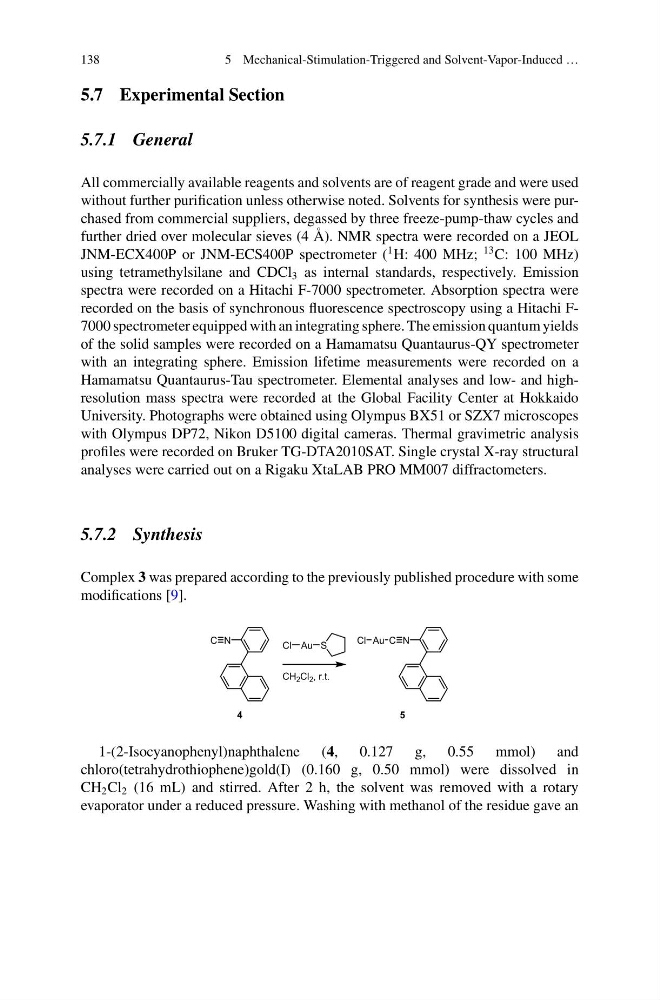
1-(2-Isocyanophenyl)naphthalene (4, 0.127 g, 0.55 mmol) and
chloro(tetrahydrothiophene)gold(I) (0.160 g, 0.50 mmol) were dissolved in
CH 2 Cl 2 (16 mL) and stirred. After 2 h, the solvent was removed with a rotary
evaporator under a reduced pressure. Washing with methanol of the residue gave an
5 Mechanical-Stimulation-Triggered and Solvent-Vapor-Induced …
5.7 Experimental Section
5.7.1 General
All commercially available reagents and solvents are of reagent grade and were used
without further purification unless otherwise noted. Solvents for synthesis were purchased from commercial suppliers, degassed by three freeze-pump-thaw cycles and
further dried over molecular sieves (4 Å). NMR spectra were recorded on a JEOL
JNM-ECX400P or JNM-ECS400P spectrometer (
1 H: 400 MHz;
13 C: 100 MHz)
using tetramethylsilane and CDCl 3 as internal standards, respectively. Emission
spectra were recorded on a Hitachi F-7000 spectrometer. Absorption spectra were
recorded on the basis of synchronous fluorescence spectroscopy using a Hitachi F7000 spectrometer equipped with an integrating sphere. The emission quantum yields
of the solid samples were recorded on a Hamamatsu Quantaurus-QY spectrometer
with an integrating sphere. Emission lifetime measurements were recorded on a
Hamamatsu Quantaurus-Tau spectrometer. Elemental analyses and low- and highresolution mass spectra were recorded at the Global Facility Center at Hokkaido
University. Photographs were obtained using Olympus BX51 or SZX7 microscopes
with Olympus DP72, Nikon D5100 digital cameras. Thermal gravimetric analysis
profiles were recorded on Bruker TG-DTA2010SAT. Single crystal X-ray structural
analyses were carried out on a Rigaku XtaLAB PRO MM007 diffractometers.
5.7.2 Synthesis
Complex 3 was prepared according to the previously published procedure with some
modifications [9].
N
C
Au
Cl
N
C
CH 2 Cl 2 , r.t.
Cl Au S
4
5
1-(2-Isocyanophenyl)naphthalene (4, 0.127 g, 0.55 mmol) and
chloro(tetrahydrothiophene)gold(I) (0.160 g, 0.50 mmol) were dissolved in
CH 2 Cl 2 (16 mL) and stirred. After 2 h, the solvent was removed with a rotary
evaporator under a reduced pressure. Washing with methanol of the residue gave an