

4.4 Studies on Mechano-Induced Crystal Structure Alterations
113
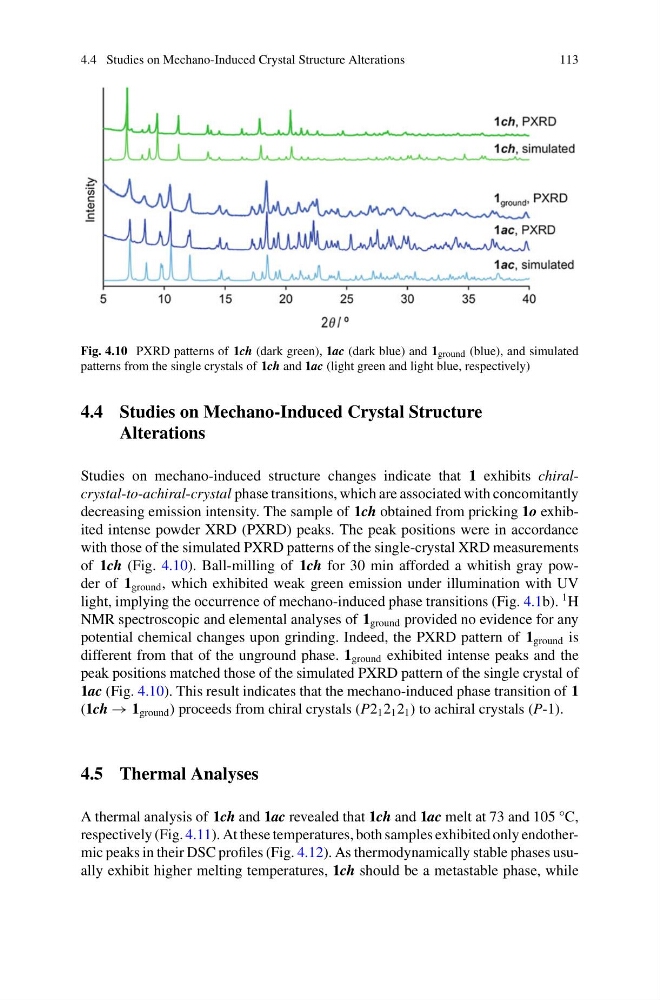
Fig. 4.10 PXRD patterns of 1ch (dark green), 1ac (dark blue) and 1 ground (blue), and simulated
patterns from the single crystals of 1ch and 1ac (light green and light blue, respectively)
4.4 Studies on Mechano-Induced Crystal Structure
Alterations
Studies on mechano-induced structure changes indicate that 1 exhibits chiralcrystal-to-achiral-crystal phase transitions, which are associated with concomitantly
decreasing emission intensity. The sample of 1ch obtained from pricking 1o exhibited intense powder XRD (PXRD) peaks. The peak positions were in accordance
with those of the simulated PXRD patterns of the single-crystal XRD measurements
of 1ch (Fig. 4.10). Ball-milling of 1ch for 30 min afforded a whitish gray powder of 1 ground , which exhibited weak green emission under illumination with UV
light, implying the occurrence of mechano-induced phase transitions (Fig. 4.1b).
1 H
NMR spectroscopic and elemental analyses of 1 ground provided no evidence for any
potential chemical changes upon grinding. Indeed, the PXRD pattern of 1 ground is
different from that of the unground phase. 1 ground exhibited intense peaks and the
peak positions matched those of the simulated PXRD pattern of the single crystal of
1ac (Fig. 4.10). This result indicates that the mechano-induced phase transition of 1
(1ch → 1 ground ) proceeds from chiral crystals (P2 1 2 1 2 1 ) to achiral crystals (P-1).
4.5 Thermal Analyses
A thermal analysis of 1ch and 1ac revealed that 1ch and 1ac melt at 73 and 105 °C,
respectively (Fig. 4.11). At these temperatures, both samples exhibited only endothermic peaks in their DSC profiles (Fig. 4.12). As thermodynamically stable phases usually exhibit higher melting temperatures, 1ch should be a metastable phase, while
113
Fig. 4.10 PXRD patterns of 1ch (dark green), 1ac (dark blue) and 1 ground (blue), and simulated
patterns from the single crystals of 1ch and 1ac (light green and light blue, respectively)
4.4 Studies on Mechano-Induced Crystal Structure
Alterations
Studies on mechano-induced structure changes indicate that 1 exhibits chiralcrystal-to-achiral-crystal phase transitions, which are associated with concomitantly
decreasing emission intensity. The sample of 1ch obtained from pricking 1o exhibited intense powder XRD (PXRD) peaks. The peak positions were in accordance
with those of the simulated PXRD patterns of the single-crystal XRD measurements
of 1ch (Fig. 4.10). Ball-milling of 1ch for 30 min afforded a whitish gray powder of 1 ground , which exhibited weak green emission under illumination with UV
light, implying the occurrence of mechano-induced phase transitions (Fig. 4.1b).
1 H
NMR spectroscopic and elemental analyses of 1 ground provided no evidence for any
potential chemical changes upon grinding. Indeed, the PXRD pattern of 1 ground is
different from that of the unground phase. 1 ground exhibited intense peaks and the
peak positions matched those of the simulated PXRD pattern of the single crystal of
1ac (Fig. 4.10). This result indicates that the mechano-induced phase transition of 1
(1ch → 1 ground ) proceeds from chiral crystals (P2 1 2 1 2 1 ) to achiral crystals (P-1).
4.5 Thermal Analyses
A thermal analysis of 1ch and 1ac revealed that 1ch and 1ac melt at 73 and 105 °C,
respectively (Fig. 4.11). At these temperatures, both samples exhibited only endothermic peaks in their DSC profiles (Fig. 4.12). As thermodynamically stable phases usually exhibit higher melting temperatures, 1ch should be a metastable phase, while