

112
4 Mechano-Responsive Luminescence via Crystal-to-Crystal Phase …
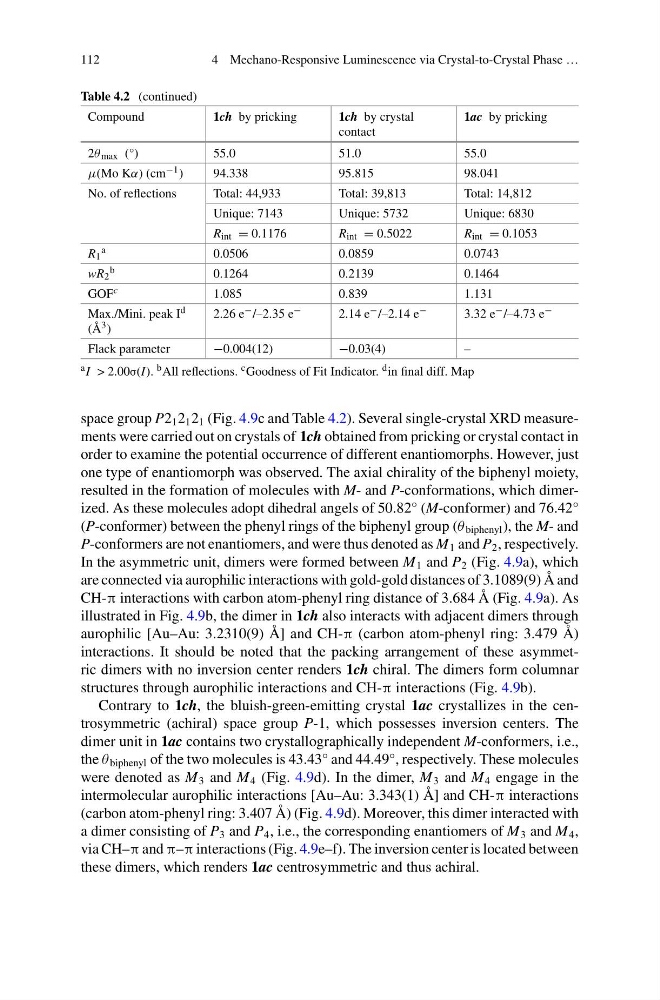
Table 4.2 (continued)
Compound
1ch by pricking
1ch by crystal
contact
1ac by pricking
2θ max (°)
55.0
51.0
55.0
μ(Mo Kα) (cm −1 )
94.338
95.815
98.041
No. of reflections
Total: 44,933
Total: 39,813
Total: 14,812
Unique: 7143
Unique: 5732
Unique: 6830
R int = 0.1176
R int = 0.5022
R int = 0.1053
R 1
a
0.0506
0.0859
0.0743
wR 2
b
0.1264
0.2139
0.1464
GOF c
1.085
0.839
1.131
Max./Mini. peak I d
(Å 3 )
2.26 e − /–2.35 e −
2.14 e − /–2.14 e −
3.32 e − /–4.73 e −
Flack parameter
−0.004(12)
−0.03(4)
–
a I > 2.00σ(I). b All reflections. c Goodness of Fit Indicator. d in final diff. Map
space group P2 1 2 1 2 1 (Fig. 4.9c and Table 4.2). Several single-crystal XRD measurements were carried out on crystals of 1ch obtained from pricking or crystal contact in
order to examine the potential occurrence of different enantiomorphs. However, just
one type of enantiomorph was observed. The axial chirality of the biphenyl moiety,
resulted in the formation of molecules with M- and P-conformations, which dimerized. As these molecules adopt dihedral angels of 50.82° (M-conformer) and 76.42°
(P-conformer) between the phenyl rings of the biphenyl group (θ biphenyl ), the M- and
P-conformers are not enantiomers, and were thus denoted as M 1 and P 2 , respectively.
In the asymmetric unit, dimers were formed between M 1 and P 2 (Fig. 4.9a), which
are connected via aurophilic interactions with gold-gold distances of 3.1089(9) Å and
CH-π interactions with carbon atom-phenyl ring distance of 3.684 Å (Fig. 4.9a). As
illustrated in Fig. 4.9b, the dimer in 1ch also interacts with adjacent dimers through
aurophilic [Au–Au: 3.2310(9) Å] and CH-π (carbon atom-phenyl ring: 3.479 Å)
interactions. It should be noted that the packing arrangement of these asymmetric dimers with no inversion center renders 1ch chiral. The dimers form columnar
structures through aurophilic interactions and CH-π interactions (Fig. 4.9b).
Contrary to 1ch, the bluish-green-emitting crystal 1ac crystallizes in the centrosymmetric (achiral) space group P-1, which possesses inversion centers. The
dimer unit in 1ac contains two crystallographically independent M-conformers, i.e.,
the θ biphenyl of the two molecules is 43.43° and 44.49°, respectively. These molecules
were denoted as M 3 and M 4 (Fig. 4.9d). In the dimer, M 3 and M 4 engage in the
intermolecular aurophilic interactions [Au–Au: 3.343(1) Å] and CH-π interactions
(carbon atom-phenyl ring: 3.407 Å) (Fig. 4.9d). Moreover, this dimer interacted with
a dimer consisting of P 3 and P 4 , i.e., the corresponding enantiomers of M 3 and M 4 ,
via CH–π and π–π interactions (Fig. 4.9e–f). The inversion center is located between
these dimers, which renders 1ac centrosymmetric and thus achiral.
4 Mechano-Responsive Luminescence via Crystal-to-Crystal Phase …
Table 4.2 (continued)
Compound
1ch by pricking
1ch by crystal
contact
1ac by pricking
2θ max (°)
55.0
51.0
55.0
μ(Mo Kα) (cm −1 )
94.338
95.815
98.041
No. of reflections
Total: 44,933
Total: 39,813
Total: 14,812
Unique: 7143
Unique: 5732
Unique: 6830
R int = 0.1176
R int = 0.5022
R int = 0.1053
R 1
a
0.0506
0.0859
0.0743
wR 2
b
0.1264
0.2139
0.1464
GOF c
1.085
0.839
1.131
Max./Mini. peak I d
(Å 3 )
2.26 e − /–2.35 e −
2.14 e − /–2.14 e −
3.32 e − /–4.73 e −
Flack parameter
−0.004(12)
−0.03(4)
–
a I > 2.00σ(I). b All reflections. c Goodness of Fit Indicator. d in final diff. Map
space group P2 1 2 1 2 1 (Fig. 4.9c and Table 4.2). Several single-crystal XRD measurements were carried out on crystals of 1ch obtained from pricking or crystal contact in
order to examine the potential occurrence of different enantiomorphs. However, just
one type of enantiomorph was observed. The axial chirality of the biphenyl moiety,
resulted in the formation of molecules with M- and P-conformations, which dimerized. As these molecules adopt dihedral angels of 50.82° (M-conformer) and 76.42°
(P-conformer) between the phenyl rings of the biphenyl group (θ biphenyl ), the M- and
P-conformers are not enantiomers, and were thus denoted as M 1 and P 2 , respectively.
In the asymmetric unit, dimers were formed between M 1 and P 2 (Fig. 4.9a), which
are connected via aurophilic interactions with gold-gold distances of 3.1089(9) Å and
CH-π interactions with carbon atom-phenyl ring distance of 3.684 Å (Fig. 4.9a). As
illustrated in Fig. 4.9b, the dimer in 1ch also interacts with adjacent dimers through
aurophilic [Au–Au: 3.2310(9) Å] and CH-π (carbon atom-phenyl ring: 3.479 Å)
interactions. It should be noted that the packing arrangement of these asymmetric dimers with no inversion center renders 1ch chiral. The dimers form columnar
structures through aurophilic interactions and CH-π interactions (Fig. 4.9b).
Contrary to 1ch, the bluish-green-emitting crystal 1ac crystallizes in the centrosymmetric (achiral) space group P-1, which possesses inversion centers. The
dimer unit in 1ac contains two crystallographically independent M-conformers, i.e.,
the θ biphenyl of the two molecules is 43.43° and 44.49°, respectively. These molecules
were denoted as M 3 and M 4 (Fig. 4.9d). In the dimer, M 3 and M 4 engage in the
intermolecular aurophilic interactions [Au–Au: 3.343(1) Å] and CH-π interactions
(carbon atom-phenyl ring: 3.407 Å) (Fig. 4.9d). Moreover, this dimer interacted with
a dimer consisting of P 3 and P 4 , i.e., the corresponding enantiomers of M 3 and M 4 ,
via CH–π and π–π interactions (Fig. 4.9e–f). The inversion center is located between
these dimers, which renders 1ac centrosymmetric and thus achiral.