

82
M. Senami and A. Fukushima
−6.0
0.0
6.0
[bohr]
−6.0
0.0
6.0
[bohr]
−1.0
0.0
1.0
4
0.1
4
0.1
La
O
(a)
(a)
−6.0
0.0
6.0
[bohr]
−6.0
0.0
6.0
[bohr]
−1.0
0.0
1.0
4
0.1
4
0.1
La
O
(b)
−6.0
0.0
6.0
[bohr]
−6.0
0.0
6.0
[bohr]
−1.0
0.0
1.0
4
0.1
4
0.1
La
O
(c)
−1
0
1
0 /
i [−]
i =1
i =2
i =3
0
1
La
O
|sin|
(d)
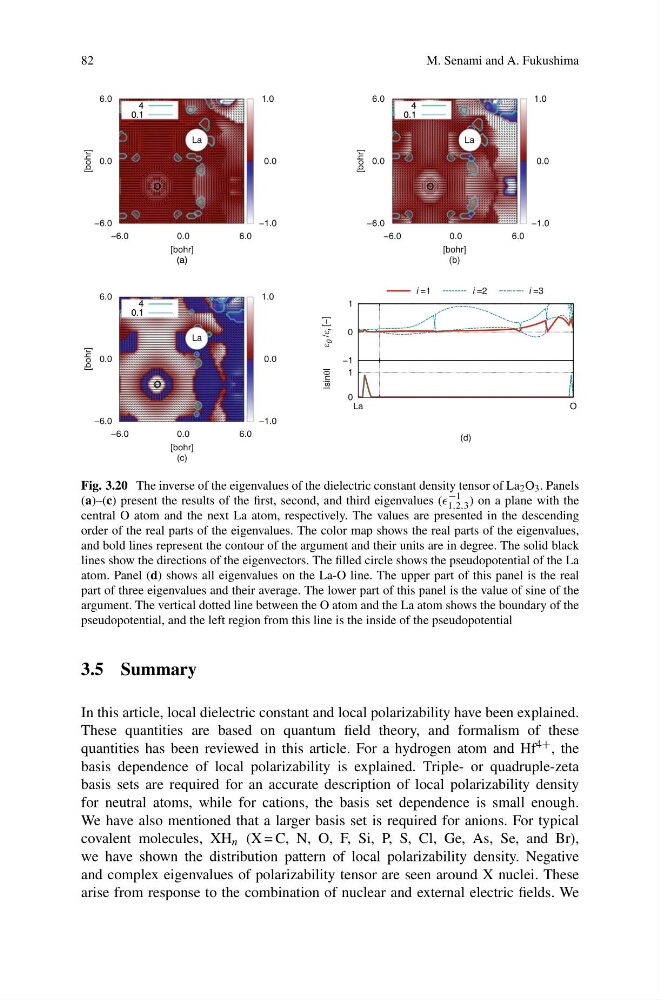
Fig. 3.20 The inverse of the eigenvalues of the dielectric constant density tensor of La 2 O 3 . Panels
(a)–(c) present the results of the first, second, and third eigenvalues (
−1
1,2,3 ) on a plane with the
central O atom and the next La atom, respectively. The values are presented in the descending
order of the real parts of the eigenvalues. The color map shows the real parts of the eigenvalues,
and bold lines represent the contour of the argument and their units are in degree. The solid black
lines show the directions of the eigenvectors. The filled circle shows the pseudopotential of the La
atom. Panel (d) shows all eigenvalues on the La-O line. The upper part of this panel is the real
part of three eigenvalues and their average. The lower part of this panel is the value of sine of the
argument. The vertical dotted line between the O atom and the La atom shows the boundary of the
pseudopotential, and the left region from this line is the inside of the pseudopotential
3.5 Summary
In this article, local dielectric constant and local polarizability have been explained.
These quantities are based on quantum field theory, and formalism of these
quantities has been reviewed in this article. For a hydrogen atom and Hf 4+ , the
basis dependence of local polarizability is explained. Triple- or quadruple-zeta
basis sets are required for an accurate description of local polarizability density
for neutral atoms, while for cations, the basis set dependence is small enough.
We have also mentioned that a larger basis set is required for anions. For typical
covalent molecules, XH n (X = C, N, O, F, Si, P, S, Cl, Ge, As, Se, and Br),
we have shown the distribution pattern of local polarizability density. Negative
and complex eigenvalues of polarizability tensor are seen around X nuclei. These
arise from response to the combination of nuclear and external electric fields. We
M. Senami and A. Fukushima
−6.0
0.0
6.0
[bohr]
−6.0
0.0
6.0
[bohr]
−1.0
0.0
1.0
4
0.1
4
0.1
La
O
(a)
(a)
−6.0
0.0
6.0
[bohr]
−6.0
0.0
6.0
[bohr]
−1.0
0.0
1.0
4
0.1
4
0.1
La
O
(b)
−6.0
0.0
6.0
[bohr]
−6.0
0.0
6.0
[bohr]
−1.0
0.0
1.0
4
0.1
4
0.1
La
O
(c)
−1
0
1
0 /
i [−]
i =1
i =2
i =3
0
1
La
O
|sin|
(d)
Fig. 3.20 The inverse of the eigenvalues of the dielectric constant density tensor of La 2 O 3 . Panels
(a)–(c) present the results of the first, second, and third eigenvalues (
−1
1,2,3 ) on a plane with the
central O atom and the next La atom, respectively. The values are presented in the descending
order of the real parts of the eigenvalues. The color map shows the real parts of the eigenvalues,
and bold lines represent the contour of the argument and their units are in degree. The solid black
lines show the directions of the eigenvectors. The filled circle shows the pseudopotential of the La
atom. Panel (d) shows all eigenvalues on the La-O line. The upper part of this panel is the real
part of three eigenvalues and their average. The lower part of this panel is the value of sine of the
argument. The vertical dotted line between the O atom and the La atom shows the boundary of the
pseudopotential, and the left region from this line is the inside of the pseudopotential
3.5 Summary
In this article, local dielectric constant and local polarizability have been explained.
These quantities are based on quantum field theory, and formalism of these
quantities has been reviewed in this article. For a hydrogen atom and Hf 4+ , the
basis dependence of local polarizability is explained. Triple- or quadruple-zeta
basis sets are required for an accurate description of local polarizability density
for neutral atoms, while for cations, the basis set dependence is small enough.
We have also mentioned that a larger basis set is required for anions. For typical
covalent molecules, XH n (X = C, N, O, F, Si, P, S, Cl, Ge, As, Se, and Br),
we have shown the distribution pattern of local polarizability density. Negative
and complex eigenvalues of polarizability tensor are seen around X nuclei. These
arise from response to the combination of nuclear and external electric fields. We