

3 Local Dielectric Constant Density Analysis of High-k Dielectric Nanomaterial
55
motion has a significant different feature. In quantum mechanics, the time evolution
of a physical quantity is given by Heisenberg equation. A physical quantity used in
Heisenberg equation of quantum mechanics is given as the inner product defined
by the integration over the whole space. Hence, Heisenberg equation in quantum
mechanics does not describe the evolution of a physical quantity density in a specific
local region. In quantum field theory, the density value of a physical quantity can be
treated simply by a field operator and its physical quantity operator. For example,
electromagnetic field even in classical field theory can be described as a local density
quantity. The time evolution of a physical quantity can be described even for the
density in field theory. Therefore, only quantum field theory can explain the behavior
of a physical quantity in a local region, and we believe that the analysis in a local
region of a device material should be studied based on this theory.
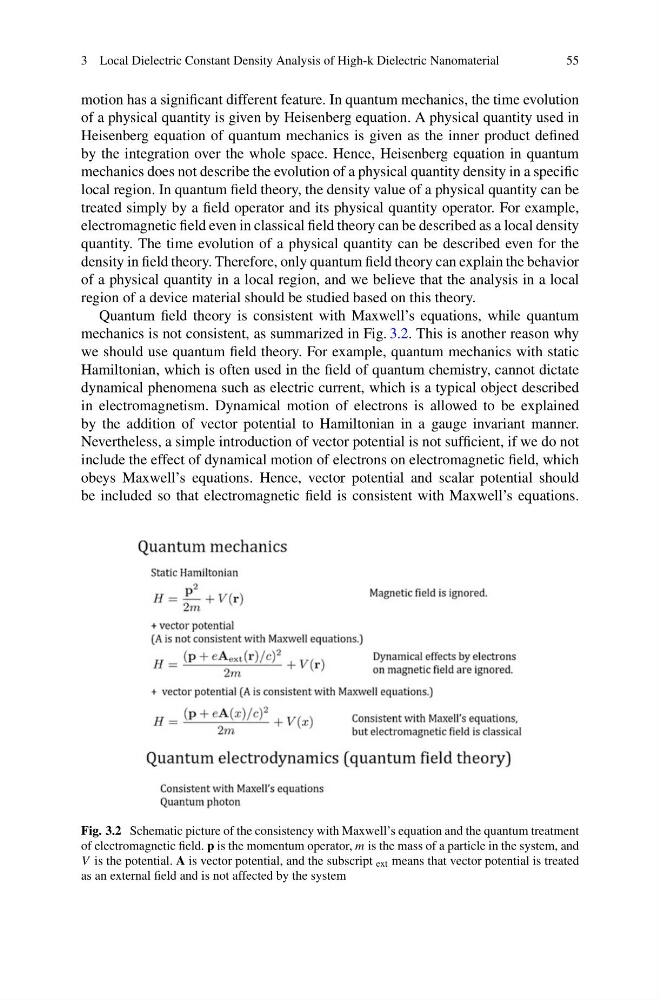
Quantum field theory is consistent with Maxwell’s equations, while quantum
mechanics is not consistent, as summarized in Fig. 3.2. This is another reason why
we should use quantum field theory. For example, quantum mechanics with static
Hamiltonian, which is often used in the field of quantum chemistry, cannot dictate
dynamical phenomena such as electric current, which is a typical object described
in electromagnetism. Dynamical motion of electrons is allowed to be explained
by the addition of vector potential to Hamiltonian in a gauge invariant manner.
Nevertheless, a simple introduction of vector potential is not sufficient, if we do not
include the effect of dynamical motion of electrons on electromagnetic field, which
obeys Maxwell’s equations. Hence, vector potential and scalar potential should
be included so that electromagnetic field is consistent with Maxwell’s equations.
Fig. 3.2 Schematic picture of the consistency with Maxwell’s equation and the quantum treatment
of electromagnetic field. p is the momentum operator, m is the mass of a particle in the system, and
V is the potential. A is vector potential, and the subscript ext means that vector potential is treated
as an external field and is not affected by the system
55
motion has a significant different feature. In quantum mechanics, the time evolution
of a physical quantity is given by Heisenberg equation. A physical quantity used in
Heisenberg equation of quantum mechanics is given as the inner product defined
by the integration over the whole space. Hence, Heisenberg equation in quantum
mechanics does not describe the evolution of a physical quantity density in a specific
local region. In quantum field theory, the density value of a physical quantity can be
treated simply by a field operator and its physical quantity operator. For example,
electromagnetic field even in classical field theory can be described as a local density
quantity. The time evolution of a physical quantity can be described even for the
density in field theory. Therefore, only quantum field theory can explain the behavior
of a physical quantity in a local region, and we believe that the analysis in a local
region of a device material should be studied based on this theory.
Quantum field theory is consistent with Maxwell’s equations, while quantum
mechanics is not consistent, as summarized in Fig. 3.2. This is another reason why
we should use quantum field theory. For example, quantum mechanics with static
Hamiltonian, which is often used in the field of quantum chemistry, cannot dictate
dynamical phenomena such as electric current, which is a typical object described
in electromagnetism. Dynamical motion of electrons is allowed to be explained
by the addition of vector potential to Hamiltonian in a gauge invariant manner.
Nevertheless, a simple introduction of vector potential is not sufficient, if we do not
include the effect of dynamical motion of electrons on electromagnetic field, which
obeys Maxwell’s equations. Hence, vector potential and scalar potential should
be included so that electromagnetic field is consistent with Maxwell’s equations.
Fig. 3.2 Schematic picture of the consistency with Maxwell’s equation and the quantum treatment
of electromagnetic field. p is the momentum operator, m is the mass of a particle in the system, and
V is the potential. A is vector potential, and the subscript ext means that vector potential is treated
as an external field and is not affected by the system