

48
T. Onishi
MO30 (Min) = 0.12φ K1 (3pz)
+ 0.26φ H1
1s
+0.43φ H1
1s
+0.10φ H2
1s
+0.16φ H2
1s
+ 0.10φ H3
1s
+ 0.16φ H3
1s
− 0.12φ Mg1 (2s) + 0.20φ Mg1
3s
+ 0.13φ Mg2
3s
(2.15)
MO30 (Max) = − 0.14φ K1 (3pz)
− 0.30φ H1
1s
−0.47φ H1
1s
−0.11φ H2
1s
−0.11φ H3
1s
+ 0.17φ Mg1 (2s) − 0.22φ Mg1
3s
(2.16)
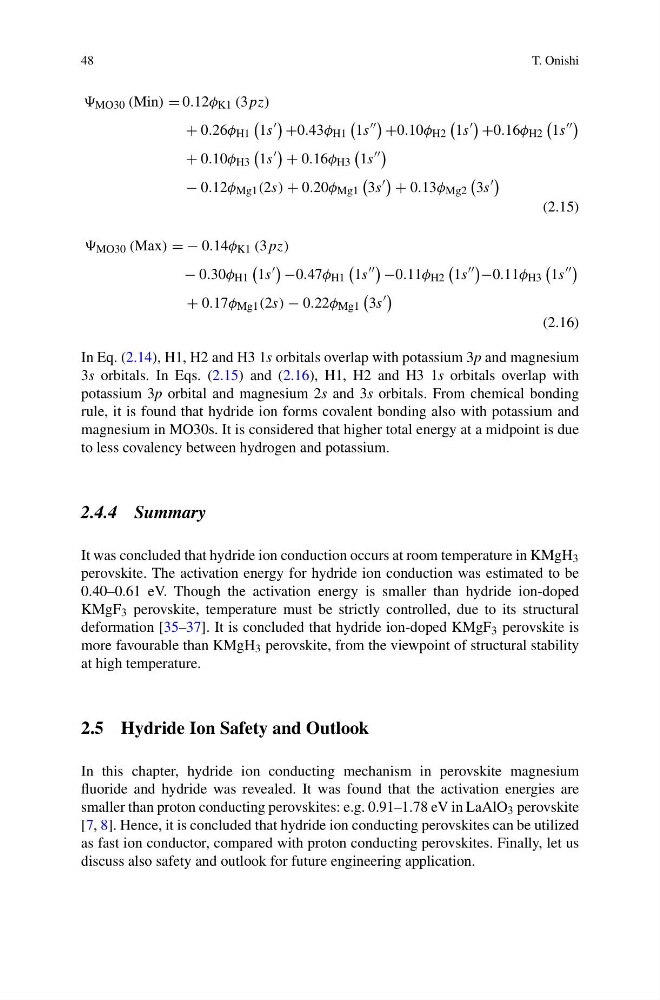
In Eq. (2.14), H1, H2 and H3 1s orbitals overlap with potassium 3p and magnesium
3s orbitals. In Eqs. (2.15) and (2.16), H1, H2 and H3 1s orbitals overlap with
potassium 3p orbital and magnesium 2s and 3s orbitals. From chemical bonding
rule, it is found that hydride ion forms covalent bonding also with potassium and
magnesium in MO30s. It is considered that higher total energy at a midpoint is due
to less covalency between hydrogen and potassium.
2.4.4 Summary
It was concluded that hydride ion conduction occurs at room temperature in KMgH 3
perovskite. The activation energy for hydride ion conduction was estimated to be
0.40–0.61 eV. Though the activation energy is smaller than hydride ion-doped
KMgF 3 perovskite, temperature must be strictly controlled, due to its structural
deformation [35–37]. It is concluded that hydride ion-doped KMgF 3 perovskite is
more favourable than KMgH 3 perovskite, from the viewpoint of structural stability
at high temperature.
2.5 Hydride Ion Safety and Outlook
In this chapter, hydride ion conducting mechanism in perovskite magnesium
fluoride and hydride was revealed. It was found that the activation energies are
smaller than proton conducting perovskites: e.g. 0.91–1.78 eV in LaAlO 3 perovskite
[7, 8]. Hence, it is concluded that hydride ion conducting perovskites can be utilized
as fast ion conductor, compared with proton conducting perovskites. Finally, let us
discuss also safety and outlook for future engineering application.
T. Onishi
MO30 (Min) = 0.12φ K1 (3pz)
+ 0.26φ H1
1s
+0.43φ H1
1s
+0.10φ H2
1s
+0.16φ H2
1s
+ 0.10φ H3
1s
+ 0.16φ H3
1s
− 0.12φ Mg1 (2s) + 0.20φ Mg1
3s
+ 0.13φ Mg2
3s
(2.15)
MO30 (Max) = − 0.14φ K1 (3pz)
− 0.30φ H1
1s
−0.47φ H1
1s
−0.11φ H2
1s
−0.11φ H3
1s
+ 0.17φ Mg1 (2s) − 0.22φ Mg1
3s
(2.16)
In Eq. (2.14), H1, H2 and H3 1s orbitals overlap with potassium 3p and magnesium
3s orbitals. In Eqs. (2.15) and (2.16), H1, H2 and H3 1s orbitals overlap with
potassium 3p orbital and magnesium 2s and 3s orbitals. From chemical bonding
rule, it is found that hydride ion forms covalent bonding also with potassium and
magnesium in MO30s. It is considered that higher total energy at a midpoint is due
to less covalency between hydrogen and potassium.
2.4.4 Summary
It was concluded that hydride ion conduction occurs at room temperature in KMgH 3
perovskite. The activation energy for hydride ion conduction was estimated to be
0.40–0.61 eV. Though the activation energy is smaller than hydride ion-doped
KMgF 3 perovskite, temperature must be strictly controlled, due to its structural
deformation [35–37]. It is concluded that hydride ion-doped KMgF 3 perovskite is
more favourable than KMgH 3 perovskite, from the viewpoint of structural stability
at high temperature.
2.5 Hydride Ion Safety and Outlook
In this chapter, hydride ion conducting mechanism in perovskite magnesium
fluoride and hydride was revealed. It was found that the activation energies are
smaller than proton conducting perovskites: e.g. 0.91–1.78 eV in LaAlO 3 perovskite
[7, 8]. Hence, it is concluded that hydride ion conducting perovskites can be utilized
as fast ion conductor, compared with proton conducting perovskites. Finally, let us
discuss also safety and outlook for future engineering application.