

46
T. Onishi
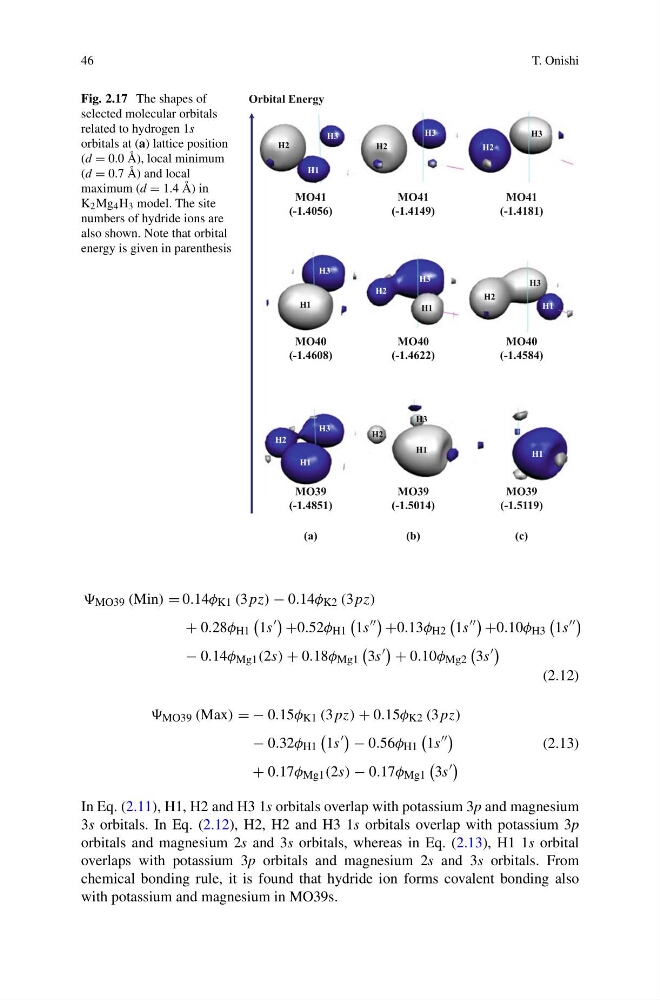
Fig. 2.17 The shapes of
selected molecular orbitals
related to hydrogen 1s
orbitals at (a) lattice position
(d = 0.0 Å), local minimum
(d = 0.7 Å) and local
maximum (d = 1.4 Å) in
K 2 Mg 4 H 3 model. The site
numbers of hydride ions are
also shown. Note that orbital
energy is given in parenthesis
Orbital Energy
(a)
(b)
MO39
(-1.4851)
MO40
(-1.4608)
MO41
(-1.4056)
(c)
MO39
(-1.5014)
MO40
(-1.4622)
MO41
(-1.4149)
MO39
(-1.5119)
MO40
(-1.4584)
MO41
(-1.4181)
H1
H2
H3
H1
H3
H1
H2
H3
H1
H2
H3
H1
H2
H3
H2
H3
H2
H3
H1
H2
H3
H1
MO39 (Min) = 0.14φ K1 (3pz) − 0.14φ K2 (3pz)
+ 0.28φ H1
1s
+0.52φ H1
1s
+0.13φ H2
1s
+0.10φ H3
1s
− 0.14φ Mg1 (2s) + 0.18φ Mg1
3s
+ 0.10φ Mg2
3s
(2.12)
MO39 (Max) = − 0.15φ K1 (3pz) + 0.15φ K2 (3pz)
− 0.32φ H1
1s
− 0.56φ H1
1s
+ 0.17φ Mg1 (2s) − 0.17φ Mg1
3s
(2.13)
In Eq. (2.11), H1, H2 and H3 1s orbitals overlap with potassium 3p and magnesium
3s orbitals. In Eq. (2.12), H2, H2 and H3 1s orbitals overlap with potassium 3p
orbitals and magnesium 2s and 3s orbitals, whereas in Eq. (2.13), H1 1s orbital
overlaps with potassium 3p orbitals and magnesium 2s and 3s orbitals. From
chemical bonding rule, it is found that hydride ion forms covalent bonding also
with potassium and magnesium in MO39s.
T. Onishi
Fig. 2.17 The shapes of
selected molecular orbitals
related to hydrogen 1s
orbitals at (a) lattice position
(d = 0.0 Å), local minimum
(d = 0.7 Å) and local
maximum (d = 1.4 Å) in
K 2 Mg 4 H 3 model. The site
numbers of hydride ions are
also shown. Note that orbital
energy is given in parenthesis
Orbital Energy
(a)
(b)
MO39
(-1.4851)
MO40
(-1.4608)
MO41
(-1.4056)
(c)
MO39
(-1.5014)
MO40
(-1.4622)
MO41
(-1.4149)
MO39
(-1.5119)
MO40
(-1.4584)
MO41
(-1.4181)
H1
H2
H3
H1
H3
H1
H2
H3
H1
H2
H3
H1
H2
H3
H2
H3
H2
H3
H1
H2
H3
H1
MO39 (Min) = 0.14φ K1 (3pz) − 0.14φ K2 (3pz)
+ 0.28φ H1
1s
+0.52φ H1
1s
+0.13φ H2
1s
+0.10φ H3
1s
− 0.14φ Mg1 (2s) + 0.18φ Mg1
3s
+ 0.10φ Mg2
3s
(2.12)
MO39 (Max) = − 0.15φ K1 (3pz) + 0.15φ K2 (3pz)
− 0.32φ H1
1s
− 0.56φ H1
1s
+ 0.17φ Mg1 (2s) − 0.17φ Mg1
3s
(2.13)
In Eq. (2.11), H1, H2 and H3 1s orbitals overlap with potassium 3p and magnesium
3s orbitals. In Eq. (2.12), H2, H2 and H3 1s orbitals overlap with potassium 3p
orbitals and magnesium 2s and 3s orbitals, whereas in Eq. (2.13), H1 1s orbital
overlaps with potassium 3p orbitals and magnesium 2s and 3s orbitals. From
chemical bonding rule, it is found that hydride ion forms covalent bonding also
with potassium and magnesium in MO39s.