

14 Simulating Quantum Dynamics in Classical Nanoscale Environments
541
driving strength on the population and coherence dynamics of the quantum dot,
as well as on the rate of change of the metamolecule energy, were presented and
discussed. Interestingly, in the strong subsystem-field coupling case, large and
irregular variations in the populations and coherences of the quantum dot were
observed.
The QCLE-based approach to modelling quantum dynamics in classical environments has proven to be successful in studying a variety of quantum processes at
the nanoscale. Nevertheless, the currently available algorithms present significant
challenges, necessitating the need for further improvements and developments.
Thus, we hope that this chapter will stimulate research along this direction. In
addition, we are interested in broadening the scope of applications studied by
the methods discussed herein. In particular, we believe that these methods can be
effectively used to study energy and charge transfer dynamics in nanoscale devices.
Appendix
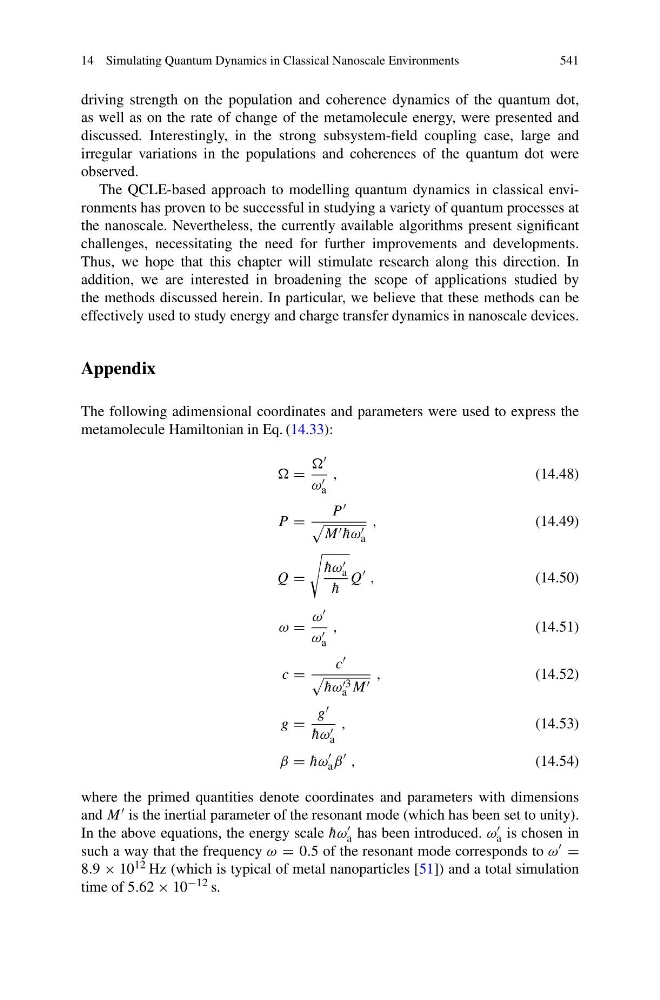
The following adimensional coordinates and parameters were used to express the
metamolecule Hamiltonian in Eq. (14.33):
=
ω
a
,
(14.48)
P =
P
M ¯
hω
a
,
(14.49)
Q =
¯
hω
a
¯
h
Q
,
(14.50)
ω =
ω
ω
a
,
(14.51)
c =
c
¯
hω 3
a M
,
(14.52)
g =
g
¯
hω
a
,
(14.53)
β = ¯
hω
a β
,
(14.54)
where the primed quantities denote coordinates and parameters with dimensions
and M is the inertial parameter of the resonant mode (which has been set to unity).
In the above equations, the energy scale ¯
hω
a has been introduced. ω
a is chosen in
such a way that the frequency ω = 0.5 of the resonant mode corresponds to ω =
8.9 × 10 12 Hz (which is typical of metal nanoparticles [51]) and a total simulation
time of 5.62 × 10 −12 s.
541
driving strength on the population and coherence dynamics of the quantum dot,
as well as on the rate of change of the metamolecule energy, were presented and
discussed. Interestingly, in the strong subsystem-field coupling case, large and
irregular variations in the populations and coherences of the quantum dot were
observed.
The QCLE-based approach to modelling quantum dynamics in classical environments has proven to be successful in studying a variety of quantum processes at
the nanoscale. Nevertheless, the currently available algorithms present significant
challenges, necessitating the need for further improvements and developments.
Thus, we hope that this chapter will stimulate research along this direction. In
addition, we are interested in broadening the scope of applications studied by
the methods discussed herein. In particular, we believe that these methods can be
effectively used to study energy and charge transfer dynamics in nanoscale devices.
Appendix
The following adimensional coordinates and parameters were used to express the
metamolecule Hamiltonian in Eq. (14.33):
=
ω
a
,
(14.48)
P =
P
M ¯
hω
a
,
(14.49)
Q =
¯
hω
a
¯
h
Q
,
(14.50)
ω =
ω
ω
a
,
(14.51)
c =
c
¯
hω 3
a M
,
(14.52)
g =
g
¯
hω
a
,
(14.53)
β = ¯
hω
a β
,
(14.54)
where the primed quantities denote coordinates and parameters with dimensions
and M is the inertial parameter of the resonant mode (which has been set to unity).
In the above equations, the energy scale ¯
hω
a has been introduced. ω
a is chosen in
such a way that the frequency ω = 0.5 of the resonant mode corresponds to ω =
8.9 × 10 12 Hz (which is typical of metal nanoparticles [51]) and a total simulation
time of 5.62 × 10 −12 s.