

14 Simulating Quantum Dynamics in Classical Nanoscale Environments
517
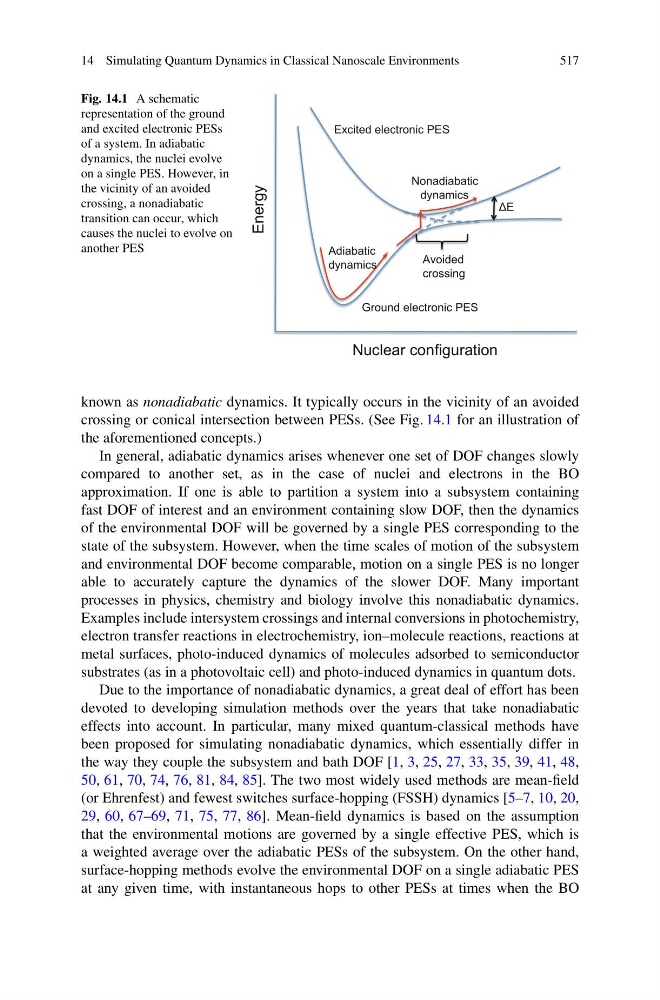
Fig. 14.1 A schematic
representation of the ground
and excited electronic PESs
of a system. In adiabatic
dynamics, the nuclei evolve
on a single PES. However, in
the vicinity of an avoided
crossing, a nonadiabatic
transition can occur, which
causes the nuclei to evolve on
another PES
Energy
Nuclear configuration
Ground electronic PES
Excited electronic PES
E
Avoided
crossing
Adiabatic
dynamics
Nonadiabatic
dynamics
known as nonadiabatic dynamics. It typically occurs in the vicinity of an avoided
crossing or conical intersection between PESs. (See Fig. 14.1 for an illustration of
the aforementioned concepts.)
In general, adiabatic dynamics arises whenever one set of DOF changes slowly
compared to another set, as in the case of nuclei and electrons in the BO
approximation. If one is able to partition a system into a subsystem containing
fast DOF of interest and an environment containing slow DOF, then the dynamics
of the environmental DOF will be governed by a single PES corresponding to the
state of the subsystem. However, when the time scales of motion of the subsystem
and environmental DOF become comparable, motion on a single PES is no longer
able to accurately capture the dynamics of the slower DOF. Many important
processes in physics, chemistry and biology involve this nonadiabatic dynamics.
Examples include intersystem crossings and internal conversions in photochemistry,
electron transfer reactions in electrochemistry, ion–molecule reactions, reactions at
metal surfaces, photo-induced dynamics of molecules adsorbed to semiconductor
substrates (as in a photovoltaic cell) and photo-induced dynamics in quantum dots.
Due to the importance of nonadiabatic dynamics, a great deal of effort has been
devoted to developing simulation methods over the years that take nonadiabatic
effects into account. In particular, many mixed quantum-classical methods have
been proposed for simulating nonadiabatic dynamics, which essentially differ in
the way they couple the subsystem and bath DOF [1, 3, 25, 27, 33, 35, 39, 41, 48,
50, 61, 70, 74, 76, 81, 84, 85]. The two most widely used methods are mean-field
(or Ehrenfest) and fewest switches surface-hopping (FSSH) dynamics [5–7, 10, 20,
29, 60, 67–69, 71, 75, 77, 86]. Mean-field dynamics is based on the assumption
that the environmental motions are governed by a single effective PES, which is
a weighted average over the adiabatic PESs of the subsystem. On the other hand,
surface-hopping methods evolve the environmental DOF on a single adiabatic PES
at any given time, with instantaneous hops to other PESs at times when the BO
517
Fig. 14.1 A schematic
representation of the ground
and excited electronic PESs
of a system. In adiabatic
dynamics, the nuclei evolve
on a single PES. However, in
the vicinity of an avoided
crossing, a nonadiabatic
transition can occur, which
causes the nuclei to evolve on
another PES
Energy
Nuclear configuration
Ground electronic PES
Excited electronic PES
E
Avoided
crossing
Adiabatic
dynamics
Nonadiabatic
dynamics
known as nonadiabatic dynamics. It typically occurs in the vicinity of an avoided
crossing or conical intersection between PESs. (See Fig. 14.1 for an illustration of
the aforementioned concepts.)
In general, adiabatic dynamics arises whenever one set of DOF changes slowly
compared to another set, as in the case of nuclei and electrons in the BO
approximation. If one is able to partition a system into a subsystem containing
fast DOF of interest and an environment containing slow DOF, then the dynamics
of the environmental DOF will be governed by a single PES corresponding to the
state of the subsystem. However, when the time scales of motion of the subsystem
and environmental DOF become comparable, motion on a single PES is no longer
able to accurately capture the dynamics of the slower DOF. Many important
processes in physics, chemistry and biology involve this nonadiabatic dynamics.
Examples include intersystem crossings and internal conversions in photochemistry,
electron transfer reactions in electrochemistry, ion–molecule reactions, reactions at
metal surfaces, photo-induced dynamics of molecules adsorbed to semiconductor
substrates (as in a photovoltaic cell) and photo-induced dynamics in quantum dots.
Due to the importance of nonadiabatic dynamics, a great deal of effort has been
devoted to developing simulation methods over the years that take nonadiabatic
effects into account. In particular, many mixed quantum-classical methods have
been proposed for simulating nonadiabatic dynamics, which essentially differ in
the way they couple the subsystem and bath DOF [1, 3, 25, 27, 33, 35, 39, 41, 48,
50, 61, 70, 74, 76, 81, 84, 85]. The two most widely used methods are mean-field
(or Ehrenfest) and fewest switches surface-hopping (FSSH) dynamics [5–7, 10, 20,
29, 60, 67–69, 71, 75, 77, 86]. Mean-field dynamics is based on the assumption
that the environmental motions are governed by a single effective PES, which is
a weighted average over the adiabatic PESs of the subsystem. On the other hand,
surface-hopping methods evolve the environmental DOF on a single adiabatic PES
at any given time, with instantaneous hops to other PESs at times when the BO