

508
N. C. Bacalis
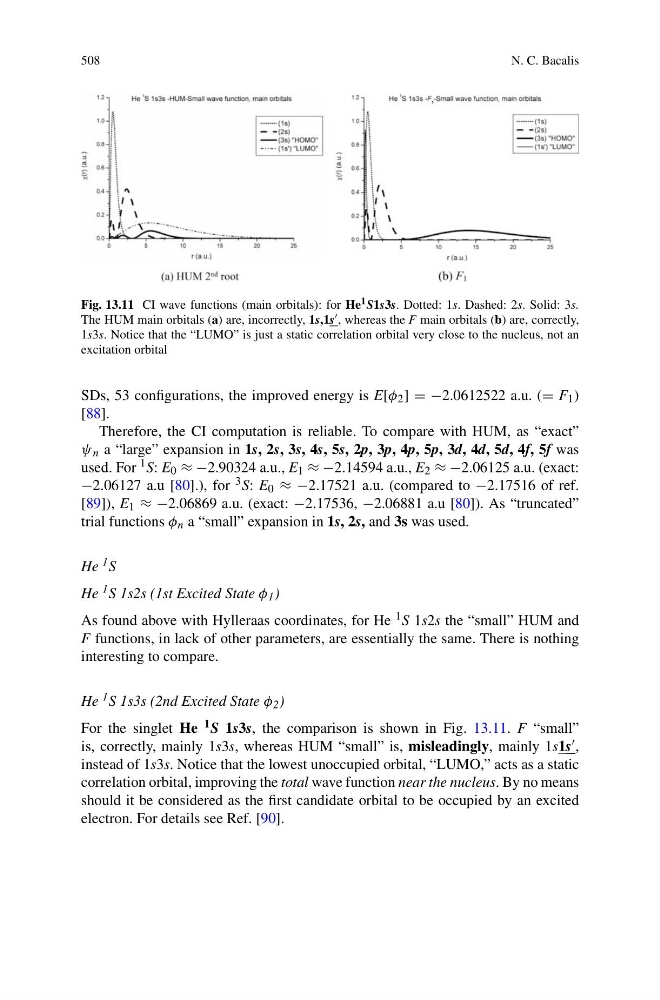
Fig. 13.11 CI wave functions (main orbitals): for He 1 S1s3s. Dotted: 1s. Dashed: 2s. Solid: 3s.
The HUM main orbitals (a) are, incorrectly, 1s,1s , whereas the F main orbitals (b) are, correctly,
1s3s. Notice that the “LUMO” is just a static correlation orbital very close to the nucleus, not an
excitation orbital
SDs, 53 configurations, the improved energy is E[φ 2 ] = −2.0612522 a.u. (= F 1 )
[88].
Therefore, the CI computation is reliable. To compare with HUM, as “exact”
ψ n a “large” expansion in 1s, 2s, 3s, 4s, 5s, 2p, 3p, 4p, 5p, 3d, 4d, 5d, 4f, 5f was
used. For 1 S: E 0 ≈ −2.90324 a.u., E 1 ≈ −2.14594 a.u., E 2 ≈ −2.06125 a.u. (exact:
−2.06127 a.u [80].), for 3 S: E 0 ≈ −2.17521 a.u. (compared to −2.17516 of ref.
[89]), E 1 ≈ −2.06869 a.u. (exact: −2.17536, −2.06881 a.u [80]). As “truncated”
trial functions φ n a “small” expansion in 1s, 2s, and 3s was used.
He 1 S
He 1 S 1s2s (1st Excited State φ 1 )
As found above with Hylleraas coordinates, for He 1 S 1s2s the “small” HUM and
F functions, in lack of other parameters, are essentially the same. There is nothing
interesting to compare.
He 1 S 1s3s (2nd Excited State φ 2 )
For the singlet He 1 S 1s3s, the comparison is shown in Fig. 13.11. F “small”
is, correctly, mainly 1s3s, whereas HUM “small” is, misleadingly, mainly 1s1s ,
instead of 1s3s. Notice that the lowest unoccupied orbital, “LUMO,” acts as a static
correlation orbital, improving the total wave function near the nucleus. By no means
should it be considered as the first candidate orbital to be occupied by an excited
electron. For details see Ref. [90].
N. C. Bacalis
Fig. 13.11 CI wave functions (main orbitals): for He 1 S1s3s. Dotted: 1s. Dashed: 2s. Solid: 3s.
The HUM main orbitals (a) are, incorrectly, 1s,1s , whereas the F main orbitals (b) are, correctly,
1s3s. Notice that the “LUMO” is just a static correlation orbital very close to the nucleus, not an
excitation orbital
SDs, 53 configurations, the improved energy is E[φ 2 ] = −2.0612522 a.u. (= F 1 )
[88].
Therefore, the CI computation is reliable. To compare with HUM, as “exact”
ψ n a “large” expansion in 1s, 2s, 3s, 4s, 5s, 2p, 3p, 4p, 5p, 3d, 4d, 5d, 4f, 5f was
used. For 1 S: E 0 ≈ −2.90324 a.u., E 1 ≈ −2.14594 a.u., E 2 ≈ −2.06125 a.u. (exact:
−2.06127 a.u [80].), for 3 S: E 0 ≈ −2.17521 a.u. (compared to −2.17516 of ref.
[89]), E 1 ≈ −2.06869 a.u. (exact: −2.17536, −2.06881 a.u [80]). As “truncated”
trial functions φ n a “small” expansion in 1s, 2s, and 3s was used.
He 1 S
He 1 S 1s2s (1st Excited State φ 1 )
As found above with Hylleraas coordinates, for He 1 S 1s2s the “small” HUM and
F functions, in lack of other parameters, are essentially the same. There is nothing
interesting to compare.
He 1 S 1s3s (2nd Excited State φ 2 )
For the singlet He 1 S 1s3s, the comparison is shown in Fig. 13.11. F “small”
is, correctly, mainly 1s3s, whereas HUM “small” is, misleadingly, mainly 1s1s ,
instead of 1s3s. Notice that the lowest unoccupied orbital, “LUMO,” acts as a static
correlation orbital, improving the total wave function near the nucleus. By no means
should it be considered as the first candidate orbital to be occupied by an excited
electron. For details see Ref. [90].