

13 If Truncated Wave Functions of Excited State Energy Saddle Points Are. . .
503
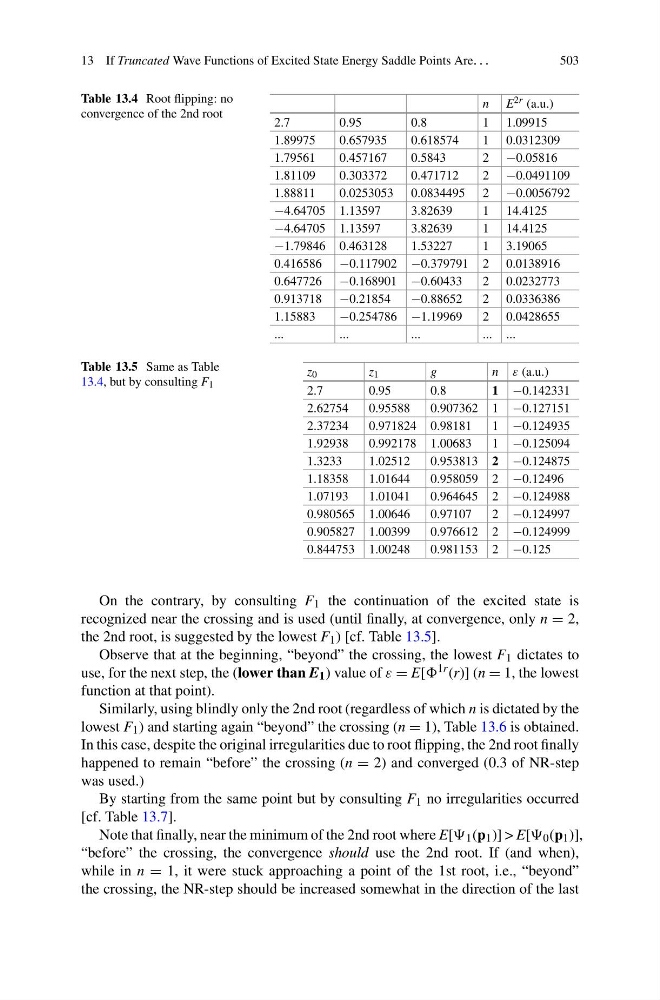
Table 13.4 Root flipping: no
convergence of the 2nd root
n E 2r (a.u.)
2.7
0.95
0.8
1 1.09915
1.89975
0.657935
0.618574
1 0.0312309
1.79561
0.457167
0.5843
2 −0.05816
1.81109
0.303372
0.471712
2 −0.0491109
1.88811
0.0253053 0.0834495 2 −0.0056792
−4.64705 1.13597
3.82639
1 14.4125
−4.64705 1.13597
3.82639
1 14.4125
−1.79846 0.463128
1.53227
1 3.19065
0.416586 −0.117902 −0.379791 2 0.0138916
0.647726 −0.168901 −0.60433
2 0.0232773
0.913718 −0.21854
−0.88652
2 0.0336386
1.15883
−0.254786 −1.19969
2 0.0428655
...
...
...
... ...
Table 13.5 Same as Table
13.4, but by consulting F 1
z 0
z 1
g
n ε (a.u.)
2.7
0.95
0.8
1 −0.142331
2.62754
0.95588
0.907362 1 −0.127151
2.37234
0.971824 0.98181
1 −0.124935
1.92938
0.992178 1.00683
1 −0.125094
1.3233
1.02512
0.953813 2 −0.124875
1.18358
1.01644
0.958059 2 −0.12496
1.07193
1.01041
0.964645 2 −0.124988
0.980565 1.00646
0.97107
2 −0.124997
0.905827 1.00399
0.976612 2 −0.124999
0.844753 1.00248
0.981153 2 −0.125
On the contrary, by consulting F 1 the continuation of the excited state is
recognized near the crossing and is used (until finally, at convergence, only n = 2,
the 2nd root, is suggested by the lowest F 1 ) [cf. Table 13.5].
Observe that at the beginning, “beyond” the crossing, the lowest F 1 dictates to
use, for the next step, the (lower than E 1 ) value of ε = E[ 1r (r)] (n = 1, the lowest
function at that point).
Similarly, using blindly only the 2nd root (regardless of which n is dictated by the
lowest F 1 ) and starting again “beyond” the crossing (n = 1), Table 13.6 is obtained.
In this case, despite the original irregularities due to root flipping, the 2nd root finally
happened to remain “before” the crossing (n = 2) and converged (0.3 of NR-step
was used.)
By starting from the same point but by consulting F 1 no irregularities occurred
[cf. Table 13.7].
Note that finally, near the minimum of the 2nd root where E[ 1 (p 1 )] > E[ 0 (p 1 )],
“before” the crossing, the convergence should use the 2nd root. If (and when),
while in n = 1, it were stuck approaching a point of the 1st root, i.e., “beyond”
the crossing, the NR-step should be increased somewhat in the direction of the last
503
Table 13.4 Root flipping: no
convergence of the 2nd root
n E 2r (a.u.)
2.7
0.95
0.8
1 1.09915
1.89975
0.657935
0.618574
1 0.0312309
1.79561
0.457167
0.5843
2 −0.05816
1.81109
0.303372
0.471712
2 −0.0491109
1.88811
0.0253053 0.0834495 2 −0.0056792
−4.64705 1.13597
3.82639
1 14.4125
−4.64705 1.13597
3.82639
1 14.4125
−1.79846 0.463128
1.53227
1 3.19065
0.416586 −0.117902 −0.379791 2 0.0138916
0.647726 −0.168901 −0.60433
2 0.0232773
0.913718 −0.21854
−0.88652
2 0.0336386
1.15883
−0.254786 −1.19969
2 0.0428655
...
...
...
... ...
Table 13.5 Same as Table
13.4, but by consulting F 1
z 0
z 1
g
n ε (a.u.)
2.7
0.95
0.8
1 −0.142331
2.62754
0.95588
0.907362 1 −0.127151
2.37234
0.971824 0.98181
1 −0.124935
1.92938
0.992178 1.00683
1 −0.125094
1.3233
1.02512
0.953813 2 −0.124875
1.18358
1.01644
0.958059 2 −0.12496
1.07193
1.01041
0.964645 2 −0.124988
0.980565 1.00646
0.97107
2 −0.124997
0.905827 1.00399
0.976612 2 −0.124999
0.844753 1.00248
0.981153 2 −0.125
On the contrary, by consulting F 1 the continuation of the excited state is
recognized near the crossing and is used (until finally, at convergence, only n = 2,
the 2nd root, is suggested by the lowest F 1 ) [cf. Table 13.5].
Observe that at the beginning, “beyond” the crossing, the lowest F 1 dictates to
use, for the next step, the (lower than E 1 ) value of ε = E[ 1r (r)] (n = 1, the lowest
function at that point).
Similarly, using blindly only the 2nd root (regardless of which n is dictated by the
lowest F 1 ) and starting again “beyond” the crossing (n = 1), Table 13.6 is obtained.
In this case, despite the original irregularities due to root flipping, the 2nd root finally
happened to remain “before” the crossing (n = 2) and converged (0.3 of NR-step
was used.)
By starting from the same point but by consulting F 1 no irregularities occurred
[cf. Table 13.7].
Note that finally, near the minimum of the 2nd root where E[ 1 (p 1 )] > E[ 0 (p 1 )],
“before” the crossing, the convergence should use the 2nd root. If (and when),
while in n = 1, it were stuck approaching a point of the 1st root, i.e., “beyond”
the crossing, the NR-step should be increased somewhat in the direction of the last