

13 If Truncated Wave Functions of Excited State Energy Saddle Points Are. . .
501
0
200 400 600 800 1000 1200 1400 1600 1800 2000 2200
-2.5
-2.0
-1.5
-1.0
2100
2150
2200
-2.1452
E
1
(a.u.)
E
1
(a.u.)
E 1
F 1
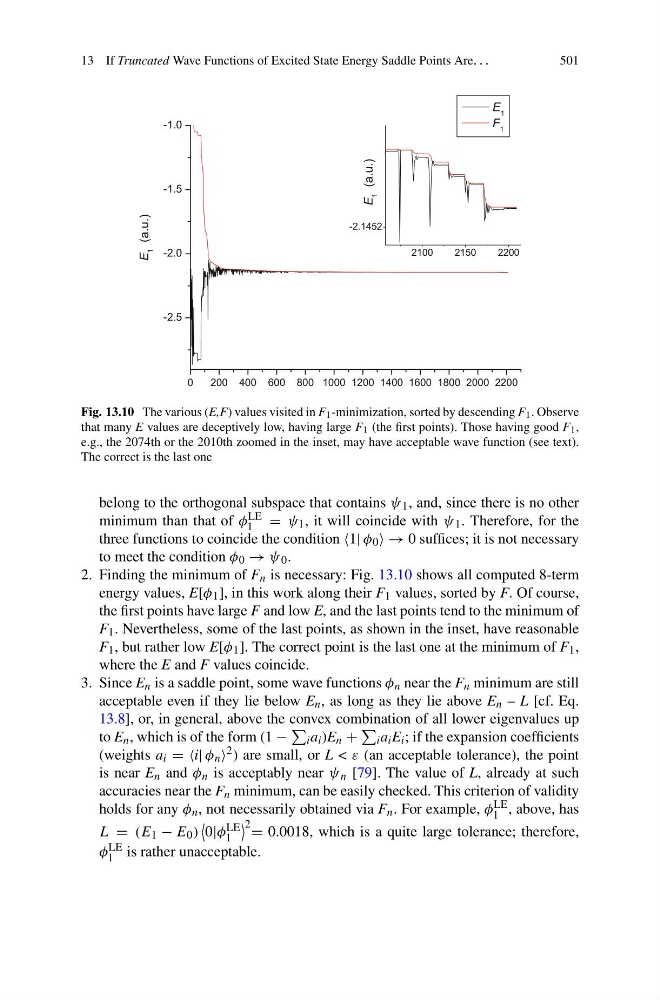
Fig. 13.10 The various (E,F) values visited in F 1 -minimization, sorted by descending F 1 . Observe
that many E values are deceptively low, having large F 1 (the first points). Those having good F 1 ,
e.g., the 2074th or the 2010th zoomed in the inset, may have acceptable wave function (see text).
The correct is the last one
belong to the orthogonal subspace that contains ψ 1 , and, since there is no other
minimum than that of φ LE
1 = ψ 1 , it will coincide with ψ 1 . Therefore, for the
three functions to coincide the condition 1| φ 0 → 0 suffices; it is not necessary
to meet the condition φ 0 → ψ 0 .
2. Finding the minimum of F n is necessary: Fig. 13.10 shows all computed 8-term
energy values, E[φ 1 ], in this work along their F 1 values, sorted by F. Of course,
the first points have large F and low E, and the last points tend to the minimum of
F 1 . Nevertheless, some of the last points, as shown in the inset, have reasonable
F 1 , but rather low E[φ 1 ]. The correct point is the last one at the minimum of F 1 ,
where the E and F values coincide.
3. Since E n is a saddle point, some wave functions φ n near the F n minimum are still
acceptable even if they lie below E n , as long as they lie above E n – L [cf. Eq.
13.8], or, in general, above the convex combination of all lower eigenvalues up
to E n , which is of the form (1 −
i a i )E n +
i a i E i ; if the expansion coefficients
(weights a i = =i| φ n 2 ) are small, or L < ε (an acceptable tolerance), the point
is near E n and φ n is acceptably near ψ n [79]. The value of L, already at such
accuracies near the F n minimum, can be easily checked. This criterion of validity
holds for any φ n , not necessarily obtained via F n . For example, φ LE
1 , above, has
L = (E 1 − E 0 )
0|φ LE
1
2 = 0.0018, which is a quite large tolerance; therefore,
φ LE
1 is rather unacceptable.
501
0
200 400 600 800 1000 1200 1400 1600 1800 2000 2200
-2.5
-2.0
-1.5
-1.0
2100
2150
2200
-2.1452
E
1
(a.u.)
E
1
(a.u.)
E 1
F 1
Fig. 13.10 The various (E,F) values visited in F 1 -minimization, sorted by descending F 1 . Observe
that many E values are deceptively low, having large F 1 (the first points). Those having good F 1 ,
e.g., the 2074th or the 2010th zoomed in the inset, may have acceptable wave function (see text).
The correct is the last one
belong to the orthogonal subspace that contains ψ 1 , and, since there is no other
minimum than that of φ LE
1 = ψ 1 , it will coincide with ψ 1 . Therefore, for the
three functions to coincide the condition 1| φ 0 → 0 suffices; it is not necessary
to meet the condition φ 0 → ψ 0 .
2. Finding the minimum of F n is necessary: Fig. 13.10 shows all computed 8-term
energy values, E[φ 1 ], in this work along their F 1 values, sorted by F. Of course,
the first points have large F and low E, and the last points tend to the minimum of
F 1 . Nevertheless, some of the last points, as shown in the inset, have reasonable
F 1 , but rather low E[φ 1 ]. The correct point is the last one at the minimum of F 1 ,
where the E and F values coincide.
3. Since E n is a saddle point, some wave functions φ n near the F n minimum are still
acceptable even if they lie below E n , as long as they lie above E n – L [cf. Eq.
13.8], or, in general, above the convex combination of all lower eigenvalues up
to E n , which is of the form (1 −
i a i )E n +
i a i E i ; if the expansion coefficients
(weights a i = =i| φ n 2 ) are small, or L < ε (an acceptable tolerance), the point
is near E n and φ n is acceptably near ψ n [79]. The value of L, already at such
accuracies near the F n minimum, can be easily checked. This criterion of validity
holds for any φ n , not necessarily obtained via F n . For example, φ LE
1 , above, has
L = (E 1 − E 0 )
0|φ LE
1
2 = 0.0018, which is a quite large tolerance; therefore,
φ LE
1 is rather unacceptable.