

13 If Truncated Wave Functions of Excited State Energy Saddle Points Are. . .
499
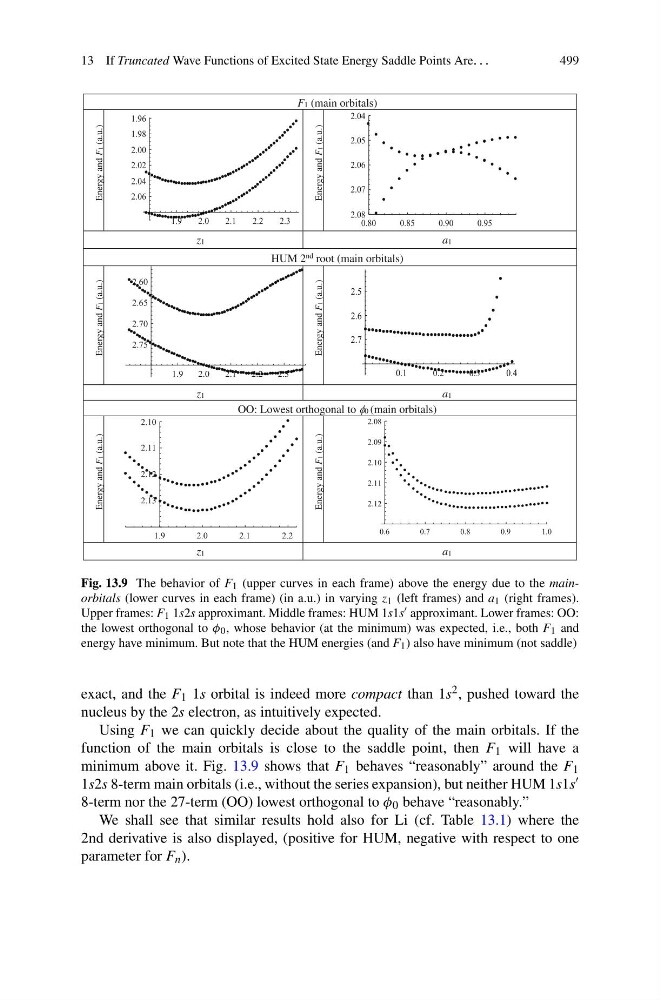
Fig. 13.9 The behavior of F 1 (upper curves in each frame) above the energy due to the mainorbitals (lower curves in each frame) (in a.u.) in varying z 1 (left frames) and a 1 (right frames).
Upper frames: F 1 1s2s approximant. Middle frames: HUM 1s1s approximant. Lower frames: OO:
the lowest orthogonal to φ 0 , whose behavior (at the minimum) was expected, i.e., both F 1 and
energy have minimum. But note that the HUM energies (and F 1 ) also have minimum (not saddle)
exact, and the F 1 1s orbital is indeed more compact than 1s 2 , pushed toward the
nucleus by the 2s electron, as intuitively expected.
Using F 1 we can quickly decide about the quality of the main orbitals. If the
function of the main orbitals is close to the saddle point, then F 1 will have a
minimum above it. Fig. 13.9 shows that F 1 behaves “reasonably” around the F 1
1s2s 8-term main orbitals (i.e., without the series expansion), but neither HUM 1s1s
8-term nor the 27-term (OO) lowest orthogonal to φ 0 behave “reasonably.”
We shall see that similar results hold also for Li (cf. Table 13.1) where the
2nd derivative is also displayed, (positive for HUM, negative with respect to one
parameter for F n ).
499
Fig. 13.9 The behavior of F 1 (upper curves in each frame) above the energy due to the mainorbitals (lower curves in each frame) (in a.u.) in varying z 1 (left frames) and a 1 (right frames).
Upper frames: F 1 1s2s approximant. Middle frames: HUM 1s1s approximant. Lower frames: OO:
the lowest orthogonal to φ 0 , whose behavior (at the minimum) was expected, i.e., both F 1 and
energy have minimum. But note that the HUM energies (and F 1 ) also have minimum (not saddle)
exact, and the F 1 1s orbital is indeed more compact than 1s 2 , pushed toward the
nucleus by the 2s electron, as intuitively expected.
Using F 1 we can quickly decide about the quality of the main orbitals. If the
function of the main orbitals is close to the saddle point, then F 1 will have a
minimum above it. Fig. 13.9 shows that F 1 behaves “reasonably” around the F 1
1s2s 8-term main orbitals (i.e., without the series expansion), but neither HUM 1s1s
8-term nor the 27-term (OO) lowest orthogonal to φ 0 behave “reasonably.”
We shall see that similar results hold also for Li (cf. Table 13.1) where the
2nd derivative is also displayed, (positive for HUM, negative with respect to one
parameter for F n ).