

13 If Truncated Wave Functions of Excited State Energy Saddle Points Are. . .
489
13.6.1.3 Results
For He (Z = 2) 1 S, the exact eigenvalues are [80] E 0 = −2.90372 a.u.,
E 1 = −2.14597 a.u., E 2 = −2.06127 a.u.
The Lowest Orthogonal to φ 0 (OO)
Before proceeding to HUM and F n results and their comparisons, it will be
demonstrated that minimizing the excited state energy while keeping orthogonality
to a normalized approximant, φ 0 , of the ground state (e.g., the 1-term “fixed,” used
in F 1 ) leads to a function, φ LE
1 , lying lower than the exact, therefore veered away
from the exact.
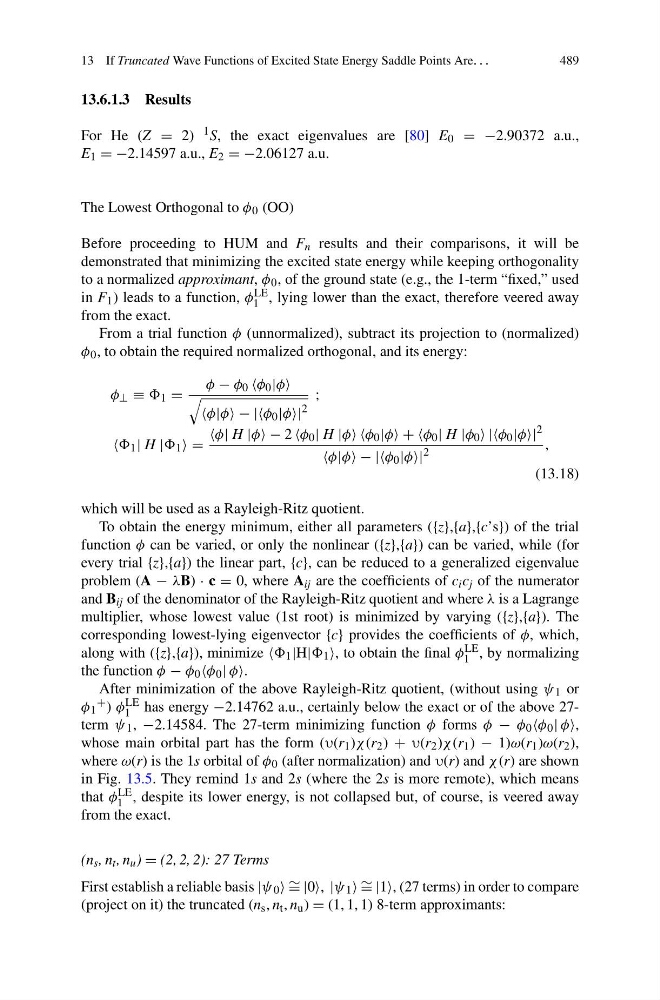
From a trial function φ (unnormalized), subtract its projection to (normalized)
φ 0 , to obtain the required normalized orthogonal, and its energy:
φ ⊥ ≡ 1 =
φ − φ 0 φ 0 |φ
φ|φ − ||φ 0 |φ|
2
;
1 | H | 1 =
φ| H |φ − 2 φ 0 | H |φ φ 0 |φ + φ 0 | H |φ 0 ||φ 0 |φ|
2
φ|φ − ||φ 0 |φ|
2
,
(13.18)
which will be used as a Rayleigh-Ritz quotient.
To obtain the energy minimum, either all parameters ({z},{a},{c’s}) of the trial
function φ can be varied, or only the nonlinear ({z},{a}) can be varied, while (for
every trial {z},{a}) the linear part, {c}, can be reduced to a generalized eigenvalue
problem (A − λB) · c = 0, where A ij are the coefficients of c i c j of the numerator
and B ij of the denominator of the Rayleigh-Ritz quotient and where λ is a Lagrange
multiplier, whose lowest value (1st root) is minimized by varying ({z},{a}). The
corresponding lowest-lying eigenvector {c} provides the coefficients of φ, which,
along with ({z},{a}), minimize 1 |H| 1 , to obtain the final φ LE
1 , by normalizing
the function φ − φ 0 φ 0 | φ.
After minimization of the above Rayleigh-Ritz quotient, (without using ψ 1 or
φ 1
+ ) φ LE
1 has energy −2.14762 a.u., certainly below the exact or of the above 27term ψ 1 , −2.14584. The 27-term minimizing function φ forms φ − φ 0 φ 0 | φ,
whose main orbital part has the form (υ(r 1 )χ (r 2 ) + υ(r 2 )χ (r 1 ) − 1)ω(r 1 )ω(r 2 ),
where ω(r) is the 1s orbital of φ 0 (after normalization) and υ(r) and χ (r) are shown
in Fig. 13.5. They remind 1s and 2s (where the 2s is more remote), which means
that φ LE
1 , despite its lower energy, is not collapsed but, of course, is veered away
from the exact.
(n s , n t , n u ) = (2, 2, 2): 27 Terms
First establish a reliable basis |ψ 0 ∼ = |0, |ψ 1 ∼ = |1, (27 terms) in order to compare
(project on it) the truncated (n s , n t , n u ) = (1, 1, 1) 8-term approximants:
489
13.6.1.3 Results
For He (Z = 2) 1 S, the exact eigenvalues are [80] E 0 = −2.90372 a.u.,
E 1 = −2.14597 a.u., E 2 = −2.06127 a.u.
The Lowest Orthogonal to φ 0 (OO)
Before proceeding to HUM and F n results and their comparisons, it will be
demonstrated that minimizing the excited state energy while keeping orthogonality
to a normalized approximant, φ 0 , of the ground state (e.g., the 1-term “fixed,” used
in F 1 ) leads to a function, φ LE
1 , lying lower than the exact, therefore veered away
from the exact.
From a trial function φ (unnormalized), subtract its projection to (normalized)
φ 0 , to obtain the required normalized orthogonal, and its energy:
φ ⊥ ≡ 1 =
φ − φ 0 φ 0 |φ
φ|φ − ||φ 0 |φ|
2
;
1 | H | 1 =
φ| H |φ − 2 φ 0 | H |φ φ 0 |φ + φ 0 | H |φ 0 ||φ 0 |φ|
2
φ|φ − ||φ 0 |φ|
2
,
(13.18)
which will be used as a Rayleigh-Ritz quotient.
To obtain the energy minimum, either all parameters ({z},{a},{c’s}) of the trial
function φ can be varied, or only the nonlinear ({z},{a}) can be varied, while (for
every trial {z},{a}) the linear part, {c}, can be reduced to a generalized eigenvalue
problem (A − λB) · c = 0, where A ij are the coefficients of c i c j of the numerator
and B ij of the denominator of the Rayleigh-Ritz quotient and where λ is a Lagrange
multiplier, whose lowest value (1st root) is minimized by varying ({z},{a}). The
corresponding lowest-lying eigenvector {c} provides the coefficients of φ, which,
along with ({z},{a}), minimize 1 |H| 1 , to obtain the final φ LE
1 , by normalizing
the function φ − φ 0 φ 0 | φ.
After minimization of the above Rayleigh-Ritz quotient, (without using ψ 1 or
φ 1
+ ) φ LE
1 has energy −2.14762 a.u., certainly below the exact or of the above 27term ψ 1 , −2.14584. The 27-term minimizing function φ forms φ − φ 0 φ 0 | φ,
whose main orbital part has the form (υ(r 1 )χ (r 2 ) + υ(r 2 )χ (r 1 ) − 1)ω(r 1 )ω(r 2 ),
where ω(r) is the 1s orbital of φ 0 (after normalization) and υ(r) and χ (r) are shown
in Fig. 13.5. They remind 1s and 2s (where the 2s is more remote), which means
that φ LE
1 , despite its lower energy, is not collapsed but, of course, is veered away
from the exact.
(n s , n t , n u ) = (2, 2, 2): 27 Terms
First establish a reliable basis |ψ 0 ∼ = |0, |ψ 1 ∼ = |1, (27 terms) in order to compare
(project on it) the truncated (n s , n t , n u ) = (1, 1, 1) 8-term approximants: